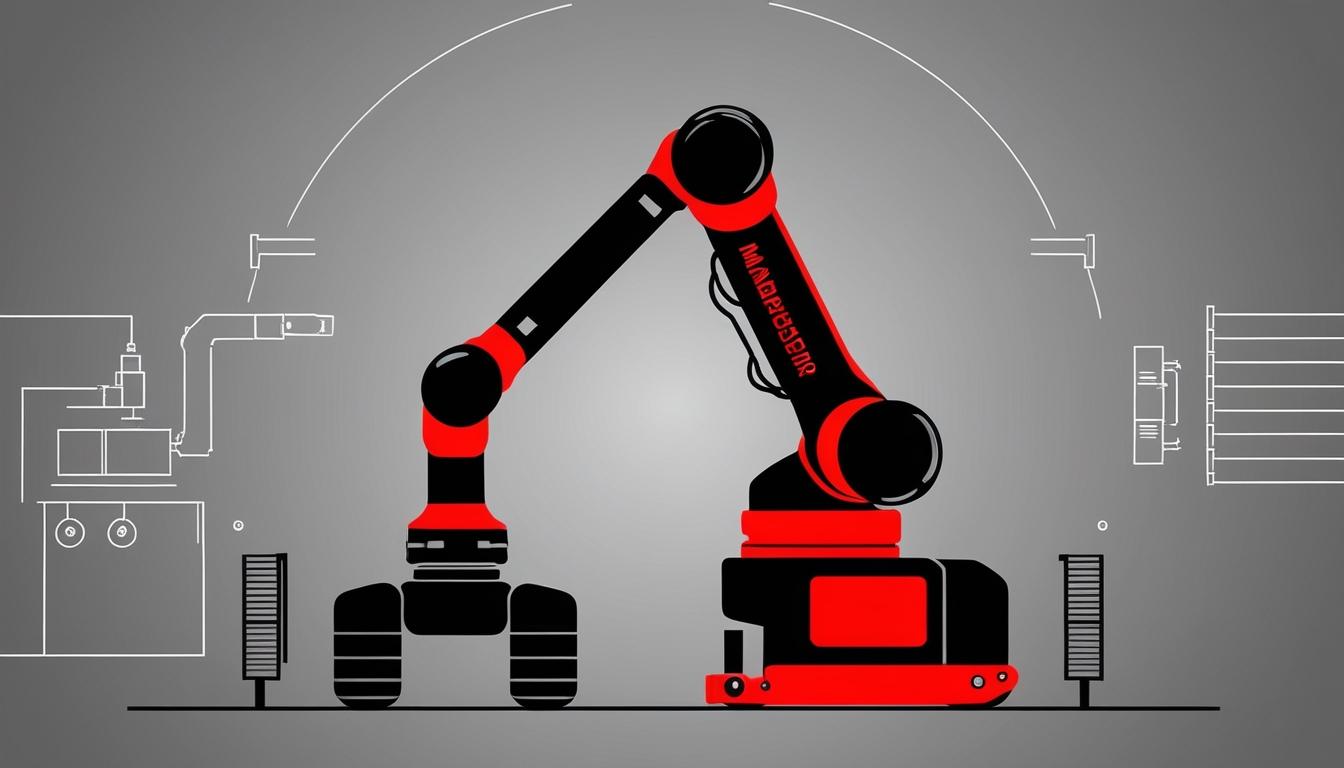
ASTM International is advancing the realm of robotics and automation with the ongoing development of a standard designed specifically for mobile manipulators, under the designation WK92144. This initiative, undertaken by the organisation's F45.05 Committee on Robotics, Automation, and Autonomous Systems, aims to establish benchmarks for the performance and accuracy of these advanced machines.
Mobile manipulators are characterised as autonomous mobile robots (AMRs) equipped with multi-axis robotic arms, offering significant functionality across a range of industrial applications. The established ANSI/RIA R15.08-1-2020 standard provides a classification for industrial mobile robots, including this category of manipulators.
Omar Aboul-Enein, a co-author of a pertinent National Institute of Standards and Technology (NIST) paper and a member of the F45 committee, elucidated the standard's inception. "We started this standards effort in 2014 or 2015," he stated. "In many cases, there’s noncontinuous performance. For example, the arm and vehicle don’t move simultaneously for machine tending or assembly tasks. We needed terminology for discrete pose-constrained tasks."
In 2022, ASTM broadened its focus to encompass robotics and automation. Aboul-Enein noted that the NIST had previously evaluated the noncontinuous performance of various robots, such as automated guided vehicles (AGVs), and conducted tests on continuous systems in large-scale manufacturing scenarios.
According to Aboul-Enein, ASTM has divided its standards work into several task groups focused on mobile manipulation, grasp-type end effectors, and robotic assembly. The mobile manipulation group currently comprises over 30 members who collaborate on defining foundational tests for various workpiece properties.
To facilitate consistent documentation of robot configurations, ASTM is developing a configurable test apparatus tailored for mobile manipulation. The apparatus is designed to be constructed from low-cost components, aiming for ease of reproduction and in-situ testing capabilities. However, it is crucial to note that the forthcoming standards will not encompass end effectors, payloads, or fleet behaviour, although they may be instrumental in the simulation of robots and their actions.
Addressing potential complications, Aboul-Enein remarked, "It definitely has potential, but there are always factors lurking in the real world, such as a dip in the lab floor or the weight of the arm when it’s fully stretched out to one side." He confirmed that the committee's consensus-driven approach has been pivotal in the development of guidelines for assessing mobile manipulators.
Aaron Prather, director of the Robotics and Autonomous Systems Program at ASTM International, provided insight regarding the new testing table that the committee has developed. The testing table acts as a critical tool for evaluating the precision of mobile manipulators, as it requires the robots to navigate while performing various tasks, including tracking an S-shaped target for welding or fitting pegs into designated slots.
Operators have the flexibility to adjust the tabletop’s orientation to challenge the manipulators further. For instance, the design allows for a 90-degree upright position, a 45-degree tilt, or a flat surface. Additionally, a shaker can be added to introduce vibrations and motions to enhance testing rigour.
“The table design will be standardized, and the committee will provide instructions on how everyone can build their table,” Prather explained. He mentioned that several test standards are on the horizon, all aiming to utilise the table as a foundational element for assessing new grasping, manipulation, and assembly applications, focusing on accuracy and repeatability.
Looking towards the future, Prather noted, “Also, expect to see our new Student Competition Challenges to use the boards and table. This will help get students involved in how to use standards and send them out into the community with the knowledge on how to leverage these new test tools we are going to keep launching to ensure new robot systems can pass them.”
In closing, Prather expressed a vision for the sector, saying, “Our hope is that we see humanoids and mobile manipulators having to show their results to help end users better understand capabilities and ensure they are getting the right system for their application.” As ASTM International heads towards the deployment of these standards, they are anticipated to play a transformative role in the integration of robotics in varying industrial applications.
Source: Noah Wire Services