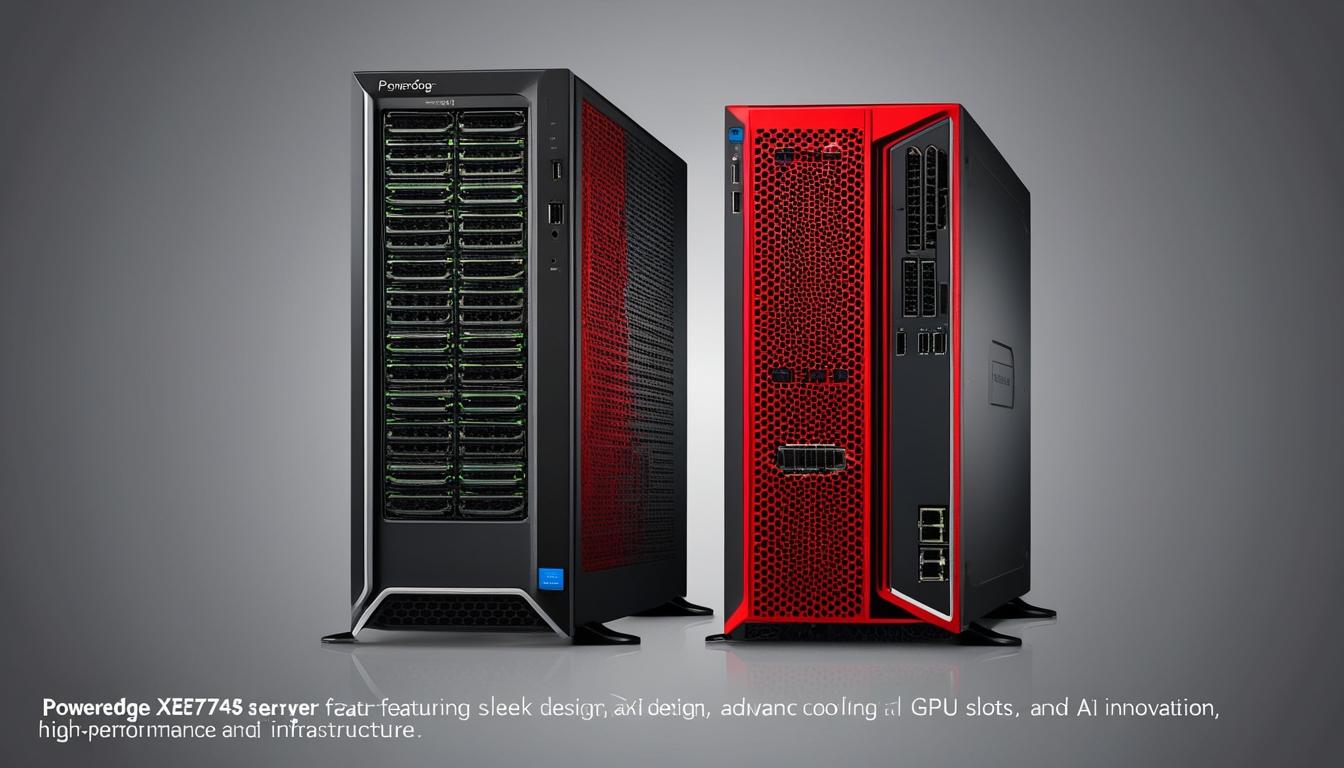
Dell Technologies has recently unveiled an innovative portfolio of PowerEdge servers, specifically designed to meet the growing demand for scalable and high-performance infrastructure in an increasingly competitive AI and data-driven landscape. This announcement was made against the background of a rapidly evolving technology sector, where businesses are consistently looking for solutions that enable efficiency, improved performance, and energy savings.
The new line-up features several models, including the PowerEdge XE7745 server, which is set to be available in January 2025, alongside the R6715, R7715, R6725, and R7725 servers, which are scheduled for release in November 2024. Each of these servers is equipped with the latest AMD 5th Generation EPYC processors and advanced cooling systems, aiming to facilitate demanding enterprise workloads and bolster AI capabilities.
At the forefront of this launch is the PowerEdge XE7745 server, which is designed particularly for AI workloads including inferencing, model fine-tuning, and high-performance computing (HPC). This robust server supports an impressive configuration of up to eight double-width or 16 single-width PCIe GPUs. Its 4U air-cooled chassis also includes eight additional PCIe Gen 5.0 slots to enhance network connectivity, helping enterprises maximise their computing power.
The PowerEdge R6725 and R7725 servers promise significant performance enhancements for companies seeking robust scalability. Dell reports that the R7725 model delivers a 66% increase in performance and boosts efficiency by 33% during peak operation. This model supports up to 50% more cores along with a 37% rise in performance per core, reducing the requirement for multiple servers while simultaneously decreasing CPU power consumption by as much as 65%, thus enabling notable energy savings.
Furthermore, Dell is keen on emphasising the efficiency of its single-socket servers, the PowerEdge R6715 and R7715. With a focus on storage density, these servers provide up to 37% more drive capacity and can accommodate up to 24 DIMMs (Dual In-line Memory Modules), which ensures maximum performance suitable for diverse enterprise applications. These configurations are complemented by the updated Integrated Dell Remote Access Controller (iDRAC), which enhances management capabilities for IT teams.
In collaboration with AMD, Dell has also introduced Generative AI Solutions, incorporating the PowerEdge XE9680 server and AMD Instinct MI300X accelerators. This combination aims to streamline AI inferencing and customisation processes, particularly in tasks related to retrieval-augmented generation (RAG), which may reduce time-to-value by as much as 86%.
In a bid to support advanced AI deployments, Dell has upgraded the Dell Enterprise Hub on Hugging Face, enhancing compatibility with the PowerEdge XE9680. This integration allows enterprises to deploy advanced AI models such as Llama and Mixtral, which are optimised for AI inferencing with Hugging Face’s Text Generation Inference (TGI) backend.
Arthur Lewis, president of Dell’s Infrastructure Solutions Group, stated, “By integrating AMD technology into the latest Dell servers, AI solutions, and services through the Dell AI Factory, we’re providing the performance and efficiencies enterprises need today and in the future.” He further highlighted that the alliance with AMD is pivotal in setting new standards in AI performance, emphasising the provision of powerful and cost-effective solutions that are essential in today’s data-driven environments.
Dell's latest PowerEdge portfolio not only illustrates a commitment to advancing AI technologies but also aims to furnish enterprises with the necessary tools to enhance operational efficiency, scale their operations, and manage costs effectively—all while staying at the forefront of technological innovation.
Source: Noah Wire Services