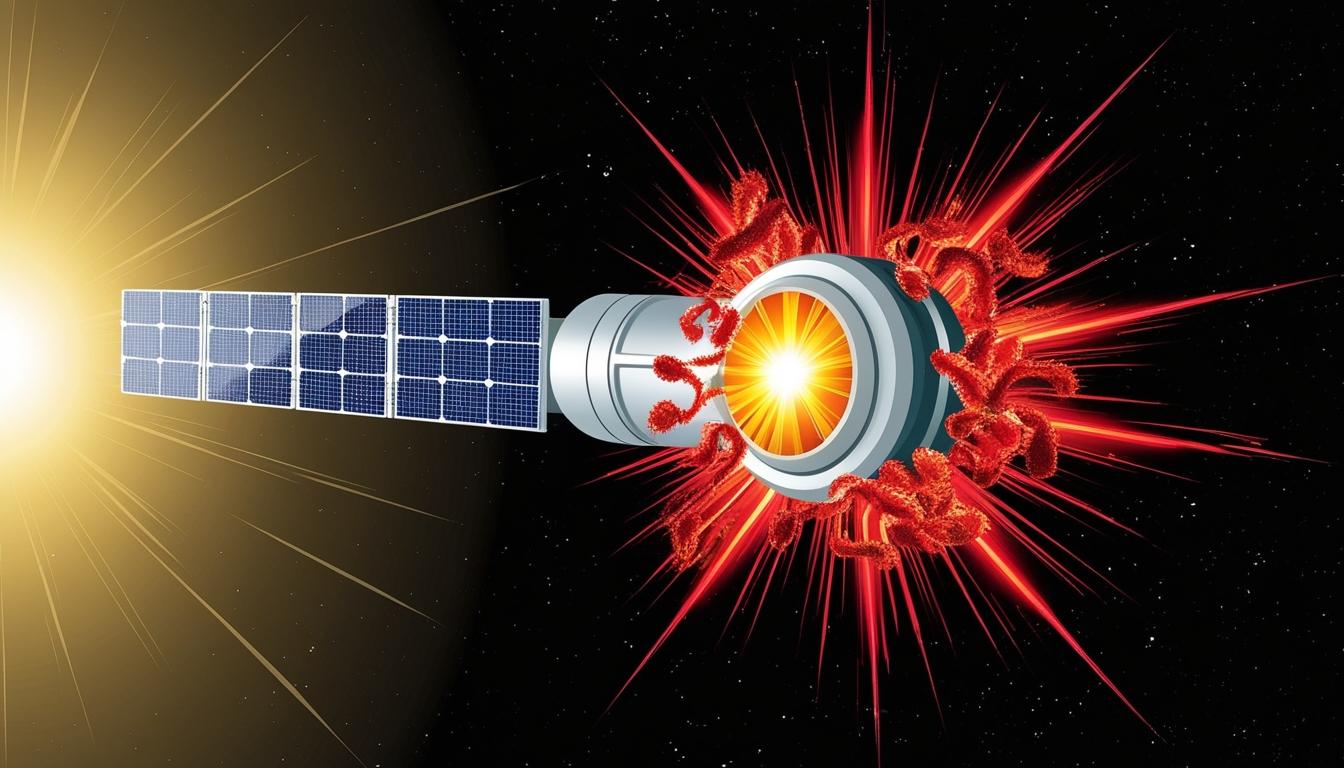
Researchers from the U.K., Germany, Italy, and Poland are embarking on an innovative project that could revolutionise power generation for satellites in space. The initiative, known as APACE, involves utilising solar-powered lasers derived from the photosynthetic properties of bacteria. This approach aims to replace traditional solar arrays, which are often bulky, complex, and expensive to transport into orbit.
Leading the project is Erik Gauger, a professor of photonics and quantum science at Heriot-Watt University in Edinburgh. In an interview with Space.com, Gauger explained the project's core concept: "Our plan is to use photosynthetic structures extracted from bacteria, and the idea is that you can grow them and keep replenishing material; you don't need to maintain a supply line from Earth." This ability to cultivate the necessary materials in space could eliminate the logistical challenges associated with resupplying astronauts and equipment.
As satellite launches continue to increase, the demand for reliable and sustainable power sources in orbit has grown. Power beaming technology, which converts solar energy into lasers or microwaves for transmission to satellites, has emerged as a potential solution. In early 2023, the Space Solar Power Demonstrator satellite successfully demonstrated the transmission of low-power microwaves to a ground station at Caltech, a breakthrough that holds promise for future applications. Japanese researchers are preparing to conduct similar tests in 2025.
Gauger and his team propose a paradigm shift in power generation. Currently, most solar arrays require intricate designs and electronic components that are difficult to maintain. The APACE project seeks to turn this approach on its head by replacing conventional optics with "photosynthetic antenna complexes." This method would allow the solar energy harnessed by these bacterial antennas to be transformed directly into laser energy without the need for extensive electrical circuitry.
The project is funded by the European Innovation Council and Innovate U.K., which have allocated 476,000 euros for the first phase. Gauger highlighted that the initial phase focuses on establishing proof of principle in laboratory settings, with plans to simulate space conditions as the project progresses. Researchers will investigate which bacteria yield the most efficient photosynthetic antennas and will also explore the potential of nano-engineered artificial antennas.
Certain extremophilic bacteria thrive in low-light environments and possess molecular antennas capable of absorbing nearly all available photons. The findings from this research could be pivotal in developing a new generation of solar-powered spacecraft. In the APACE project, sunlight captured by these bacteria is intended to stimulate a laser mechanism. The study is considering the use of neodymium nano-crystals as the gain medium needed for laser generation.
With the potential for bacteria cultivation in space—either on the International Space Station or on satellites—this research could significantly reduce the reliance on continual shipments of solar equipment from Earth. However, Gauger noted that launching a prototype into orbit would require additional funding and would depend heavily on the success of initial experiments.
While the research currently anticipates a conversion efficiency of 10–15% for the organic solar arrays, researchers acknowledge that this falls short of the natural efficiency achieved by bacteria, which can approach 100%. Gauger remarked, "Maybe that's not surprising since evolution has optimized it over a long time."
Despite these limitations, the APACE project promises substantial advancements in energy generation methods. Unlike traditional solar cells that convert energy into electricity before it can be used, the APACE approach aims to harness sunlight directly into laser energy without intricate electronic components. This could streamline power generation in space.
The implications of successful developments in this area extend beyond simply powering satellites. Gauger envisions potential applications on the Moon or Mars, suggesting that the technology could eventually enable power beaming to terrestrial bases or vehicles. He stated, "It could be extended in capacity in space by growing more bacteria and manufacturing it there, rather than needing to ship it out." With several engineering challenges remaining, the long-term vision remains an exciting prospect for the future of energy generation in space.
Source: Noah Wire Services