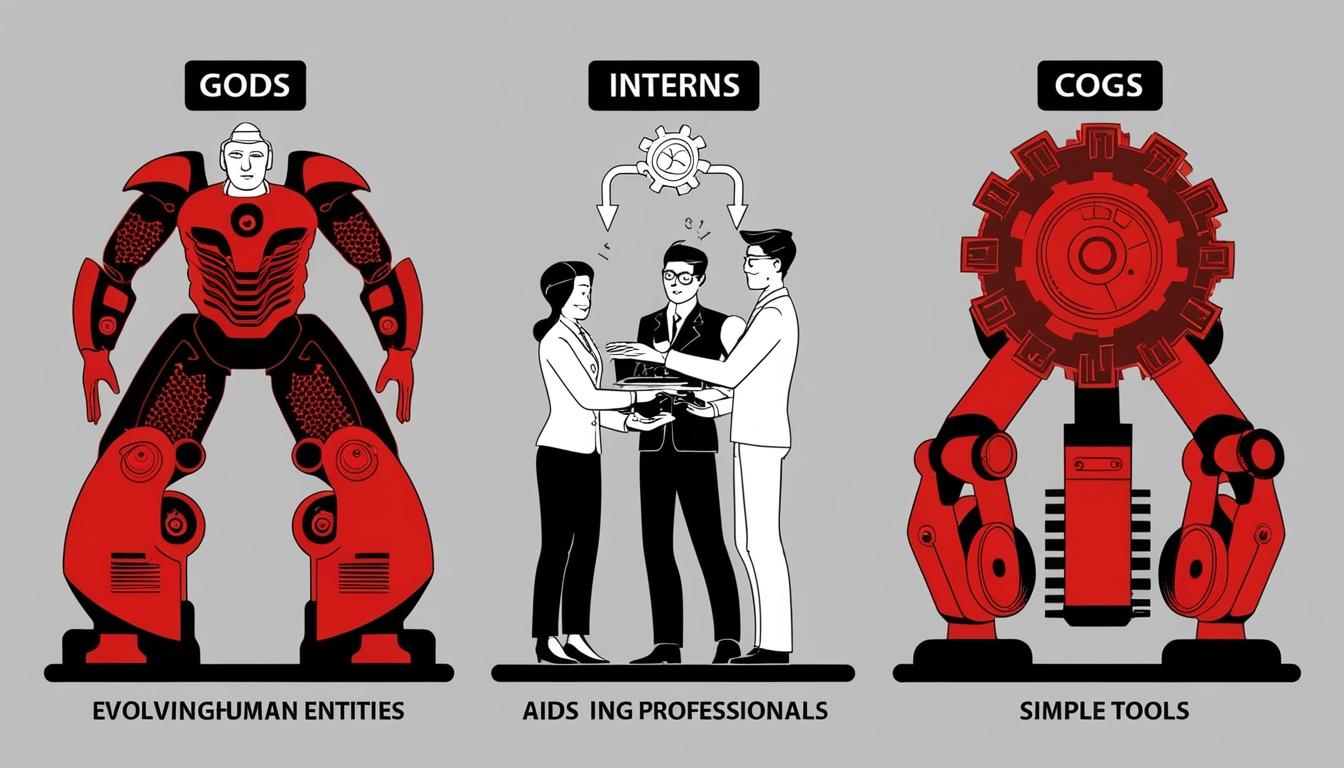
Drew Breunig, a cultural anthropologist, has introduced a novel framework to decipher the myriad meanings associated with artificial intelligence, categorising it into three distinct use cases: "gods," "interns," and "cogs." This categorisation aims to clarify the various applications and implications of AI for businesses and industries.
The "gods" category refers to super-intelligent entities that operate autonomously, typically referred to as artificial general intelligence (AGI). This level of AI, which is under active development by firms like OpenAI, involves considerable investment and resource consumption, with growing concerns about its potential existential threats to humanity. Breunig characterises these AI gods as human replacement tools, demanding immense computational power and resources, thereby raising environmental concerns about carbon emissions linked to their operation.
The second category, "interns," encompasses supervised tools that assist professionals in their work, often characterised by large language models such as ChatGPT, Claude, and Llama. These AI "interns" are designed to augment human capabilities by managing routine tasks, from documentation recovery to idea generation. Currently, this type of AI is prevalent across various industries, becoming a key element in human-machine collaboration.
"Cog" refers to simpler AI systems that excel in performing specific tasks within a larger process. Breunig notes that the prevailing use of AI primarily falls into the "intern" category, marking a shift towards closer cognitive interactions between humans and machines, particularly in professional environments.
In the healthcare sector, expectations for AI application are notably high. A significant study in collaboration with DeepMind and Moorfields Eye Hospital in 2018 showcased AI's capability to significantly expedite the analysis of retinal scans for urgent medical attention. Such advancements highlight machines’ capacity for rapid data assessment and diagnosis.
However, the integration of AI in clinical diagnosis presents mixed results, as evidenced by a recent randomised clinical trial detailed in the Journal of the American Medical Association. This study examined 50 practising physicians who had access to ChatGPT as a diagnostic tool. The findings indicate that while the availability of this AI did not enhance clinical reasoning significantly compared to traditional resources, it performed better than physicians when operating independently. As reported by the New York Times, doctors with access to ChatGPT demonstrated only a slight improvement over those without its aid, while ChatGPT alone surpassed both groups, revealing an interesting insight into the limitations of human diagnostic practices.
In an additional observation, the study exposed a tendency among doctors to remain steadfast in their diagnoses, even when faced with potentially better suggestions from ChatGPT. This highlighted gaps in the effective use of AI tools, supporting assertions from AI proponents, like Ethan Mollick, about the nuances of "prompt engineering"—the skill of crafting the right queries to elicit optimal results from language models.
Further research at MIT involved material scientists utilising AI, leading to notable productivity increases: a 44% rise in new material discoveries and a 39% surge in patent applications. The AI took over significant idea generation tasks, allowing researchers to focus on assessment and feasibility checks. However, the study also revealed a decline in job satisfaction among the scientists, presumably due to a perceived loss of agency and creativity while collaborating with an advanced machine.
This juxtaposition of increased output alongside diminished personal satisfaction raises important questions about the long-term implications of AI in professional settings. While AI's assistance yields positive results in terms of efficiency and productivity, the emotional and psychological impacts on the workforce—particularly for skilled professionals—present critical considerations for businesses as they navigate the integration of these technologies.
The landscape of AI automation is thus evolving, with businesses increasingly reliant on these technologies. As this trend continues, understanding the implications of AI across different applications and its effect on human workers is essential. The future developments in AI await to be seen as industries adapt to this shifting paradigm.
Source: Noah Wire Services