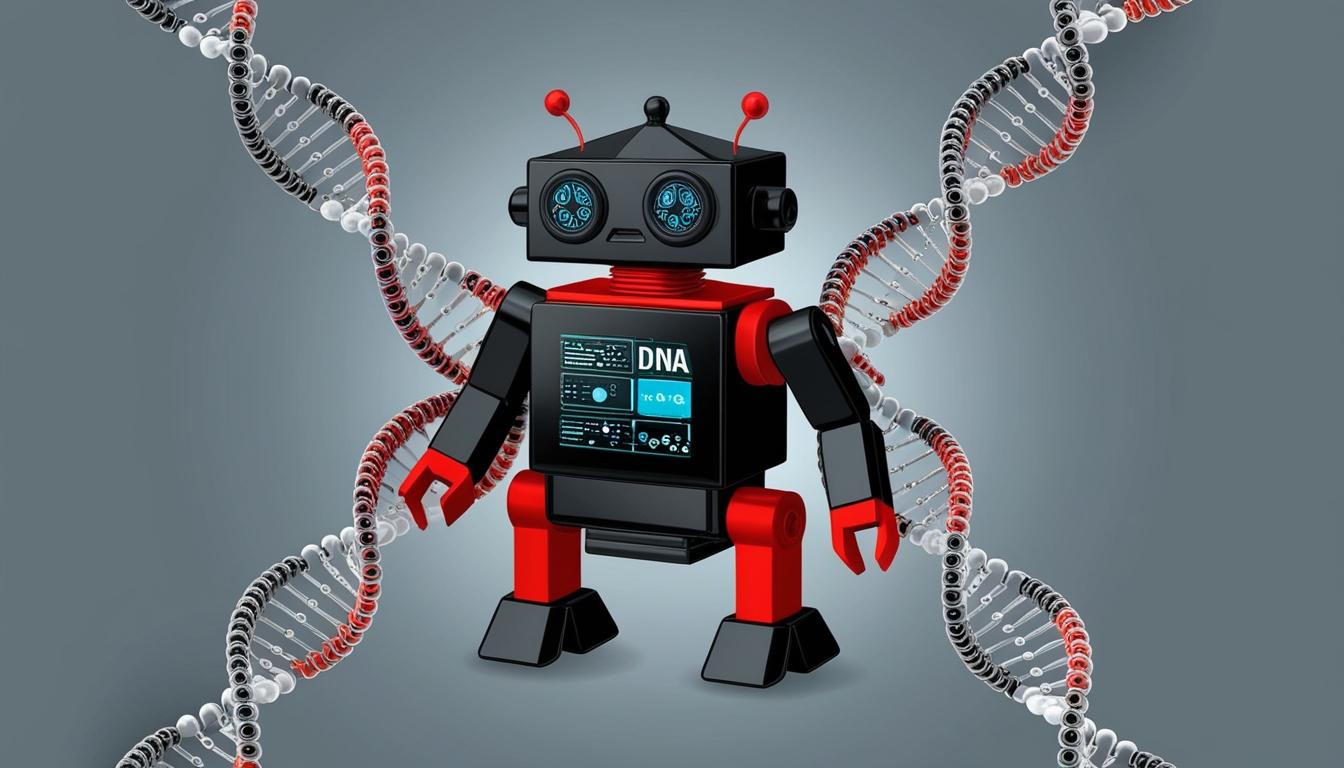
Researchers at the University of Sydney Nano Institute have made significant strides in the field of molecular robotics, as detailed in a recent study published in the prestigious journal Science Robotics. Their innovative work centres around the creation of custom-designed and programmable nanostructures using a technique known as DNA origami. This method leverages the inherent folding capabilities of DNA, which is essential in the building blocks of life, to produce novel biological structures with various applications.
The research team, led by Dr Minh Tri Luu and Dr Shelley Wickham, crafted over 50 nanoscale objects as proof-of-concept, including an intriguing 'nano-dinosaur', a 'dancing robot', and a miniature representation of Australia measuring a mere 150 nanometres wide—a scale that is a thousand times narrower than a human hair. This ground-breaking research suggests promising prospects across multiple fields, including targeted drug delivery systems, responsive materials, and energy-efficient optical signal processing.
Dr Wickham, who has a joint position with the Schools of Chemistry and Physics within the Faculty of Science, explained the technology's modular design. She remarked, “The results are a bit like using Meccano, the children’s engineering toy, or building a chain-like cat’s cradle. But instead of macroscale metal or string, we use nanoscale biology to build robots with huge potential.” This modularity allows the creation of DNA origami "voxels", which can be assembled into complex three-dimensional structures, greatly enhancing the versatility and applications of these programmable nanostructures.
The researchers’ innovations have broad implications in nanomedicine and materials science. Dr Luu indicated, “We’ve created a new class of nanomaterials with adjustable properties, enabling diverse applications—from adaptive materials that change optical properties in response to the environment to autonomous nanorobots designed to seek out and destroy cancer cells.”
To assemble these versatile voxels, additional DNA strands are incorporated onto the nanostructures' exterior, creating programmable binding sites. “These sites act like Velcro with different colours—designed so that only strands with matching 'colours' (in fact, complementary DNA sequences) can connect,” elaborated Dr Luu. This binding mechanism allows for precise control over how the voxels interact, fostering the development of customisable and specific architectures.
One of the most exciting applications of this emerging technology lies in its potential for targeted drug delivery. The researchers aim to create nanoscale robotic boxes capable of administering medication to precise locations within the body, releasing drugs only when environmental signals indicate a need. This focused approach could significantly improve the efficacy of cancer treatments while reducing unintended side effects that often accompany traditional therapies.
Beyond drug delivery, the research team is also investigating materials that could change properties based on environmental factors, such as temperature and pH levels. These responsive materials could revolutionise various industries, including medicine, computing, and electronics, by adapting their behaviour to external stimuli.
Speaking on the broader implications of this work, Dr Wickham stated, “This work enables us to imagine a world where nanobots can get to work on a huge range of tasks, from treating the human body to building futuristic electronic devices.” The team is also focusing on energy-efficient methods for optical signal processing, potentially improving technologies such as image verification and medical diagnostics through superior speed and accuracy.
Dr Luu highlighted the significance of their findings by asserting, “Our work demonstrates the incredible potential of DNA origami to create versatile and programmable nanostructures. The ability to design and assemble these components opens new avenues for innovation in nanotechnology.”
The researchers underscored the importance of interdisciplinary collaboration in driving scientific advancement. As the team continues refining its technologies, the vision of creating adaptive nanomachines capable of functioning within complex environments, such as the human body, is steadily becoming more achievable.
Source: Noah Wire Services