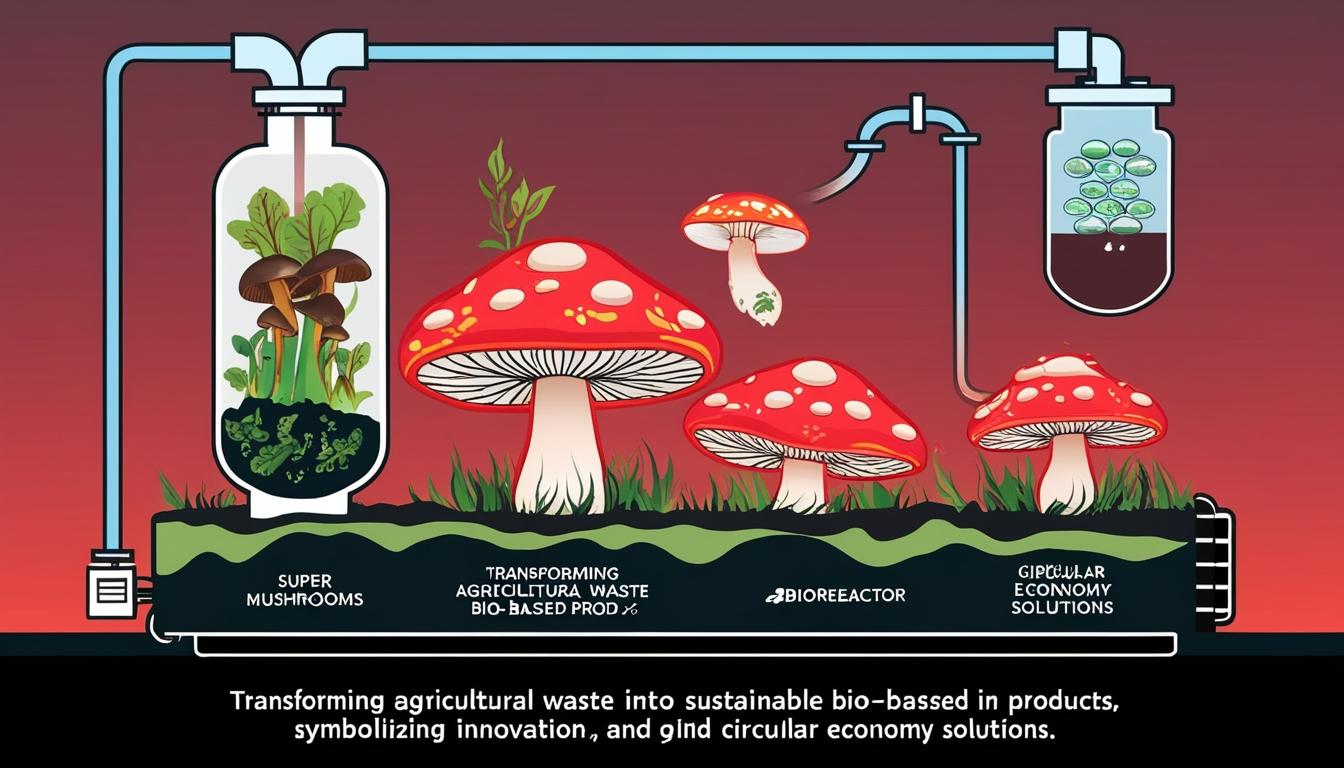
Researchers at the Danish Technological Institute are capitalising on the potential of super mushrooms to address the growing demand for bio-based goods and alternative protein sources. The innovative project seeks to transform agricultural waste into sustainable products by employing edible mushrooms in a unique fermentation process.
Mushrooms flourish within a bioreactor, where they are fed with residual agricultural streams that would typically be discarded. This waste includes an array of materials such as sugar beet production residues, surplus grain from beer brewing, and fruit peels, which undergo pre-treatment before being introduced as feed for the fungi. Senior project manager Xiaoru Hou described the process as being akin to “kombucha brewing, where you feed a fungal bacterial culture with sugar.” As part of the EU project dubbed Zest, specific fungal strains are employed to convert these agricultural residues into viable biomass which can be used directly, or further processed to yield fungal protein and chitin — valuable substances employed in medicine, food, and bioplastics.
According to Anne Christine Hastrup, project coordinator and head of centre at the Danish Technological Institute, this method presents several advantages over traditional protein production. She noted, “At the same time, the process requires only small amounts of water compared to more traditional protein production, while greenhouse gas emissions are also significantly lower.” The approach aligns with principles of zero waste and a circular economy due to its reliance on side streams from agriculture and food processes, all while ensuring high levels of food safety.
From a nutritional standpoint, mushroom protein distinguishes itself as being more readily digestible by the human body than plant-based proteins. Furthermore, mushrooms contribute essential vitamins such as B12 and D, enriching the food products containing these fungal proteins. The unique cell structure of mushrooms results in a neutral flavour profile, offering diverse textural opportunities in food applications.
As the project advances, the research team is dedicated to refining the entire production process. Hastrup elaborated, “We will optimise the entire production process by screening the most suitable waste products from agriculture and food production together with different fungal strains.” Innovations also extend to the design of new bioreactors specifically tailored for fungal fermentation. A pivotal aspect of this initiative is the integration of artificial intelligence (AI) into the process modelling to systematically monitor and manage production conditions.
Kristian Damlund Gregersen, another representative from the Danish Technological Institute, stated, “In the ZEST project, we develop machine learning models based on parameters such as temperature, pH, oxygen levels and nutrient concentrations.” The approach includes hybrid models that merge traditional fungal growth models with AI models that are informed by experimental data. This enables predictions regarding the fungi's response to various agricultural residues and ensures optimal growth conditions within the bioreactors.
The employment of AI effectively streamlines production, enhancing sustainability through extensive data analysis that facilitates continuous adjustments. This capability enables the optimisation of yields, reduction of waste, minimisation of energy use, and assurance of high-quality end products.
The initiative’s development of super mushrooms is centrally taking place within the Biosolutions Technology Center at the Danish Technological Institute. Here, businesses and startups have the opportunity to experiment with a range of outputs —from edible proteins and vitamins to biodegradable materials and packaging—all derived from biomass cultivated using microorganisms, particularly fungi.
Source: Noah Wire Services