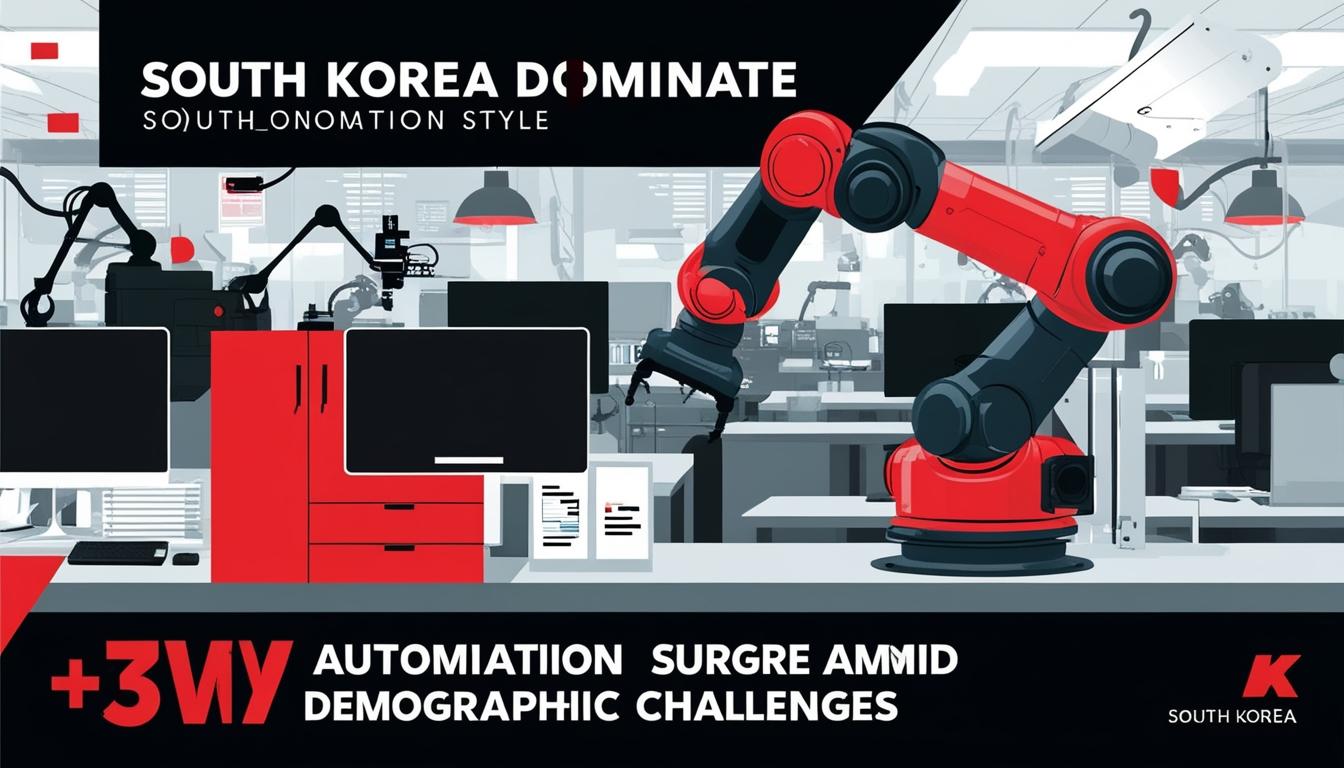
South Korea has reached a significant benchmark in the realm of workforce automation, with robots now constituting one-tenth of the nation's total workforce. This advancement marks a crucial step for a nation facing demographic challenges, particularly as its fertility rate has plummeted to a historic low of 0.72 in 2023. In response to this alarming trend, South Korean President Yoon Suk Yeol considers the declining birth rate a "national emergency."
Despite the government's investment exceeding $200 billion in fertility initiatives over the past 18 years, tangible improvements have been minimal. Recognising the urgency of the situation, the South Korean government has established a new ministry dedicated to addressing core demographic challenges, encompassing issues related to aging, immigration, and housing.
The country's expertise in automation is evident, with South Korea currently boasting a remarkable 1,102 robots per 10,000 human workers, placing it at the forefront of global robotics. This number eclipses that of its nearest competitor, Singapore, which has 770 robots per 10,000 workers. Notably, South Korea's robot density is double that of other advanced manufacturing nations, including Japan and China.
The trends in global robotics have been detailed in the 2024 World Robotics report published by the International Federation of Robotics (IFR), which documents an annual growth rate of 5 percent in robot density since 2018. The report draws attention to Singapore's high rankings in robotics, attributing it to the city-state's limited operational stock despite a significant manufacturing presence.
Looking forward, South Korea is not resting on its current achievements. In January 2024, the Ministry of Trade, Industry, and Energy launched the Fourth Intelligent Robot Basic Plan, which aims to inject over $2.24 billion into the sector through public and private investments by 2030. This initiative targets advancements in automation across diverse industries, including manufacturing, healthcare, agriculture, logistics, defence, and social safety.
Further ambitions of the plan include increasing the local manufacturing rate of core robot components from 44 percent to 80 percent by 2030, alongside addressing 51 regulatory obstacles that currently impede seamless growth in the robotics sector.
As Asia continues to take the lead in global automation, the region's average robot density stands at 182 units per 10,000 manufacturing employees, witnessing a 7.6 percent increase in recent years. Countries such as South Korea, Singapore, China, and Japan remain among the world's top ten most automated economies.
Andrew Oros, a professor at Washington College, has examined the implications of automation technology in managing the challenges of a declining workforce in East Asia's largest economies. He cautions against what he describes as "demographic materialism," highlighting the complexities presented by relying too heavily on technology as a solution.
The IFR and the South Korean Embassy in Washington D.C. have been approached by Newsweek for comments regarding these developments. As South Korea advances in automation, it appears poised to navigate its demographic challenges through innovative technological solutions.
Source: Noah Wire Services