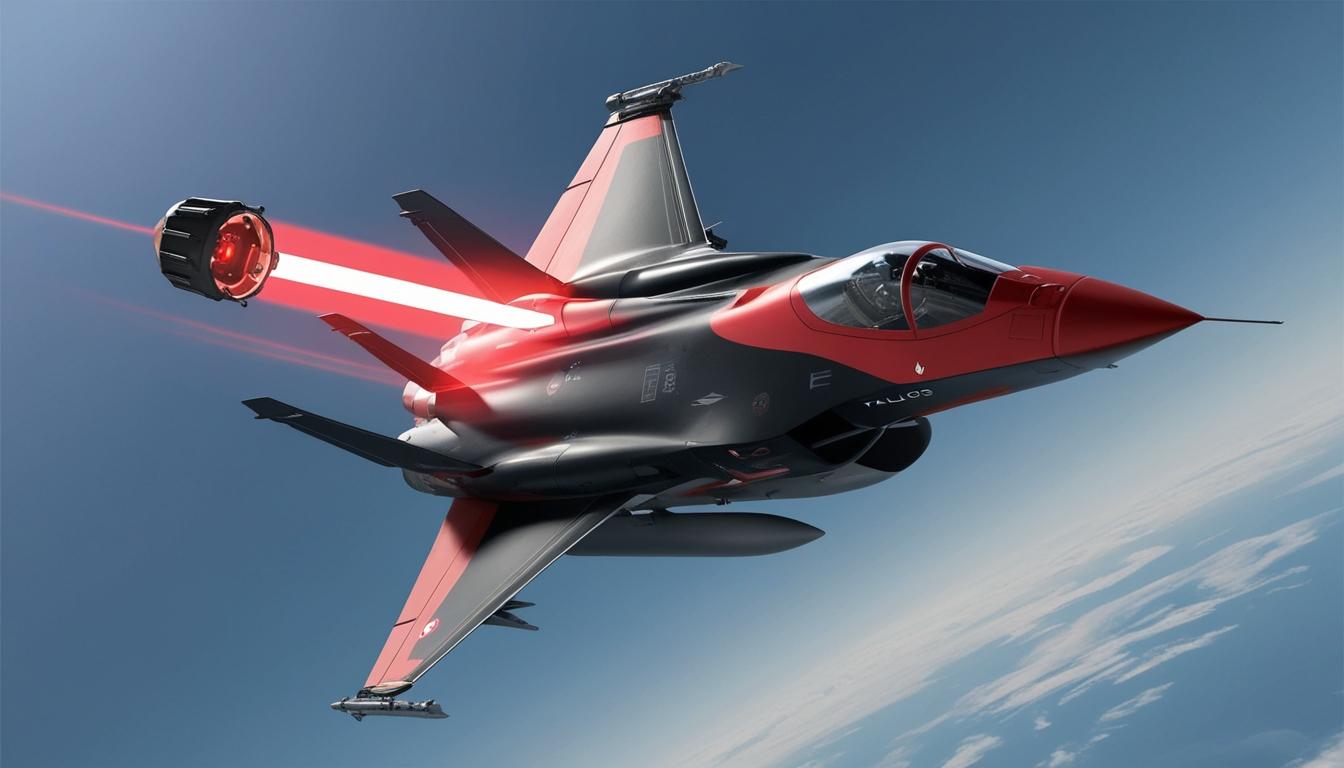
French defence technology giant Thales has announced promising advancements in its Talios laser designation pod, a critical component for Dassault Aviation’s Rafale fighter jets. The upgraded Talios pod, which is set to enter service with the Rafale F4.3 standard in 2026, will feature integrated artificial intelligence (AI) capabilities that significantly enhance its operational effectiveness.
On November 29, Thales revealed that the new model would enable real-time onboard image analysis, drastically improving both the speed and accuracy of object detection. This enhancement facilitates a more efficient operational workflow for pilots by optimizing target identification, permitting them to concentrate on executing mission objectives rather than the extended process of identifying threats.
According to the company, the AI-enabled Talios pod autonomously detects and classifies various objects—ranging from vehicles and buildings to potential threats—providing the pilot with essential information for decision-making. The upgraded system, as stated by a company representative, “will be the first function on board the Rafale to make such intensive use of deep learning technologies.”
This newly integrated system leverages Thales' advanced cortAIx accelerator, allowing it to process airborne imagery at a speed up to 100 times faster than older models. This rapid processing capability enables pilots to evaluate threats and identify targets more expediently than previously possible. Furthermore, the elimination of external data links ensures that the AI system operates securely and uninterruptedly in complex combat environments, where communication lines can often be compromised.
The Talios pod possesses the capability to function autonomously, even in difficult and remote combat scenarios, by delivering real-time data directly to the pilot, facilitating timely decision-making under pressure. Its design has effectively addressed common operational challenges associated with temperature fluctuations, vibrations, and energy consumption that can adversely affect onboard systems.
Notably, Thales developed the AI algorithms used in the Talios pod using a substantial database of imagery gathered from both test flights and French military exercises. The company collaborated closely with French military personnel to tailor the system to the specific operational needs of Rafale pilots, ensuring alignment with current mission requirements.
First introduced in 2018 and having proven indispensable for France’s Rafale jets, the Talios pod has been consistently upgraded as part of the Rafale F4 standardization initiative. It has played a crucial role in various air-to-ground missions, encompassing targeting, reconnaissance, and precision strikes, as well as aiding in the visual identification of enemy aircraft during air-to-air operations.
The initial operational deployment of the Talios pod occurred during a strike mission executed by the French Air and Space Force in January 2021. Its repertoire of features—including a new air-to-air identification mode and enhanced day colour sensor capabilities—equips pilots with the most accurate and current situational awareness needed for effective execution of their missions.
Additionally, the pod’s integration with a top-down datalink facilitates the real-time transfer of operational data to ground forces, boosting mission effectiveness and inter-unit coordination. Thales first introduced the concept of incorporating artificial intelligence into military systems in 2018. The commitment to integrating this technology culminated in a contract awarded in December 2023, with the upgraded Talios pod anticipated to become operational by 2026.
As military operations increasingly adopt collaborative combat strategies, the integration of AI within the Talios pod may revolutionize data processing and sharing during missions. The system is engineered to distill essential information, preventing communication overload that can hamper mission effectiveness, thus solidifying its role in the future of modern warfare.
Source: Noah Wire Services