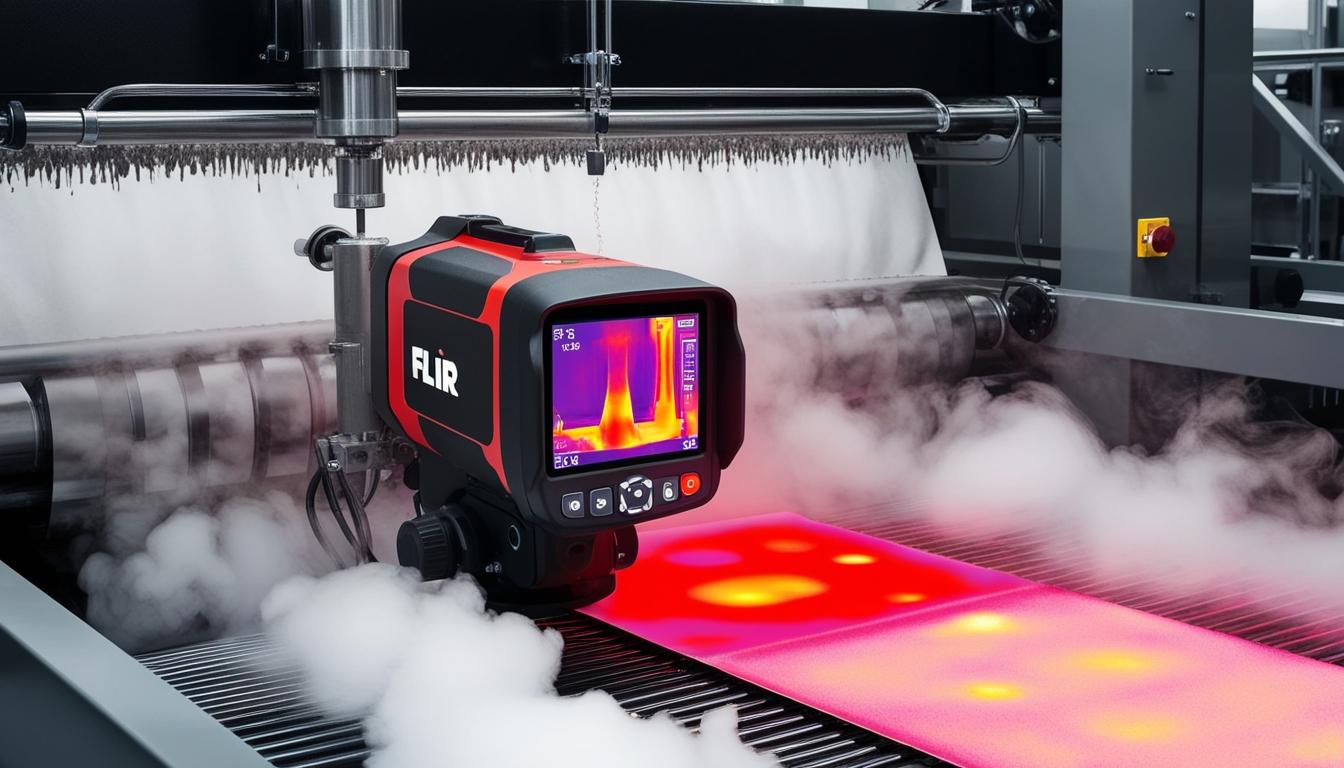
Recent advancements in thermal signature analytics have significantly broadened the scope of thermal camera applications within the papermaking industry. Once primarily relegated to routine troubleshooting, these tools are now critical in enhancing operational efficiencies, including paper machine control, energy utilisation benchmarking, wet streak detection, and early identification of specific types of sheet breaks.
Industrial Video Solutions Inc. (IVS), a specialist in papermaking automation based in the United States, is at the forefront of this technological evolution. The company is utilising FLIR infrared (IR) thermal cameras as part of its proprietary system, ThermoVision, designed to yield comprehensive data from various paper machines and improve overall machine performance.
The operation of paper machines is heavily influenced by moisture and temperature, which directly affect the paper's properties and the machine's ability to function effectively. Nevertheless, operators have often found themselves at a disadvantage due to certain constraints, including the presence of visually limited cameras in high-steam environments and a lack of efficient tools for converting visual data into actionable insights.
The ThermoVision system addresses these challenges by employing FLIR IR cameras. Through this technology, real-time moisture profiles across paper machine locations can be generated and integrated into a multi-functional thermal profiler. Key functionalities include real-time, full-width, cross-direction (CD) moisture and temperature profile mapping, as well as machine direction (MD) profile variations. The analytics capabilities of ThermoVision provide critical insights into the dewatering and drying process, which are essential for effective energy benchmarking.
The system's advantages are further amplified through its ability to detect wet streaks and foreign materials—even in environments where steam obscures visibility. For example, a FLIR IR camera can be used to capture detailed images of processes such as a pulper vortex, allowing operators to monitor optimally the machine components, including trim squirts and dryers.
While a single FLIR IR camera can accomplish core ThermoVision analyses, deploying multiple cameras would enhance complete process optimisation. The capability to integrate data from both infrared and visual spectrum cameras into an artificial intelligence (AI) module enables the system to learn about the interactions between external forces and the paper’s vulnerabilities to predict runnability issues, such as sheet breaks.
“Armed with new data for maximising paper machine performance, we estimate substantial savings for ThermoVision users,” stated Slawek Frackowiak, President and CEO of IVS, speaking to Industrial News. He elaborated on the potential impact on operational costs, estimating that users could realise annual savings of approximately $1.3 million on a 300,000-ton liner-board machine.
Frackowiak detailed that the genesis of ThermoVision was somewhat fortuitous, stemming from the bifurcation of their existing ProcessVision technology, which had already received a patent. The opportunity to pivot towards using IR cameras for moisture measurement rather than their traditional role in sheet break systems was prompted by an invitation to quote for a project in Poland.
IVS has deployed both the FLIR A50/A500 and A70/A700 series cameras, with the A70/A700 models being favoured for applications requiring higher resolution, while the A50/A500 models are used for machinery producing corrugated paper. These rugged, IP66-rated cameras are adaptable with various field-of-view options and integration capabilities to meet customer specifications, thereby ensuring enhanced asset uptime and reduced maintenance expenses.
The adoption of ThermoVision can be approached in two ways. It may be implemented as an enhancement to existing sheet break systems, harnessing its ability to detect previously 'invisible' defects and ensuring the timely identification of wet streaks to avert costly downtimes. Alternatively, it can be integrated with a quality control system (QCS) scanner, capturing instantaneous data to facilitate rapid decision-making processes.
Frackowiak elaborated on the implications for the QCS scanner, stating, “A big issue with a QCS scanner is its location at the end of a papermaking machine,” which can inhibit preemptive quality checks, consequently delaying operations.
The positive reception of ThermoVision has led to its installation at various papermaking facilities in the United States, and further prospective clients have expressed intentions to incorporate the system in future capital expenditure plans.
As the industry continues to evolve with the integration of innovative technologies, the potential for substantial improvements in quality, efficiency, and machine control within the papermaking sector appears promising. Leveraging proprietary systems alongside the capabilities of FLIR thermal vision cameras is set to advance the operational standards of the papermaking process significantly.
Source: Noah Wire Services