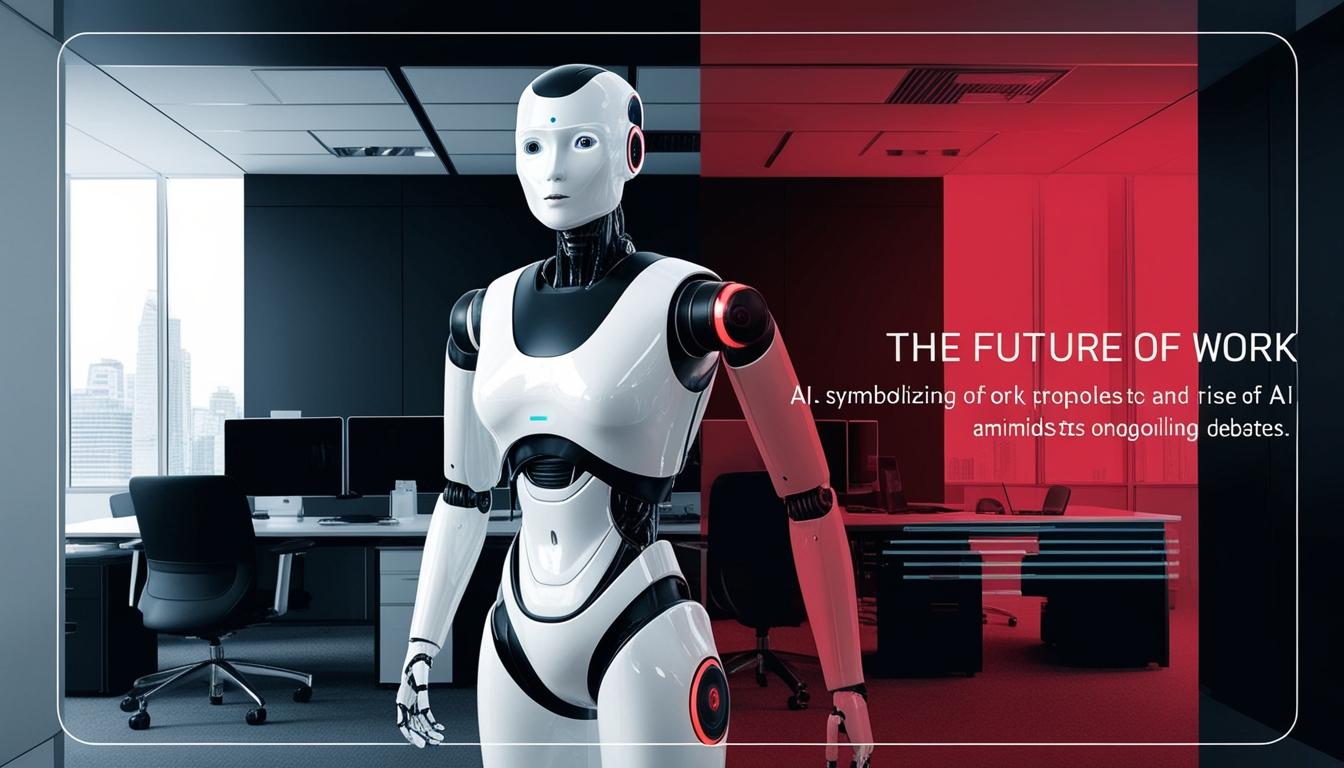
The debate surrounding the impact of artificial intelligence (AI) on the future of work is intensifying, particularly in relation to concepts such as a four-day working week and universal basic income (UBI). Renowned economist and UBI advocate Scott Santens recently articulated his belief that such measures would be beneficial for society, especially as productivity peaks due to technological advancements. Santens, who is also the CEO of the ITSA Foundation and has previously served as an economic advisor to the 2020 Democratic presidential nominee Andrew Yang, expressed these views during an interview with Newsweek.
Santens remarked, "As overall productivity continues increasing due to computerization as it has for decades but perhaps at an even faster rate, we should all benefit, especially since it's our collective data and public investments that made AI possible." He posited that the implementation of four-day work weeks alongside UBI could provide "universal dividends in the form of time and money," arguing that the increasing effectiveness of machines should serve the entire population rather than just a select few.
The discourse is not limited to Santens. Jamie Dimon, CEO of JPMorgan Chase, recently suggested that the workplace could see a drastic reduction in the working week, predicting that future generations may enjoy an average of just three and a half working days per week. Dimon conveyed his views during a November 2023 interview with Bloomberg TV, citing the relationship between technological advancements and life expectancy. He stated, "Your children are going to live to 100 and not have cancer because of technology. And literally they'll probably be working three-and-a-half days a week."
However, the assertion that productivity gains through AI will automatically translate into reduced working hours is disputed by experts in the field. Professor Janice I. Glasgow, a computing expert at Queen's University in Canada, countered these claims by highlighting the historical context. She stated, "Certainly in many fields, AI and technology in general allows workers to be more productive. Does that mean a shorter work week? For some, perhaps, as some jobs can be done more efficiently. Despite all of the advances in technology the last 50 years, the work week has not been affected."
AI's current trajectory is marked by significant innovations, including the introduction of large language models and image generators like ChatGPT and Midjourney. These technologies have raised concerns about job displacement as machines begin to match or outpace human capabilities across various domains. Elon Musk, CEO of Tesla, has indicated that advancements in robotics are on the horizon, with plans for the release of Tesla’s humanoid robot, Optimus, projected for 2026.
In a broader context, discussions around the regulation of AI are also gaining momentum, illustrated by Texas Senator Ted Cruz's recent letter to Attorney General Merrick Garland. Cruz is seeking an investigation into what he perceives as foreign influence in the regulation of AI within the United States, specifically targeting the European Union and the U.K.-based Centre for the Governance of Artificial Intelligence.
Public sentiment regarding AI in the workplace appears to be mixed. A recent survey conducted by Talker Research among 1,000 U.S. adults revealed that 43 percent felt uncomfortable with AI taking on the role of conducting job interviews, while 32 percent expressed comfort with the idea, and 26 percent remained uncertain.
As the conversation around the future of work continues to evolve, the potential repercussions of AI on employment patterns and economic structures remain a focal point for economists, industry leaders, and the general public alike.
Source: Noah Wire Services