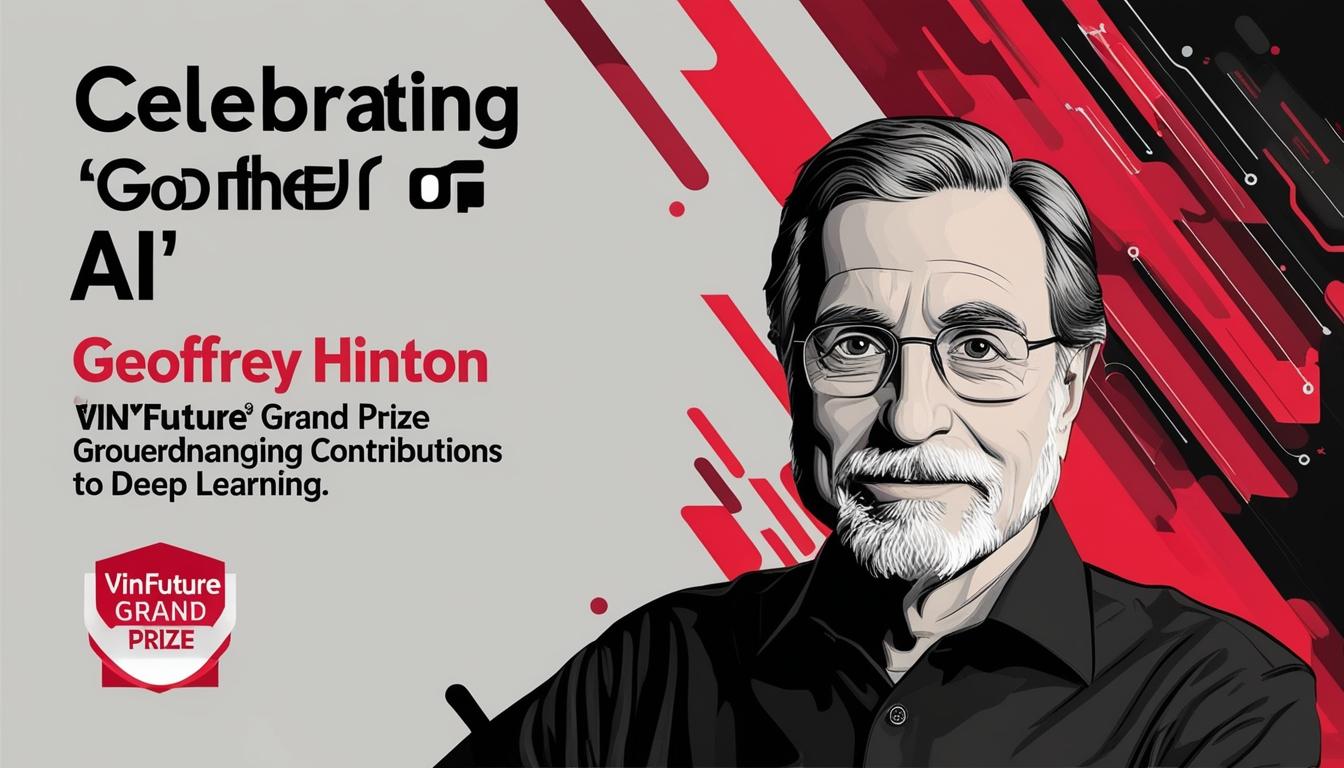
Geoffrey Hinton, a renowned computer science professor emeritus at the University of Toronto, has received the prestigious 2024 VinFuture Grand Prize in a ceremony on Friday. This honour, which comes with a US$3 million award, is administered by the VinFuture Foundation based in Vietnam and recognises remarkable scientific achievements that improve human life and contribute to a more just and sustainable future.
Hinton, who has often been referred to as the "godfather of AI," shares the accolade with notable figures Yoshua Bengio, Jen-Hsun (Jensen) Huang, Yann LeCun, and Fei-Fei Li. Together, they have been celebrated for their pioneering work in developing and implementing deep learning technologies that have the potential to breakthrough boundaries across various sectors including biomedical research, transportation, manufacturing, clean energy, and agriculture.
In a statement of appreciation, Leah Cowen, vice-president of research and innovation at the University of Toronto, expressed immense pride regarding Hinton's achievements. "When Geoff arrived at U of T nearly 40 years ago, his research into neural networks – influenced by his ideas about how the brain learns – was considered an AI backwater, if it was considered at all. Fast-forward to today, and his seminal work is transforming our world in ways that we’ve only begun to grasp," she said.
The VinFuture Foundation underscored the significance of Hinton and Bengio's contributions to neural networks and deep learning algorithms. Meanwhile, LeCun, currently the chief AI scientist at Facebook AI Research and an early student of Hinton's, garnered recognition for developing convolutional neural networks for computer vision. Additionally, Huang, co-founder and CEO of NVIDIA, was honoured for his contributions to computational architectures that facilitate deep learning, while Li, a Stanford University professor, was acknowledged for her advancements in computer vision and large-scale image recognition.
In a video message, Hinton expressed his honour in sharing the accolade with such distinguished researchers, highlighting the collaborative nature of their achievements. "The three of us spent our whole lives developing the technology of neural networks," he remarked, also recognising the contributions of Huang and Li in advancing artificial intelligence framework and data.
Notably, the VinFuture Prize, now in its fourth year, aims to honour scientific and technological innovations that align with the United Nations’ 17 Sustainable Development Goals, encompassing areas such as poverty alleviation, renewable energy, hunger eradication, and healthcare improvement.
The gathering for the award ceremony included Vietnam's Prime Minister Pham Minh Chinh and an array of leaders, scientists, and diplomats from various countries. The event was broadcast live on Vietnamese television and streamed online for a global audience.
Cowen stressed the wider impact of Hinton’s work, stating, "It’s terrific to see this recognition of Geoff’s extraordinary work and its potential to help address some of the world’s greatest challenges." She noted that researchers worldwide, including many of Hinton's former students, are harnessing AI to address critical issues relating to healthcare, sustainability, and climate change.
This honour comes at a time when Hinton is poised to accept the Nobel Prize in Physics on December 10 in Sweden, an accolade he shares with John J. Hopfield of Princeton University for foundational discoveries that have enabled advancements in machine learning through artificial neural networks. Hinton, who began his tenure at the University of Toronto in 1987, has indicated plans to utilise his heightened profile to raise awareness about potential risks associated with unsupervised AI development, a concern he initially vocalised following his departure from Google earlier this year.
Source: Noah Wire Services