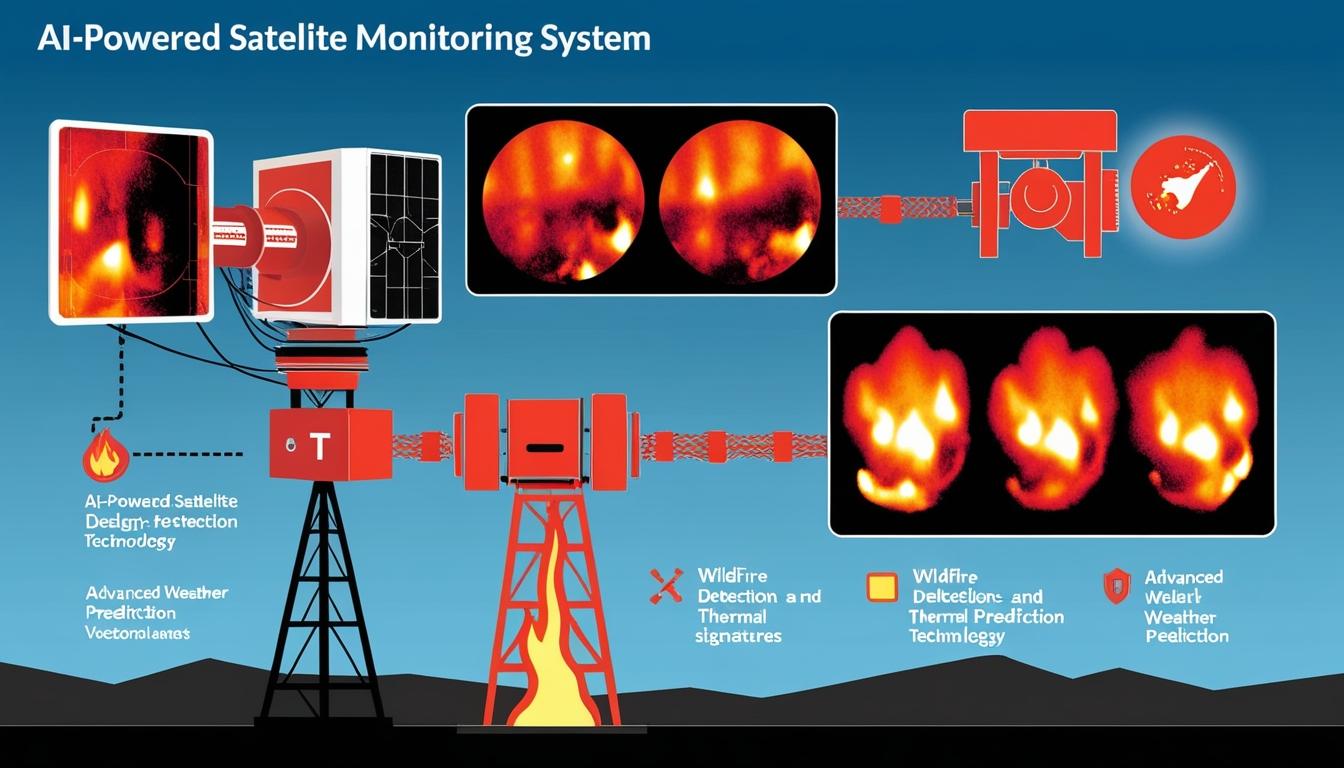
A Mountain View-based company, Muon Space, is at the forefront of integrating artificial intelligence with satellite technology to enhance weather forecasting and climate monitoring. This initiative aims to improve the specificity and accuracy of weather warnings, enabling better preparedness for severe weather events.
The company, founded by Jonny Dyer, has developed a groundbreaking system in collaboration with the Earth Fire Alliance known as the FireSat system. This AI-driven technology is designed specifically for the early detection of wildfires. It employs a network of thermal cameras mounted on a planned constellation of 52 satellites, enabling rapid analysis of images to assess fire intensity and monitor wildfires in real time. Dyer described the technology's capabilities, stating, "You can think about these. It's a large constellation... Basically, thermal cameras on them. You can think about them as seeing heat signatures on earth."
In a recent development, Muon Space secured a contract with the U.S. Space Force aimed at leveraging its satellite capabilities to enhance weather predictions. Dyer noted the significance of this contract, emphasizing the need to adapt their current technologies for improved weather forecasting. He explained, "Clouds are big forcing functions on weather in a lot of different dimensions, so that contract is actually to look at how we can adapt some of the work we're doing with the fire satellites to better address better weather predictions as well."
The implications of such technology are vast, offering potential applications that extend beyond wildfire detection to a wider scope of climate monitoring. Dyer expressed his enthusiasm for the future potential of these systems, saying, "There's a huge landscape of untapped applications for that, that we can drive massive positive impacts, you know, that will impact my children in their lifetime. And that, to me, is what's most exciting about what we're working on."
This advancement in satellite technology comes at a time when the need for accurate and timely weather information is increasingly critical given the rising frequency and intensity of extreme weather events. As businesses and communities grapple with the effects of climate change, the ability to harness AI to monitor and predict weather conditions presents a promising avenue for mitigation and adaptation strategies. The developments at Muon Space are reflective of a broader trend in the integration of AI automation within various industries to improve operational efficiencies and response capabilities.
Source: Noah Wire Services