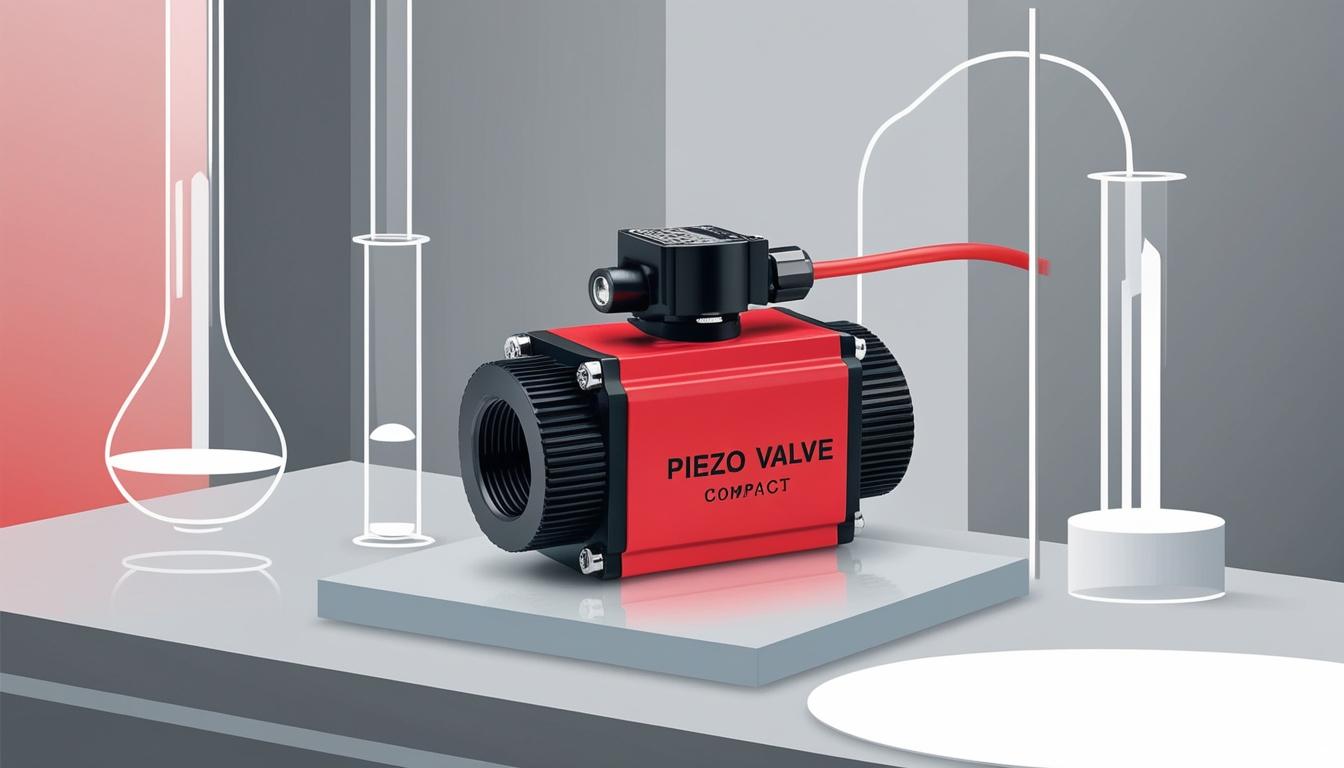
Medical technology and laboratory automation sectors are witnessing a significant shift as companies begin to replace traditional proportional solenoid valves with advanced piezo technology. This transition could lead to a remarkable reduction in energy consumption by up to 95%, coupled with the added benefit of silent operation and minimal heat generation.
Historically, the integration of piezo technology into these systems has been inhibited by the requirement for high voltages—up to 310 V—alongside specialised electronics. However, recent advancements have simplified the process of generating the necessary voltage, facilitating the adoption of piezo valves in various applications.
The operational principles of piezo technology differ markedly from those of solenoid valves. At the heart of piezo technology are piezo ceramics, which bend when electrically charged. This bending effect is directly proportional to the applied voltage, thereby allowing for precise regulation of flow rate or pressure. Unlike solenoid valves, which depend on a constant current to keep a magnetic field engaged, piezo valves only require an initial charge to engage the ceramics; thereafter, their power consumption diminishes to near-zero levels.
Piezo valves can come in different configurations—either as a 2/2-way valve for straightforward flow rate control or as a more complex 3/3-way valve, which enables comprehensive pressure regulation. The latter employs two benders and three ports, effectively managing pressurisation, exhausting, and maintaining pressure—all in a compact design that conventional solenoid valves cannot replicate.
To ease the integration into existing systems, Festo has introduced the VAVE-P piezo driver electronics. This system operates on standard 12 to 24 V supplies while generating the high voltages necessary for piezo operation. It includes everything needed for driving piezo valves, such as open-loop actuation electronics and a two-channel driver stage with current limitation. This new solution permits dual valve operation for either flow rate regulation or pressure control.
Festo also offers complete solutions comprising all necessary components for flow rate and pressure regulation. The compact flow control valve VEMD integrates a piezo valve, flow sensor, and control electronics into one unit, ensuring linear performance between input voltage and output flow rate. Similarly, the proportional pressure regulator VEAB employs two piezo valves within a tightly integrated system, including electronic controls and a pressure sensor. Both systems exemplify efficiency in the smallest possible installation footprint.
The shift toward piezo technology in medical and laboratory automation represents a broader trend in which emerging technologies are poised to transform standard business practices. As companies increasingly adopt such technologies, the implications for energy efficiency and operational performance could be substantial. For further details about these advancements and Festo's product offerings, individuals can visit the company's website.
Source: Noah Wire Services