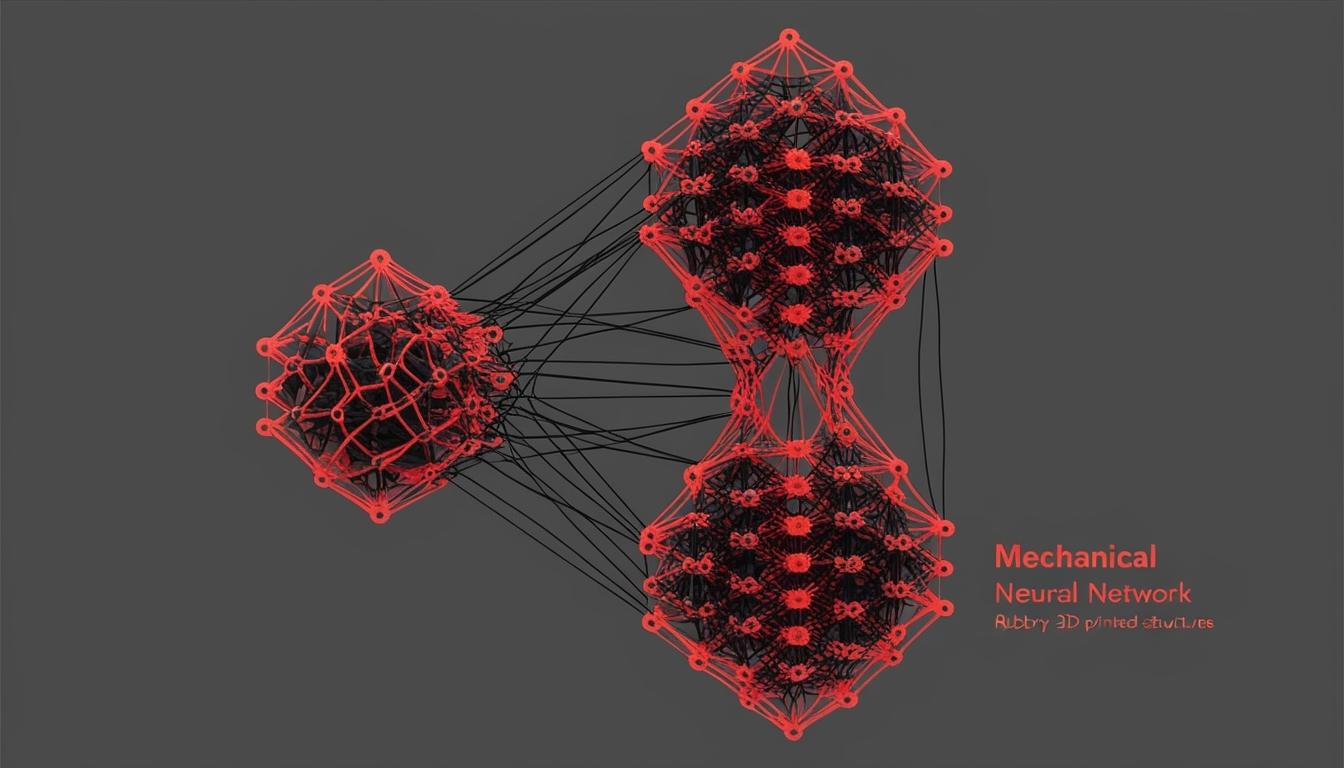
Researchers at the University of Michigan have made notable advancements in the field of artificial intelligence by illustrating that mechanical systems can learn tasks autonomously. This breakthrough expands the scope of machine learning beyond conventional digital platforms. Led by physicists Shuaifeng Li and Xiaoming Mao, the team has developed an innovative algorithm that enables materials to execute tasks without direct human guidance, exemplified by their ability to identify different species of iris plants.
Speaking to the Ann Arbor Times, Li, a postdoctoral researcher involved in the study, remarked, "We're seeing that materials can learn tasks by themselves and do computation." The algorithm hinges on backpropagation, a method typically utilised in digital and optical systems. By recontextualising this approach, the researchers open new avenues for understanding how living systems engage in learning.
The focus of Li and Mao's research lies in mechanical neural networks (MNNs). These systems function similarly to artificial neural networks but are characterised by their reliance on physical inputs, such as weights affixed to materials. When subjected to various inputs, these materials deform, thereby processing information independently of traditional computing resources. "The force is the input information and the materials itself is like the processor, and the deformation of the materials is the output or response," Li elaborated.
For their experiments, the researchers employed rubbery 3D-printed lattices, which were designed using tiny triangular structures assembled into larger trapezoidal forms. By adjusting specific segments within these lattices, they demonstrated that MNNs could be trained to produce varying responses based on the input forces applied.
A significant part of their investigation involved using datasets that described input forces related to features of iris plants. After training, the mechanical neural networks successfully identified unknown species based on prior learning.
Looking to the future, Li aims to enhance the complexity of these systems by integrating sound waves as inputs. Sound waves, which can convey more data through variations in amplitude, frequency, and phase, could facilitate more intricate data processing capabilities. Additionally, the research team is exploring broader network classes in polymers and nanoparticle assemblies, with aspirations of creating fully autonomous learning machines.
This ambitious research initiative has garnered support from the Office of Naval Research as well as the National Science Foundation Center for Complex Particle Systems (COMPASS), marking a significant step toward redefining the confines of machine learning and its potential applications in various sectors.
Source: Noah Wire Services