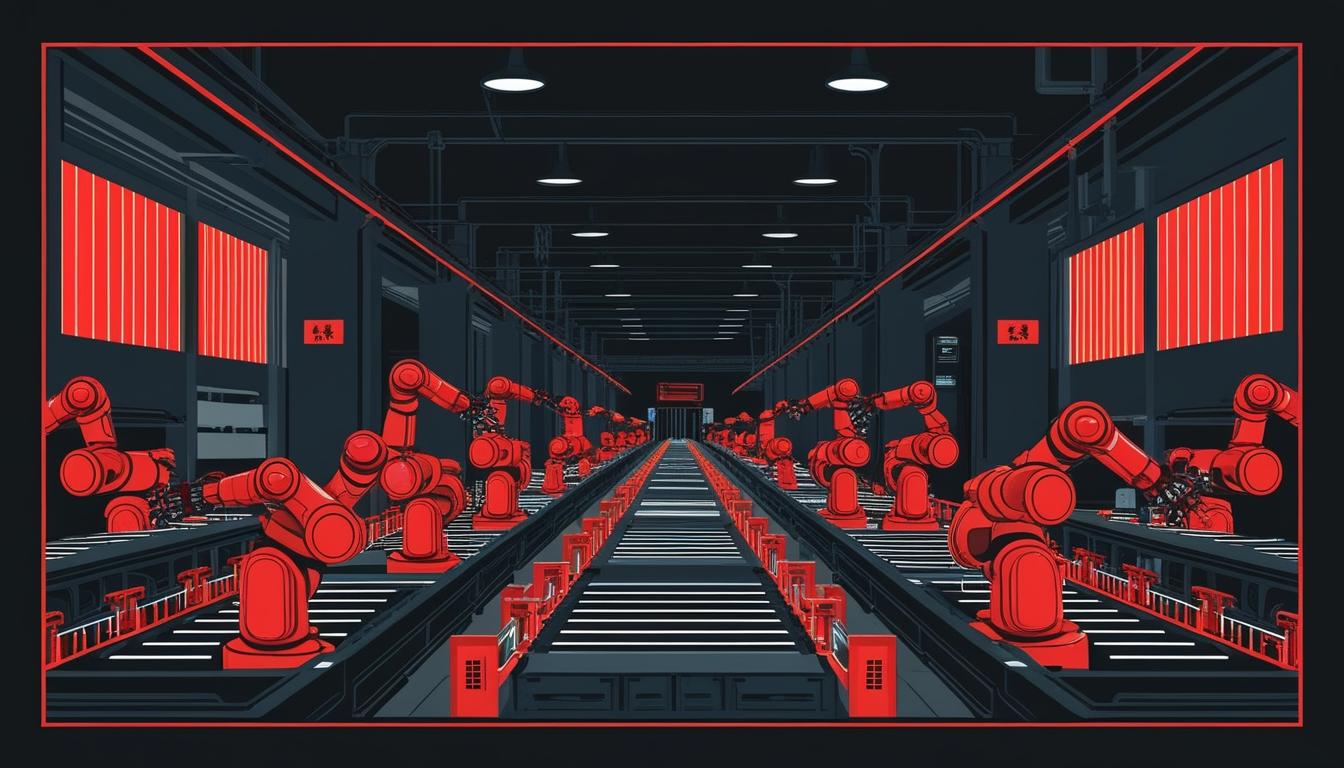
The increasing reliance on artificial intelligence (AI) and robotic automation within Chinese industries has gained significant attention as businesses adapt to evolving demographic and economic conditions. A recent article in the state-run China Daily highlights the emergence of "dark factories," where production is managed entirely by robots, eliminating the need for human oversight and even artificial lighting. This shift is evident across various sectors, from steel manufacturing to consumer electronics and household appliances.
Dark factories, also referred to as smart factories, are characterised by their uninterrupted and unattended operations, allowing for 24-hour production while minimising human intervention. This model has been exemplified in various anecdotes, including a travel vlogger's experience in Shanghai. The vlogger recounted an interaction with a delivery robot, which autonomously arrived at his hotel room, opening its compartment to reveal his food order. This scenario illustrates the potential for robots to perform tasks traditionally designated for human workers, transforming consumer experiences without the necessity for tipping or direct human interaction.
China's swift transition towards robotisation is largely driven by demographic factors. The nation is facing a dramatic decline in birth rates, with the annual number of newborns plummeting from 18 million to an estimated nine million over the past seven years. Projections indicate that the current population of approximately 1.4 billion could diminish by 100 million by 2050 and potentially by 700 million by the century's end. This situation poses significant challenges for the country’s workforce; as the working-age population shrinks, the need for automation becomes more acute.
In contrast to countries such as the United States, where strong trade unions and a robust workforce may position robots as adversaries to blue-collar jobs, China’s less unionised labour market allows for a smoother integration of robotic workers into production lines. The Chinese government’s focus on enhancing productivity through automation not only aims to maintain living standards but also to address the growing demands of an aging population. As the country grapples with its shrinking workforce, the acceleration of AI and robotics in business is seen as both economically necessary and politically feasible.
Looking ahead, China's commitment to furthering its automation initiatives signals a broader trend that may influence industrial practices globally. While these developments present opportunities for increased efficiency and productivity, they also raise questions regarding the long-term implications for the workforce and the nature of work itself in a rapidly changing economic landscape.
Source: Noah Wire Services