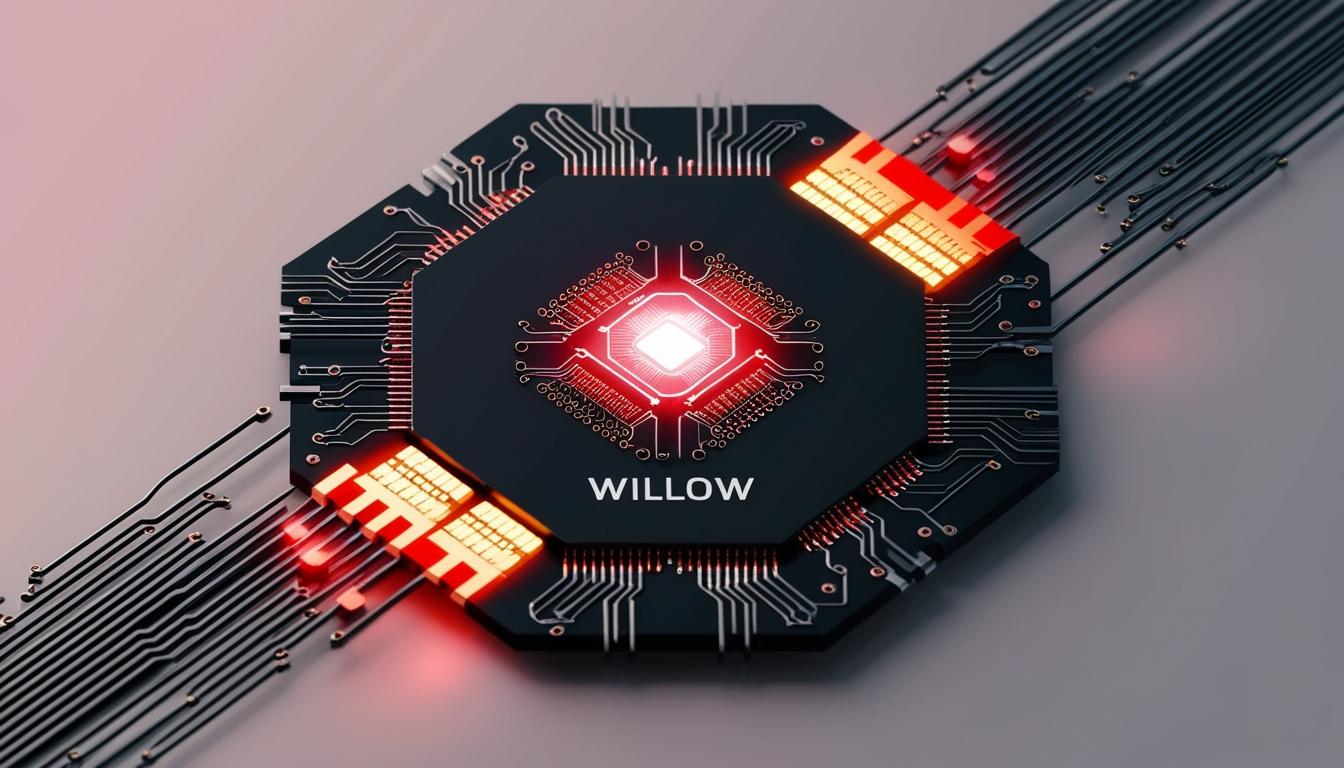
Technology giant Google has unveiled its latest advancement in quantum computing with the launch of a new chip named Willow, which is expected to significantly enhance the scope and application of quantum technologies in various business sectors. The announcement was made following a decade-long development and marks a key milestone in Google’s roadmap for quantum computing.
Willow is designed to reduce errors traditionally associated with quantum computers, employing a groundbreaking approach that enables it to effectively halve computational errors as it scales up in qubit numbers. This capability, referred to as achieving “below threshold,” is crucial as it allows for real-time error correction in superconducting quantum systems, a factor that could foster the accuracy necessary for mainstream implementation.
Notably, Willow boasts an impressive performance, completing advanced computations in under five minutes—a stark contrast to traditional supercomputers, which researchers estimate would take 10 septillion years to perform the same task. This achievement has positioned Willow at the forefront of what is known as random circuit sampling (RCS), a benchmark that tests a quantum computer’s functionality against classical counterparts.
With a total of 105 qubits, Willow demonstrates superior performance in RCS and quantum error correction tests, showing a five-fold improvement over previous iterations. The implications of this leap in technology extend to the possibility of enterprises integrating quantum computing into their workflows as early as 2028, with Google adopting a stance of useful applications that exceed classical computing paradigms.
Dr. Erik Garcell, Director of Quantum Enterprise Development at Classiq, commented on the significance of the development, stating, “Google’s advancement in quantum computing with Willow puts the likelihood of companies using quantum computers for business in the next two to three years.”
However, alongside the excitement surrounding Willow, concerns have emerged regarding its potential impact on Bitcoin, particularly fears that adversaries could exploit quantum computing to breach encryption systems. Bernstein analysts, led by Gautam Chhugani, have attempted to quell these concerns, asserting that the threat posed by Willow is still “decades away.” The analysts pointed out that the current architecture and capabilities of Willow, specifically its 105 qubits, are insufficient to compromise Bitcoin's Elliptic Curve Digital Signature Algorithm (ECDSA), which secures private keys and transaction signatures.
The Bernstein team emphasized that breaching ECDSA would necessitate millions of qubits, indicating that while the evolution of quantum technology may present future challenges, immediate threats to Bitcoin remain distant. They also advocated for proactive measures to mitigate risks associated with the advancement of quantum technology, suggesting transitions to quantum-resistant signatures as a potential avenue for securing digital assets against future threats.
Industry discourse suggests that transitioning to quantum-resistant encryption is likely to be complex, potentially requiring significant structural adjustments within the Bitcoin community, including hard forks or soft forks to enhance block sizes. Experts have indicated that navigating this transition could take several years, with some warning that preliminary threats could begin to surface in as little as five years.
Amidst these discussions, concerns about the future capabilities of quantum computing persist, with Capriole Investments Founder Charles Edwards speculating that even a comparatively modest number of logical qubits, such as 2500, might be sufficient to compromise robust encryption algorithms like SHA-256. This has left the community contemplating their next steps in anticipation of the advancements that quantum computing holds.
As Willow enters the market, the convergence of groundbreaking technology, ongoing discourse about encryption security, and the impending changes in the digital landscape continue to unfold, creating an evolving scenario that businesses will need to navigate carefully in the coming years.
Source: Noah Wire Services