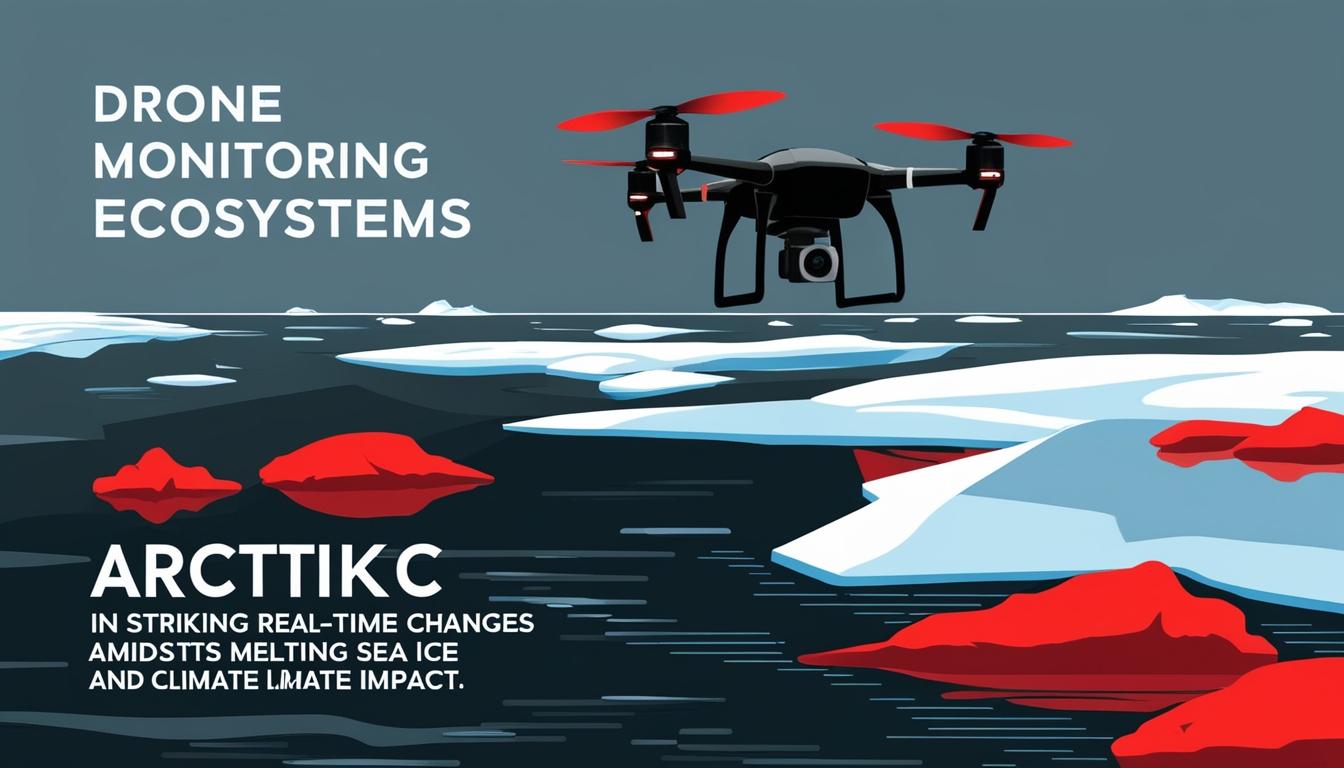
Researchers at the University of Alaska Fairbanks are employing cutting-edge drone and underwater glider technologies to monitor ecosystem changes in real-time, providing critical data that aids in understanding the impacts of climate change both locally and globally. This initiative is significant, especially as temperatures in the Arctic are rising at a rate nearly three times faster than the global average, per data from The Arctic Council.
Cathy Cahill, director of the Alaska Center for Unmanned Aircraft Systems Integration, highlighted the university’s multidisciplinary approach: “We have researchers across various departments using drones to address climate change and environmental impacts.” Various projects include measuring sea ice thickness, collaborating with agencies such as the Cold Regions Research and Engineering Lab for snow thickness measurements, and monitoring coastal erosion induced by storm activity. Drones have proven to be instrumental in accessing remote Alaskan areas, which are otherwise difficult to reach, allowing for vital measurements regarding coastal erosion and community planning.
Cahill further noted that 82% of Alaskan communities are accessible solely by air year-round. Drones have the potential to deliver essential supplies more quickly and affordably, particularly in adverse weather conditions where traditional piloted flights are not viable. However, integration of drones into the airspace faces challenges due to regulations surrounding beyond-visual-line-of-sight (BVLOS) operations. “Alaska’s lack of widespread 5G or other reliable communications networks limits our command and control capabilities,” said Cahill, emphasizing the complexity of operating in such terrain.
Particularly concerning is the notable rate of sea ice melt in the Arctic, contributing to rising sea levels that pose threats to both terrestrial and marine environments. Cahill explained the complexity of capturing sea ice thickness, which is critical for climate modelling. The Lightweight Airborne Snow and Sea Ice Thickness Observing System (LASSITOS EM) project, led by researchers Andy Mahoney and Achille Capelli, utilizes drones adapted for high-precision measurement of sea ice thickness, which would support broader climate models globally. Capelli stated, “Measuring sea ice thickness is challenging due to the brine in the ice, which blocks traditional radar methods.”
The LASSITOS EM system incorporates a tethered electromagnetic induction sensor with a laser and GPS technology, enabling accurate assessments of ice thickness. This advancement represents a shift towards automating environmental monitoring, allowing safer and more detailed assessments of ice conditions, essential for activities such as travel over frozen landscapes.
The seafood industry remains a vital economic sector in Alaska, notably reliant on fisheries for community livelihood. Declining populations, particularly that of the Alaskan snow crab, have raised concerns; NOAA data indicates a drop of over 90% in snow crab populations from 2018 to 2019, prompted by ecological shifts driven by climate change. The phenomenon of borealization is increasingly evident with warmer temperatures shifting marine ecosystems towards sub-Arctic conditions, adversely impacting the viability of local fisheries.
Seth Danielson and Hank Statskewich are furthering efforts in ecosystem monitoring through the use of underwater gliders, which gather essential data regarding ocean conditions. Statskewich stated, "Monitoring these shifts is critical to managing these resources effectively," while emphasising the importance of understanding foundational elements of the ecosystem such as ocean temperature and phytoplankton abundance.
These gliders operate autonomously, surfacing periodically to transmit data back to researchers, ensuring continuous monitoring of the marine environment. Notably, advancements in AI are being explored to enhance onboard data processing, with the potential for real-time analysis of marine life, including zooplankton.
As NOAA transitions towards ecosystem-based fisheries management, they benefit from the comprehensive data gathered by these unmanned systems, addressing a critical need for insights into marine ecosystems. Scientists have noted recent cool water temperatures conducive to the recovery of juvenile snow crab populations, suggesting a possible rebound in the industry's long-term viability.
Overall, these advancements in drone and glider technologies are pivotal to understanding climate change’s effect on Alaskan ecosystems, enabling informed decision-making for sustainable resource management in a rapidly changing environment.
Source: Noah Wire Services