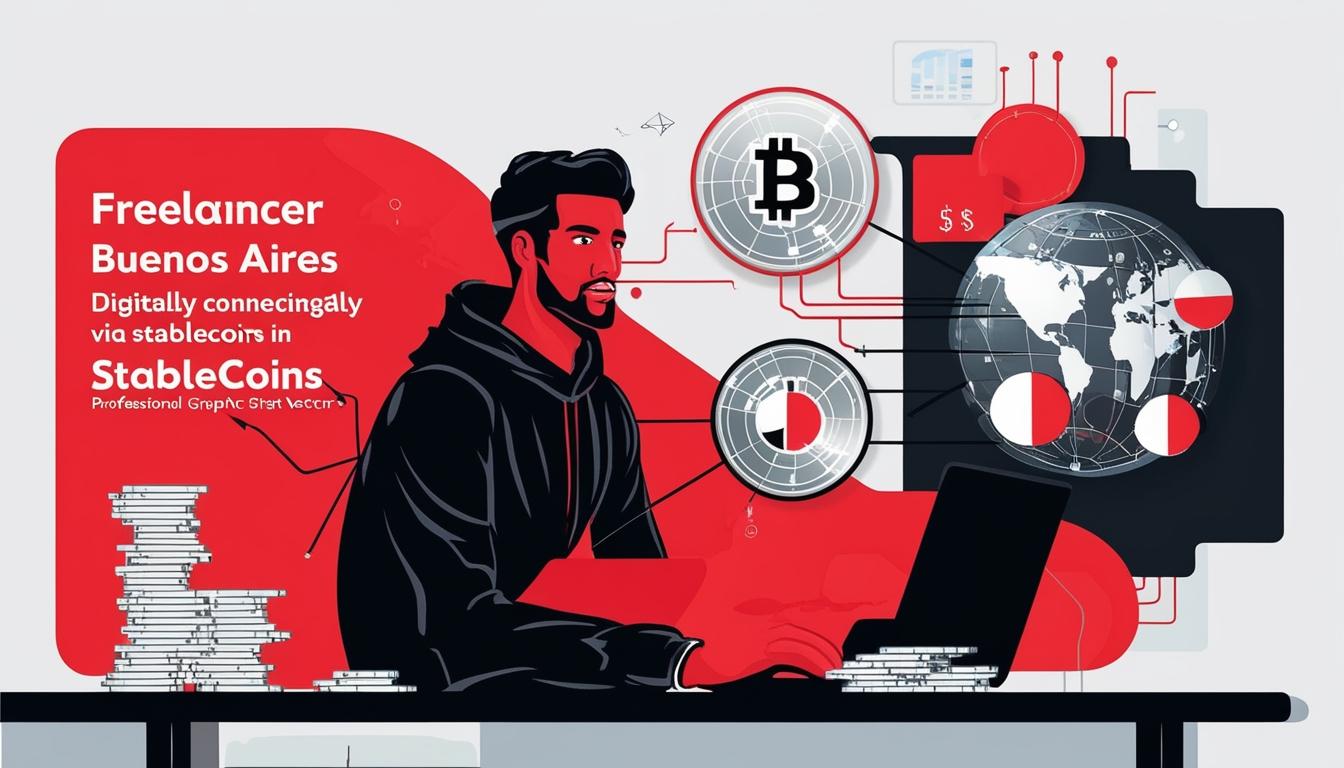
In early 2024, the landscape of financial transactions in Buenos Aires has undergone a significant transformation, particularly in response to the challenges faced by freelancers. For many, such as a local contractor named Maria (a pseudonym for privacy), their previous experiences in navigating payments were fraught with difficulty. Maria would embark on a one-and-a-half-hour ferry ride to Colonia, Uruguay each month, as rigorous capital controls in Argentina limited her ability to receive payments from European companies. Reflecting on her experience, Maria remarked, "The whole day would be lost just to get paid... It was exhausting, but we had no choice."
However, the introduction and increasing acceptance of stablecoins, which are cryptocurrency tokens pegged to the US dollar, have repositioned Buenos Aires within the global digital economy. In the city's trendy Palermo district, signs indicating the acceptance of stablecoin payments have become as commonplace as local wine bars. As Martin Carrica, founder of the stablecoin company Mountain Protocol, explains, "Freelancers have become one of the primary markets for stablecoins. They represent a simple way for people across the world to receive and hold dollars, particularly those facing capital controls or rapidly depreciating local currencies."
The volume of transactions conducted via stablecoins has surged dramatically. A recent report co-authored by Visa and Castle Island Ventures states that stablecoin transaction volumes have escalated to approximately $450 billion per month, nearly matching half of Visa's processing volume. This burgeoning uptake has not gone unnoticed by mainstream financial institutions. Stripe's acquisition of Bridge, a startup dedicated to stablecoin payment infrastructure, for $1.1 billion, underscores the inherent value placed on stablecoins in reshaping payment paradigms.
A notable development in the practical application of these stablecoins emerged from Remote.com, a global HR platform. It announced that contractors across 69 countries can now receive payments in USDC stablecoins via Stripe Connect, marking a significant transition from the initial grassroots solutions to becoming an established payment rail. Job van der Voort, CEO and co-founder of Remote, stated, "One of the biggest hurdles companies face when hiring international talent is providing fast, flexible, and reliable payments around the world." He noted that this feature has become a high-demand request by clients, especially in emerging markets, a sector where contractors from countries like Colombia, Nigeria, El Salvador, Brazil, Argentina, and Mexico are witnessing a surge in opportunities.
As the trend continues, the interest in stablecoin technology extends beyond corporate applications, with U.S. government agencies reportedly exploring the capabilities of Bridge for international disbursements. This shift illustrates the growing recognition of the revolutionary potential of stablecoins to redefine traditional financial frameworks. Maria encapsulates the sentiment shared by many freelancers, stating, "What used to take a full day and a ferry ride can now be done with a few clicks. It's not just about convenience; it's about having control over our own economic lives."
As the global stablecoin market cap approaches $200 billion, the year 2025 is anticipated to be a crucial period for the continued integration of stablecoins within financial systems. The convergence of grassroots popularity, corporate investments, and institutional recognition indicates that stablecoins are increasingly being regarded as integral components of modern finance. The evolution from Maria's challenging ferry rides to an efficient global payment network reflects the rapid advancements in financial technology, aimed at addressing the real-world challenges faced by countless freelancers. As traditional financial entities adapt to incorporate stablecoin infrastructure, the distinction between cryptocurrency innovation and conventional finance is increasingly obscured, heralding new opportunities for independence and control over financial resources.
Source: Noah Wire Services