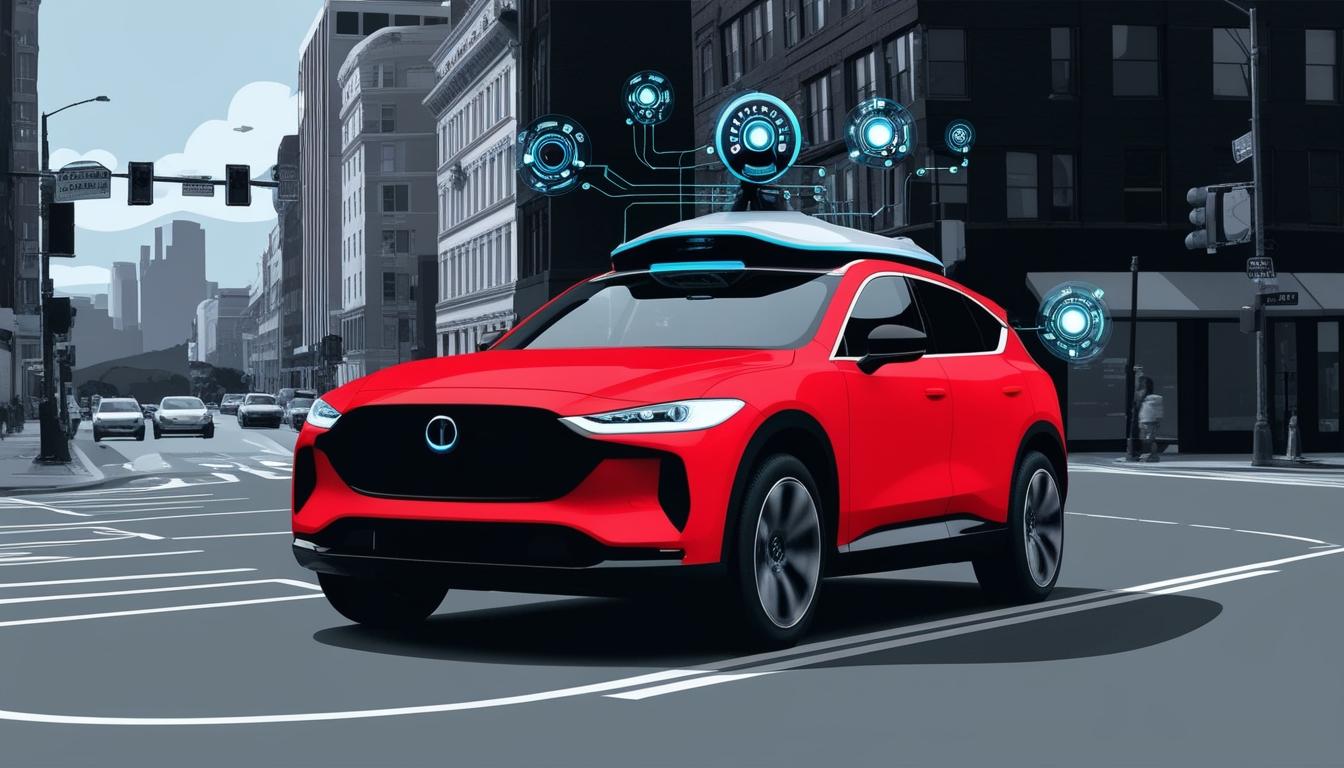
Autonomous vehicle (AV) technology has experienced significant advancements in recent years, but the goal of fully self-driving cars becoming commonplace on city streets is still not fully realised. Prominent companies in the sector, such as Waymo, Tesla, and Zoox, are conducting pilot programmes for robotaxi services in selected urban areas and tech hubs. However, the widespread adoption of autonomous vehicles remains cautious and staggered, primarily due to regulatory hurdles, safety issues, and the inherent complexities associated with scaling this innovative technology.
To provide insights into the current landscape of AV technology, TechBullion spoke with Abhishek Nanda, a tech strategist and investor renowned for his expertise in connected and autonomous vehicle systems. Nanda has an extensive background at Microsoft, where he contributed to the company’s Connected Vehicle Platform, and has a wealth of experience in tech investments and mergers and acquisitions.
When asked to summarise the evolution of AV technology over the past decade, Nanda noted that advances in artificial intelligence have been crucial, alongside steady progress in both hardware and software. He explained that SAE International delineates six levels of autonomy, ranging from Level 0, which involves no automation, to Level 5, representing full automation. “In the 2010s, we saw major progress in Level 1 and 2 features, like adaptive cruise control and lane centering,” Nanda said. He pointed out that significant strides have now been made towards Level 3 and 4 functionalities, where vehicles can self-drive in certain conditions but still require some human oversight.
Currently, companies like Waymo are operating at Level 4, where vehicles can drive independently in controlled environments, such as mapped urban areas, but are not yet equipped for all driving situations. The ultimate ambition remains achieving Level 5 autonomy, which allows vehicles to navigate all scenarios without human intervention. Tesla's recent introduction of its Cybercab service may represent progress, yet Nanda emphasized that there is still a considerable gap between current capabilities and the ambition of full autonomy.
Recent advancements facilitating Movement towards Levels 3 and 4 can be attributed to improvements in hardware capabilities, specifically better sensors such as LiDAR, cameras, and radar. “These sensors are now capable of creating highly detailed, real-time 3D imaging of their environment,” Nanda added. Furthermore, advancements in cloud-based mapping and onboard software have been pivotal, with high-definition maps offering detailed insights into traffic conditions and local infrastructure. The development of local decision-making algorithms is also nearing human safety levels, although such performance is predominantly confined to controlled settings.
Nanda elaborated on the impact of these trends during his tenure at Microsoft. “In 2016, we launched Microsoft’s Connected Vehicle Platform (MCVP) to offer services to automakers, fleet operators, and AV companies,” he stated. This platform aimed to serve as a neutral provider of tools necessary for the larger ecosystem, promoting growth within the sector as it continues to scale.
Artificial intelligence plays a central role in the functionality of self-driving cars, processing sensor inputs, predicting behaviours of surrounding vehicles and pedestrians, path planning, and managing in-cabin voice commands. Nanda indicated that different companies are employing various AI methodologies to tackle the complexities of autonomy. For example, Waymo deconstructs the driving challenge into discrete tasks, while Tesla depends on “imitation learning,” whereby vast amounts of driving data are utilised to replicate human behaviour.
From an investment and mergers and acquisitions perspective, Nanda identified opportunities within the AV sector, particularly among the diverse ecosystem of startups developing critical supporting technologies. He highlighted a notable example of a company called Foretellix, which recently secured $85 million to create a platform focused on the verification and validation of autonomous systems. Such initiatives are crucial for addressing the intricate challenges posed by unpredictable driving scenarios, such as erratic pedestrians or unusual traffic flow.
As for the future trajectory of the self-driving car industry, Nanda identified significant challenges ahead. The high costs associated with advanced sensors like LiDAR pose barriers to the scalable deployment of services like robotaxi systems, making it difficult to achieve affordability for the average consumer. He also noted the essential role of regulations, stating the need for governments to navigate the delicate balance between fostering innovation and ensuring public safety. Consumer trust will likewise take time to establish, as individuals may take a while to feel comfortable entrusting the control of vehicles to AI.
Despite the considerable obstacles existing in the path of autonomous vehicles, Nanda maintains that the technology has the potential to fundamentally transform urban living. With the prospect of reduced traffic congestion, enhanced mobility for those unable to drive, and a redefined approach to car ownership, the ongoing pursuit of full autonomy is regarded as a venture worth the effort, according to Nanda.
Source: Noah Wire Services