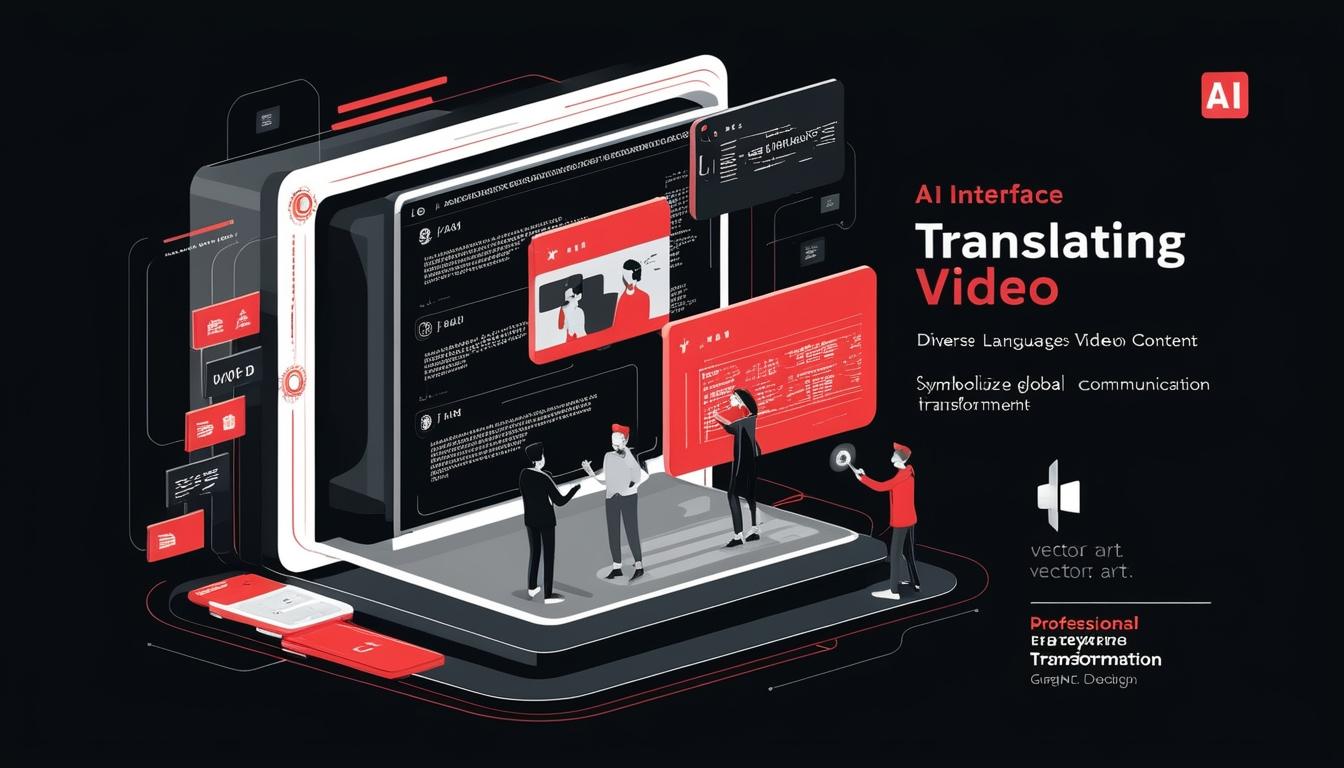
In the fast-evolving digital landscape, the significance of video content has grown immensely, becoming a pivotal element for global communication. With platforms ranging from social media to corporate training, videos serve as a robust medium for conveying messages and engaging audiences. As businesses aim to amplify their global reach, the need for effective video translation has emerged as a critical consideration.
Looking ahead to 2025, advancements in generative AI technology are set to transform how video content is translated, offering innovative solutions to break down language barriers. These sophisticated AI-powered tools are designed to enhance viewer engagement and expand audience reach by providing content in multiple languages. Not only does this facilitate connection with diverse viewers, it also contributes to improved search engine visibility and consequently, organic traffic to business websites.
The benefits of translating video content are manifold. First, it unlocks the potential for a broader audience; for instance, an English marketing video can be transformed into Spanish, Mandarin, and Hindi, potentially reaching millions of additional viewers. Additionally, localized content fosters higher engagement levels, as studies indicate viewers are more inclined to watch and share videos when presented in their native language.
Amidst the rise of AI in this domain, several tools have emerged that stand out for their effectiveness in video translation. Key among these are:
HeyGen: Recognised for its accuracy and intuitive interface, this tool employs advanced neural networks to ensure contextually precise translations.
Vidnoz AI: Prized for its swift processing capabilities, Vidnoz AI caters to content creators needing rapid translations across a variety of languages.
Veed.io: This platform combines comprehensive video editing tools with translation capabilities, enabling users to seamlessly edit and subtitle videos.
Kapwing: With its user-friendly design, Kapwing is accessible to individuals of all skill levels, and features collaborative options for team projects.
Rask: Focusing on high-quality translations, Rask also offers lip-syncing to align dubbed audio with speakers’ movements for a professional appearance.
The integration of AI in video translation not only simplifies the process but also enhances the overall quality of the final product. Key features of AI-powered translation tools include high translation accuracy through advanced algorithms, broad language support—often exceeding 100 languages—user-friendly interfaces, quick processing speeds, and the preservation of original video quality.
The process of translating video content with AI typically follows a systematic approach: it begins with transcribing the original audio into text, which is then converted into the desired languages using AI tools. Subsequent steps involve generating subtitles, creating voice-overs complete with lip-syncing capabilities, and finally, reviewing and editing for quality assurance.
Utilising AI for video translation also presents numerous benefits. Among these are cost-effectiveness, as reliance on human translators diminishes; speed, offering rapid translations essential for time-sensitive content; consistency in quality, which aids brand integrity; and scalability, allowing for the addition of multiple languages without substantial extra effort or costs.
In terms of future trends, the landscape of AI video translation is anticipated to be shaped by continuous advancements in technology. Innovations such as neural machine translation and deep learning are enhancing accuracy and efficiency, promising ever more natural translations. Furthermore, integration with other content creation tools is streamlining workflows, making for more efficient production processes.
As AI tools continue to advance and become more accessible, they also aim to increase inclusivity in video content. Features such as automatic captioning for the hearing impaired are becoming common, ensuring a broader reach for diverse audiences.
The ongoing evolution of AI in video translation is redefining how businesses and content creators engage with global markets. By adopting these AI-driven solutions, enterprises stand to benefit from enhanced viewer engagement, improved SEO performance, and consistent quality across various languages in their video content.
Source: Noah Wire Services