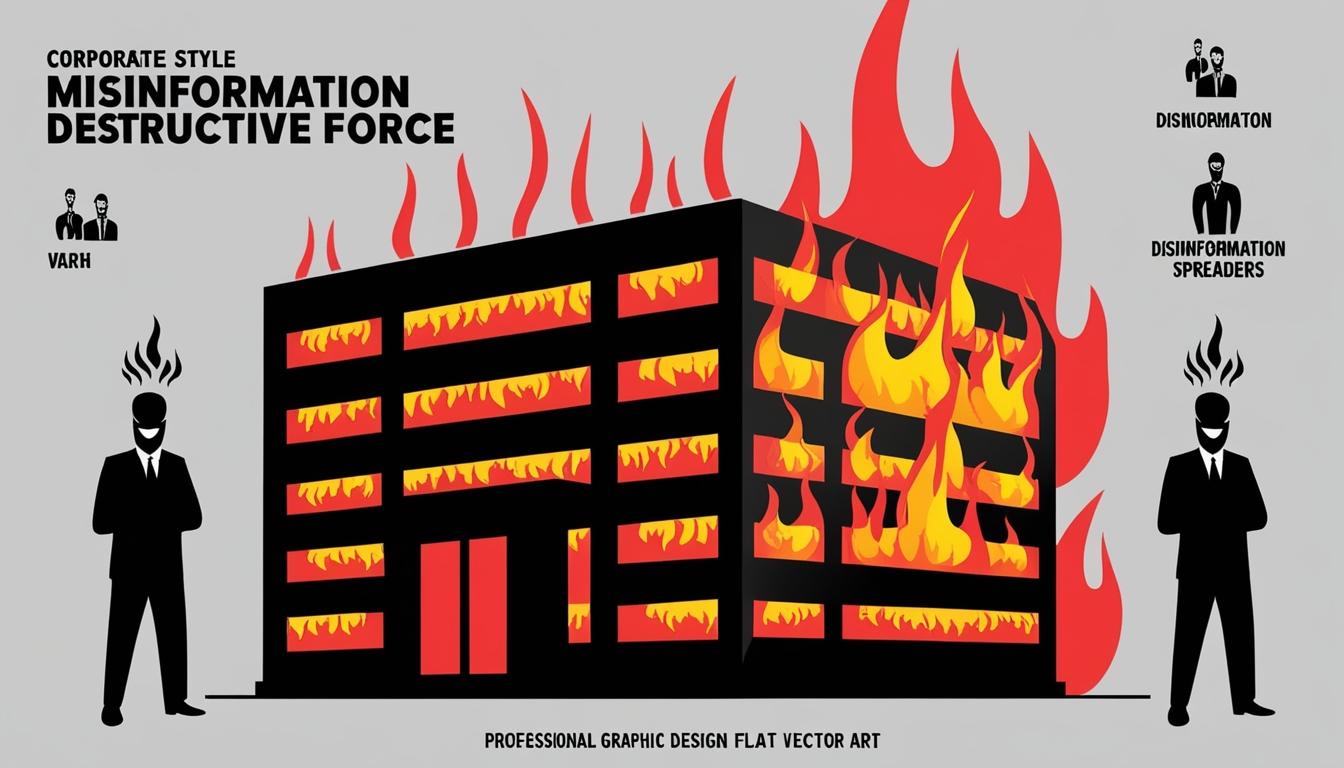
Major corporations are facing increasing challenges in managing the repercussions of internal missteps, such as executive misconduct and inadequate responses to political crises. According to the Financial Times, the complexity of safeguarding corporate reputations is compounded by the rapid spread of falsehoods and disinformation, which can undermine businesses more swiftly and insidiously than before.
Historically, corporate crises were often linked to tangible events or decisions. However, the emergence of artificial intelligence technologies, particularly in the creation of deepfake content, has escalated the risks companies encounter. "Over the last couple of years, disinformation has been on the rise and now it is spreading like knotweed," noted Julian Payne, the global chair of crisis and risk at consultancy Edelman, emphasising the pervasive nature of these threats.
The dairy industry has recently illustrated the potential consequences of misinformation on brands. Arla Foods, which operates the largest dairy cooperative in the UK, encountered severe backlash after announcing a trial of Bovaer, a feed additive aimed at reducing methane emissions in livestock. Following the announcement, customers initiated calls for a boycott amidst a wave of misleading and outrageous claims circulating on social media. These incorrect assertions included conspiracy theories that the additive was part of a scheme to ensure global depopulation and insinuated connections to influential figures such as Bill Gates. Despite UK regulatory approval for Bovaer’s safety, the company attributed the crisis to a proliferation of "mistruths and misinformation."
Other retailers have similarly fallen victim to unfounded allegations. A notorious incident involving the US retailer Wayfair spread claims about its product listings being linked to child trafficking.
A survey conducted by Edelman, involving nearly 400 senior communication and marketing executives, revealed that 80% of respondents expressed concerns about disinformation impacting their businesses, yet fewer than half felt suitably prepared to confront these evolving risks. The threats posed by misinformation, disinformation, and malinformation—defined as the distortion of accurate information for harmful ends—are further amplified by the proliferation of online “superspreaders,” often fuelled by AI technologies. Payne noted that the accelerated dissemination of falsehoods means that companies must enhance their defensive capabilities significantly: a window of response has shrunk from a day to just four hours. "Then it’s like taking a water pistol to a raging inferno," he remarked.
Despite these alarming trends, corporate boardrooms appear slow to prioritise disinformation in the same way they have begun to address cyber security vulnerabilities. An executive who aids companies in tracking such misinformation campaigns commented on the disconnect in the upper echelons of management with the divisive nature of conversations taking place in the digital realm.
In light of these developments, executives are encouraged to reflect on their stances regarding geopolitical and environmental issues, which may render their companies more vulnerable targets. Identifying potential “tripwires” and testing crisis response strategies can assist organisations in identifying existing weaknesses.
An immediate response to unfounded claims may seem logical; however, it could inadvertently amplify the reach of the false narrative, bringing it to the forefront of public consciousness. Therefore, the necessity of strategic mapping and tracking of disinformation sources has been underscored by Jack Stubbs, chief intelligence officer at Graphika. “Your operating environment is this online information space,” he stated, emphasising the relevance of understanding and navigating the digital terrain.
Building credibility with transparency is equally critical. A history of honesty in dealings with shareholders and the public enhances the likelihood that stakeholders will trust the company during crises. As the dynamics of the digital landscape evolve rapidly, organisations must adapt their crisis management strategies to move away from traditional methods that may no longer suffice.
Source: Noah Wire Services