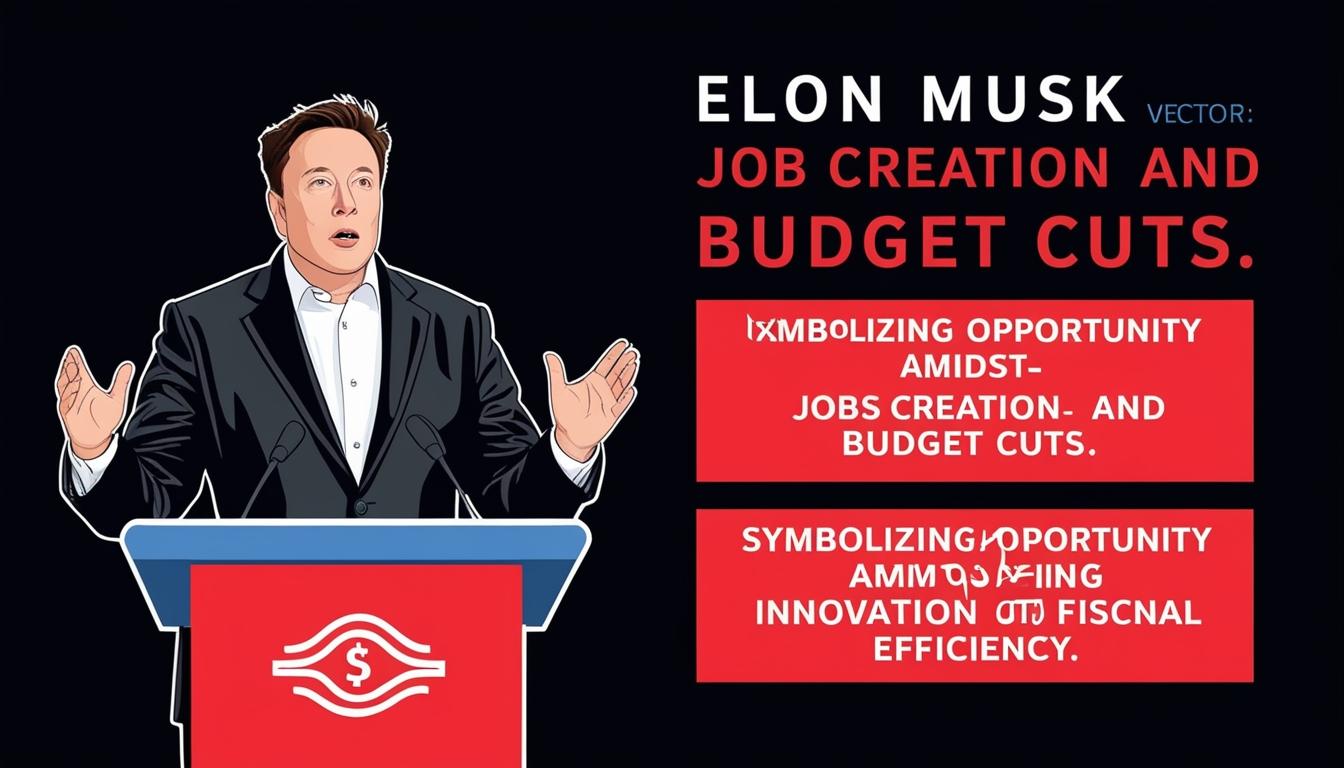
Elon Musk has asserted that the United States job market is not as fragile as widely perceived, promoting a vision of boundless opportunities for employment and entrepreneurial initiatives. His comments were made in the context of his role as co-leader of Donald Trump’s Department of Government Efficiency (D.O.G.E), a newly formed advisory group tasked with significantly reducing federal expenditure. Speaking on X (formerly Twitter), Musk articulated his stance against the "fixed pie" mentality in economic thought, suggesting that historical advancements provide evidence for infinite avenues for job and company creation.
D.O.G.E, which aims to cut an unprecedented $2 trillion from the federal budget, has sparked intense dialogue around job creation, immigration reform, artificial intelligence policy, and the broader fiscal future of the country. The substantial cuts proposed are set against a complicated backdrop; according to the 2024 projections, the U.S. government is already anticipating a deficit that aligns closely with D.O.G.E's proposed savings. The group’s strategy involves major layoffs, reductions in agency budgets, and the elimination of what they deem unnecessary regulations.
One of the most striking proposals includes a potential reduction in the federal workforce by as much as 75%. This figure has alarmed many in Washington, with experts expressing scepticism regarding its feasibility. A significant portion—approximately 75%—of federal spending is allocated to mandatory programs such as Social Security and Medicare, deemed politically untouchable. Consequently, this narrows down available discretionary spending, with around half already committed to defense.
Despite projected efficiency cuts which could yield savings of $150 billion to $200 billion annually, critics claim that these figures are far from sufficient to meet the ambitious $2 trillion target. Concerns have also been raised that failing to realise these goals could lead to heightened borrowing, escalating deficits, and mounting interest payments, amounting to an already precarious annual expenditure of $880 billion.
The discussions surrounding D.O.G.E's budgetary ambitions have also intertwined with ongoing dialogues about immigration reform. Joe Lonsdale, an entrepreneur, brought the topic to the forefront by referencing Sriram Krishnan, Trump’s senior AI policy adviser, who advocates for a merit-based immigration system that prioritises skills over nationality. Krishnan argued for the removal of nationality caps on green cards, labelling the existing framework as illogical and detrimental to the U.S.'s economic fabric.
Support for Krishnan’s stance was echoed by David Sacks, who emphasised the necessity of retaining America’s leadership in AI and other emerging technologies through skilled immigration. Musk interlinked these immigration discussions with D.O.G.E’s efficiency goals, affirming his belief that innovation is essential for economic expansion.
As the debate over D.O.G.E’s fiscal strategies continues, substantial challenges remain. The overarching target of $2 trillion in savings appears elusive, especially given the current national debt exceeding $36 trillion. Projections from the Congressional Budget Office suggest that this may escalate to 166% of GDP by 2054. In order to avoid exacerbating the deficit, it may be necessary for the government to increase borrowing—an action Trump has suggested could be mitigated by abolishing the statutory debt ceiling, albeit at the risk of unchecked long-term borrowing.
Additionally, the implications of potential tax cuts under D.O.G.E raise further questions about fiscal responsibility. Historical data from Trump’s prior administration indicate that tax breaks contributed nearly $8 trillion to the national debt, raising concerns about a similar trajectory should the current administration adopt analogous fiscal strategies.
In conclusion, as the D.O.G.E sets forth its ambitious agenda, the intersecting dynamics of job creation, federal spending cuts, and immigration reform continue to fuel a critical national conversation, reflecting the complexities of governance in the contemporary economic landscape.
Source: Noah Wire Services