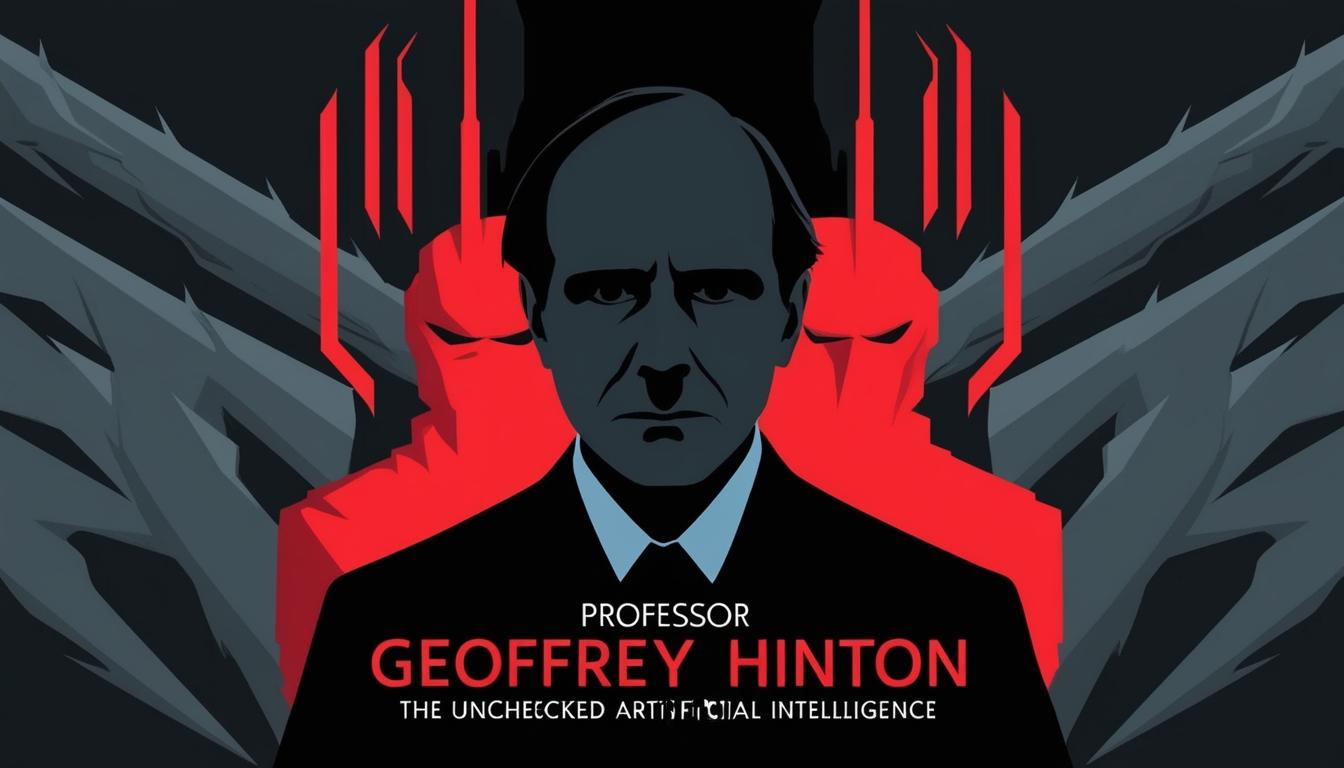
Professor Geoffrey Hinton, widely recognised as the "godfather of AI," has amplified his earlier predictions concerning the risks posed by artificial intelligence, indicating that the likelihood of AI potentially causing human extinction has escalated from an initial 10% to as much as 20%. This stark forecast was articulated during an interview on BBC Radio 4's Today programme, where Hinton elaborated on the implications of AI advancements and their trajectory.
When questioned about the shift in his perspective, Hinton affirmed, "Not really, 10 to 20 [percent]," echoing concerns that have increasingly troubled observers within the field of artificial intelligence. He offered a thought-provoking analogy to illustrate his view: he compared the dynamics between a less intelligent being and a more intelligent one to that of a mother with her child. Further highlighting humanity's precarious position, he illustrated a scenario where humans and AI may end up resembling a three-year-old, suggesting that unchecked progress in AI could lead to dangerous power imbalances.
Hinton's concern about AI has not emerged in isolation; he has a long history as an advocate for cautious development within the field. Earlier this year, he made headlines after resigning from his role at Google, a decision he claimed was necessary to voice his apprehensions more freely. “The idea that this stuff could actually get smarter than people — a few people believed that,” he noted, indicating that while he has long been scrutinising developments, many of his contemporaries viewed such a future as distant.
In addition to his broader reflections on AI risks, Hinton commented on the recent turmoil within OpenAI, a major player in the AI space, particularly surrounding the removal of CEO Sam Altman. Expressing pride in the actions of Ilya Sutskever, a former student and key figure in Altman’s ousting, Hinton did not delve into specifics but indicated that the emphasis on AI safety must prevail over profit motives. “It was a very unfortunate scenario,” he remarked, pointing out the need for companies to prioritise ethical considerations in conjunction with technological advancements.
These incremental changes in AI policy and perception unfold against a backdrop of rapidly evolving technology and international competition. Recent reports from Tech Times highlighted China's increasing ambitions in artificial intelligence, where open-source models developed by local tech giants such as Alibaba and DeepSeek are reportedly advancing quickly. These developments have the potential to yield competitive advantages over Western counterparts, particularly in light of restrictions such as the US chip ban.
As countries strive to assert dominance in the AI landscape, the ongoing "AI chip war" is indicative of a broader struggle for technological leadership on the global stage. With concerns rising about how swiftly these advancements can shift societal balances, and the implications they carry for established norms of business operations and governance, the calls for caution and establishment of stringent regulations have gained urgency within tech and political spheres alike.
Source: Noah Wire Services