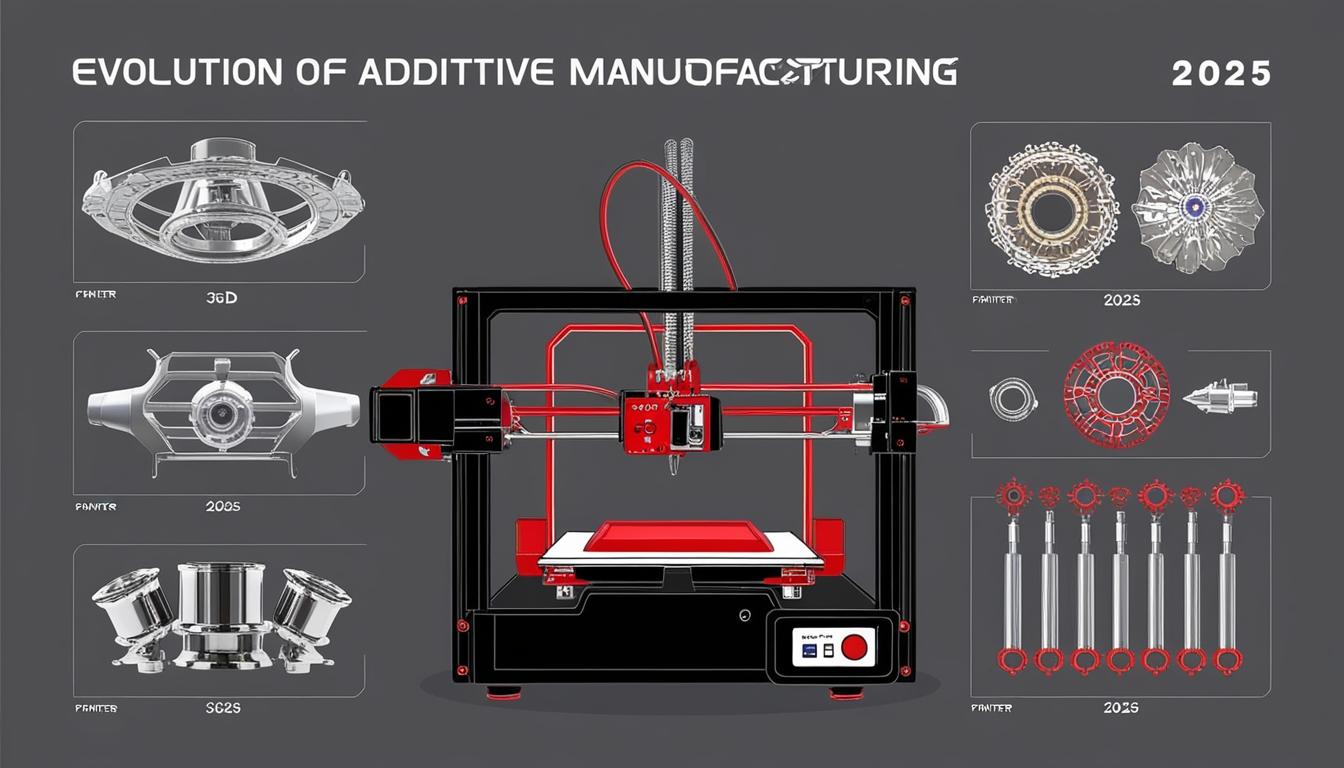
Metal 3D printing is set to undergo significant transformations in the coming years as industry experts predict key developments and trends for 2025. This technology, which is crucial for various sectors including healthcare, aerospace, and defence, has demonstrated considerable growth over the past few decades, with applications ranging from surgical implants to rocket parts.
John Barnes, principal at Barnes Global Advisors, suggests a notable shift in focus from equipment sales to service-oriented operations. In an interview, he stated, “We will see an increasing shift to services; the emphasis will be more on part manufacture and much less attention will be paid to equipment sales.” This implies a transition toward more functional machines tailored to specific applications, moving away from older equipment like single and twin laser systems, which may become confined to research and development roles. In addition, Barnes foresees an increased reliance on Direct Energy Deposition (DED) methods, particularly for larger components as the smaller Powder Bed Fusion (PBF) technologies have already proven valuable.
Ruben Wauthle, CEO of AMNovis, echoed Barnes’s observations, emphasising the competitive landscape that metal additive manufacturing (AM) will face by 2025, particularly from original equipment manufacturers (OEMs) in China offering lower-priced machinery. He remarked, “I personally am waiting for a company to disrupt the metal AM market the way Formlabs did for polymer printing!” However, he cautioned against overcapacity in specific sectors such as medical device printing, which might lead to company closures.
Industry leaders are advocating for the advent of simpler and more cost-effective machines, potentially creating a new wave of innovation akin to the significant disruption witnessed in the polymer printing arena. The emergence of products catering not only to a niche market but also reaching broader commercial applications is expected to reshape the landscape.
Marcus Pont, CEO of Domin, introduced the notion of focusing on problems rather than blindly investing in solutions. He asserted, “I think next year, we’ll see the change from people investing billions in creating solutions and hoping to find problems to a world where people search for problems and realize that 3D printing can be a solution.” This strategic pivot indicates a more application-focused approach that could pave the way for new companies that create substantial value in addressing needs within the industry.
Echoing this sentiment, Fabian Alefeld, Director of Business Development & Academy at Global Additive Minds of EOS, anticipates that by 2025, there will be a continued focus on reshoring and resilient manufacturing solutions. He remarked that, “As confidence and demand for this industrial technology continue to build, companies harnessing AM will achieve long-term sustainability and economic viability.” This strategy aims to enhance productivity and reduce dependencies on global supply chains, positioning additive manufacturing as a critical component in contemporary manufacturing ecosystems.
The influence of geopolitical factors and economic conditions on the AM sector was reiterated by Hamid Zarringhalam, CEO of Nikon Advanced Manufacturing. He highlighted that the mood in the U.S. appears to support growth, attributed to stable inflation and interest rates which can bolster capital spending by mainstream customers. He stated, “Strategic investments, especially for the defense industrial base, will continue.” This indicates that defence contractors might propel investment in additive manufacturing as a means to increase efficacy and reduce logistical vulnerabilities.
Concerns about competition among laser powder bed fusion providers were raised by Richard Hague, Professor of Additive Manufacturing at the University of Nottingham. He noted, “With the glut of laser powder bed fusion providers... I worry for the viability of many of the companies out there.” Yet he also recognised a silver lining, where increased competition could potentially lower costs to implement metal AM, thereby encouraging broader adoption of the technology.
Technological advancements are also expected to play a pivotal role, particularly within the sphere of Electron Beam Powder Bed Fusion (EB-PBF). JEOL's Corporate Officer Shoji Shiota emphasised the maturation of industrial 3D printing technology and its application in sectors like medical, aerospace, and defence. He anticipates that advancements will facilitate large-scale production and enhance quality control metrics within the industry, stating, “Technological advancements and cost reductions derived from EB-PBF are paving the way for large-scale production.”
With regard to specific materials, Ulf Ackelid, Principal Scientist at Freemelt, pointed to a growing interest in refractory metals such as tungsten and molybdenum. He posits that these materials will find increasing applications in fusion energy initiatives and military projects due to their unique properties.
As the metal 3D printing industry zigs along a path of slow and steady adoption characterized by continuous improvements seeking to meet operational demands, experts suggest this might redefine expectations within various sectors—paving the way for new innovations while also challenging existing business paradigms.
Source: Noah Wire Services