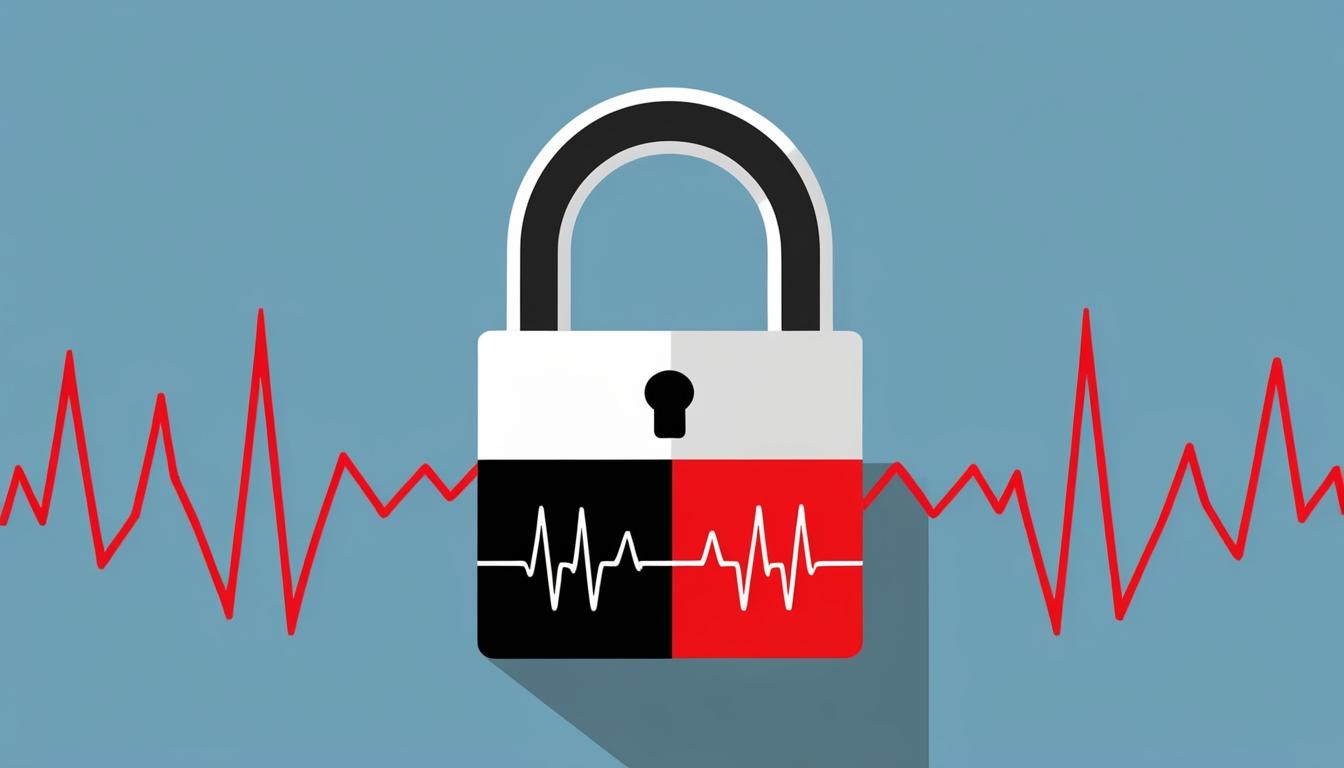
A recent study led by researchers at the University at Buffalo has unveiled a revolutionary artificial intelligence technique designed to enhance the detection of sleep apnea while prioritising patient data privacy. Funded by a substantial $200,000 grant from IBM and the State University of New York, the innovative approach utilises fully homomorphic encryption to achieve an impressive 99.56% accuracy rate in identifying the sleep disorder using encrypted electrocardiogram (ECG) data.
The findings, which were presented at the 2024 International Conference on Pattern Recognition held from December 1 to 5 in Kolkata, India, underscore the potential for AI in healthcare—specifically in diagnosing conditions that necessitate stringent privacy measures. Dr. Nalini Ratha, who is the lead investigator and a professor in the Department of Computer Science and Engineering at the University at Buffalo, stated, “This work highlights how secure, encrypted data processing can protect patient privacy while still enabling advanced, AI-based diagnostic tools. It offers significant potential for improving health care security in sleep apnea diagnosis and other areas.”
The study addresses a prevalent concern regarding the misuse of sensitive health information processed by third-party cloud providers, such as Google and Amazon. Previous hesitance towards the adoption of AI in healthcare practices has been largely attributed to worries that patient data may not be safely safeguarded, potentially leading to privacy breaches and unwanted commercial targeting based on health conditions. Ratha articulated concerns over the exposure of such data: “If a cloud service provider... runs an analytic on my data, they can potentially figure out what my sleep apnea status is and then start sending me ads to buy this or that.”
The researchers' newly developed technique manages to overcome typical drawbacks associated with homomorphic encryption, which is often criticized for its slower processing times compared to traditional analytics. By optimising various key operations within deep learning frameworks, such as convolution methods for pattern detection and other decision-making processes integral to neural networks, the researchers have facilitated a system that performs efficiently and cost-effectively.
Ratha likened their encryption method to securely entrusting gold to a jeweller for crafting without compromising ownership of the gold itself, stating, “If you want to build an ornament out of the gold... you put it in a box. The jeweller can touch the gold, but he cannot ever take it out of the box.” Through this analogy, the encryption is depicted as a protective measure that allows analysis of the data without exposing it to potential risks associated with unencrypted datasets.
While the focal point of the study was sleep apnea, the implications of this encryption method extend to a broader scope within healthcare. The ability to securely process data related to X-rays, MRIs, and CT scans opens up significant possibilities for improving diagnostics across various medical fields where confidentiality is critical.
As AI continues to evolve and permeate business practices, the integration of such advanced data protection mechanisms could pave the way for more extensive applications, potentially reshaping how healthcare organisations approach data analytics in light of privacy concerns. The growing intersection of AI capabilities and stringent data security measures suggests a promising future for the field of medicine and its reliance on technology-driven solutions.
Source: Noah Wire Services