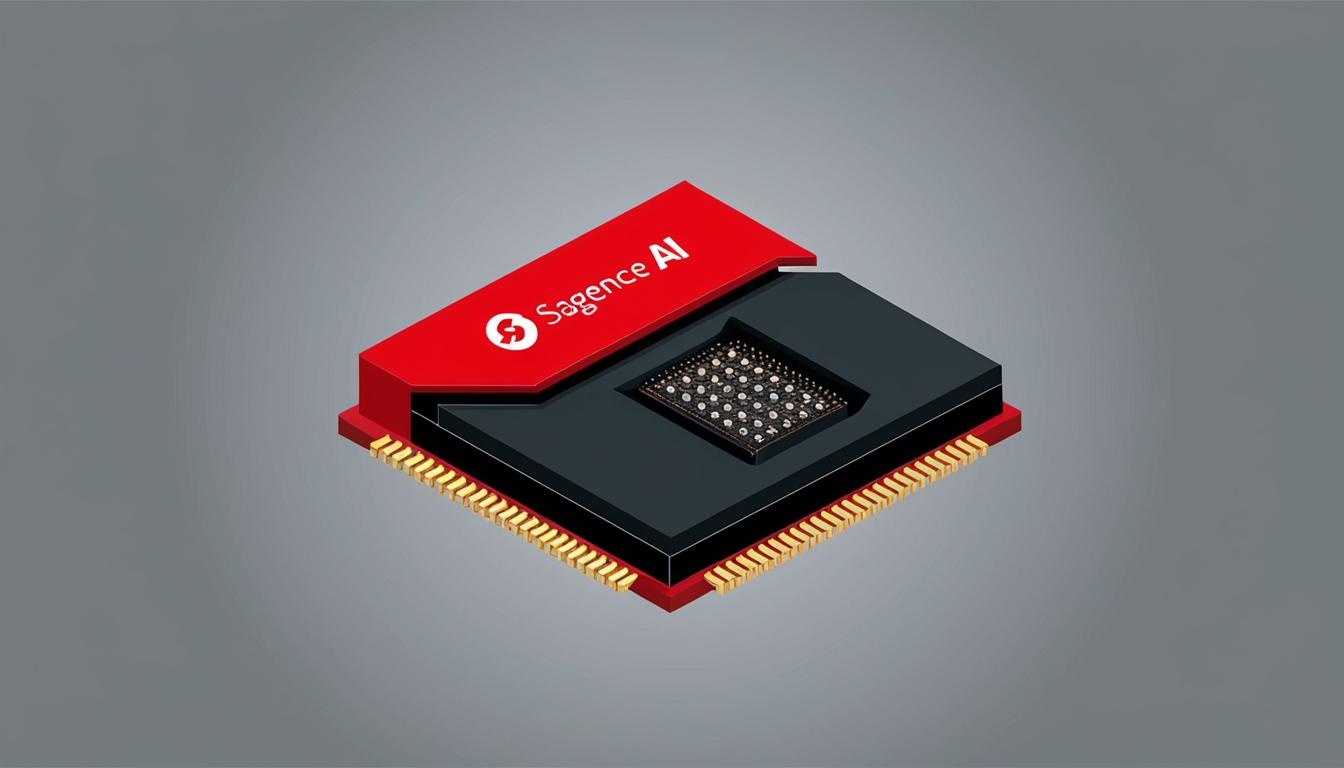
Sagence AI has unveiled an innovative analog in-memory computing architecture aimed at transforming the landscape of AI inference by drastically reducing power consumption and operational costs. This new technology is particularly designed to address the growing challenges faced by businesses as they scale their AI applications.
The breakthrough was announced in a recent report by Tech Radar, which highlighted that Sagence's architecture provides a performance level competitive with traditional high-end systems based on GPU and CPU technologies. The claims are significant, with Sagence’s designs achieving performance that processes large language models, including Llama2-70B, at a rate of 666,000 tokens per second while consuming ten times less power and incurring costs up to twenty times lower than existing leading GPU solutions.
The shift in focus towards AI inference, as opposed to training, highlights the need for more efficient computing solutions, particularly within enterprise data centres. In an era where businesses are increasingly reliant on AI for operations and customer interactions, maintaining an adequate return on investment (ROI) is paramount. Sagence's architecture is positioned to tackle these challenges head-on, with its analog-based approach integrating storage and computation directly within memory cells. This design not only streamlines chip architecture but also promises to enhance energy efficiency significantly.
In further detail, Sagence employs what it describes as "deep subthreshold computing" within multi-level memory cells, an innovative step that is set to revolutionise efficiency within the sector. This method serves as a critical advancement, especially against the backdrop of conventional CPU and GPU systems that frequently rely on complex dynamic scheduling. Such methods can lead to heightened hardware requirements and further inefficiencies, factors that Sagence aims to circumvent through simpler, statically scheduled architectures that mimic biological neural networks.
Moreover, the integration capabilities of Sagence’s technology with established AI frameworks such as PyTorch, ONNX, and TensorFlow facilitate the transition to its system. Once neural networks are trained, Sagence's platform eliminates the reliance on GPU processing, thereby simplifying the deployment phase and contributing to overall cost reductions.
Vishal Sarin, CEO and Founder of Sagence AI, underscored the necessity for advancements in AI inference hardware. He articulated the pressing demand for a computing framework that delivers exceptional performance while aligning costs with the value generated. Sarin pointed out, "The legacy computing devices today that are capable of extreme high-performance AI inferencing cost too much to be economically viable and consume too much energy to be environmentally sustainable. Our mission is to break those performance and economic limitations in an environmentally responsible way."
As Sagence AI positions itself as a potential game-changer in the heavily contested market, which is dominated by established players like Nvidia, the implications of its advancements could redefine the approaches businesses take towards implementing AI-driven solutions. With the potential for significantly lowered energy consumption and improved cost-efficiency, Sagence's innovations may well set new benchmarks in the realm of AI technology, influencing how entities across various sectors plan their computational infrastructure in the future.
Source: Noah Wire Services