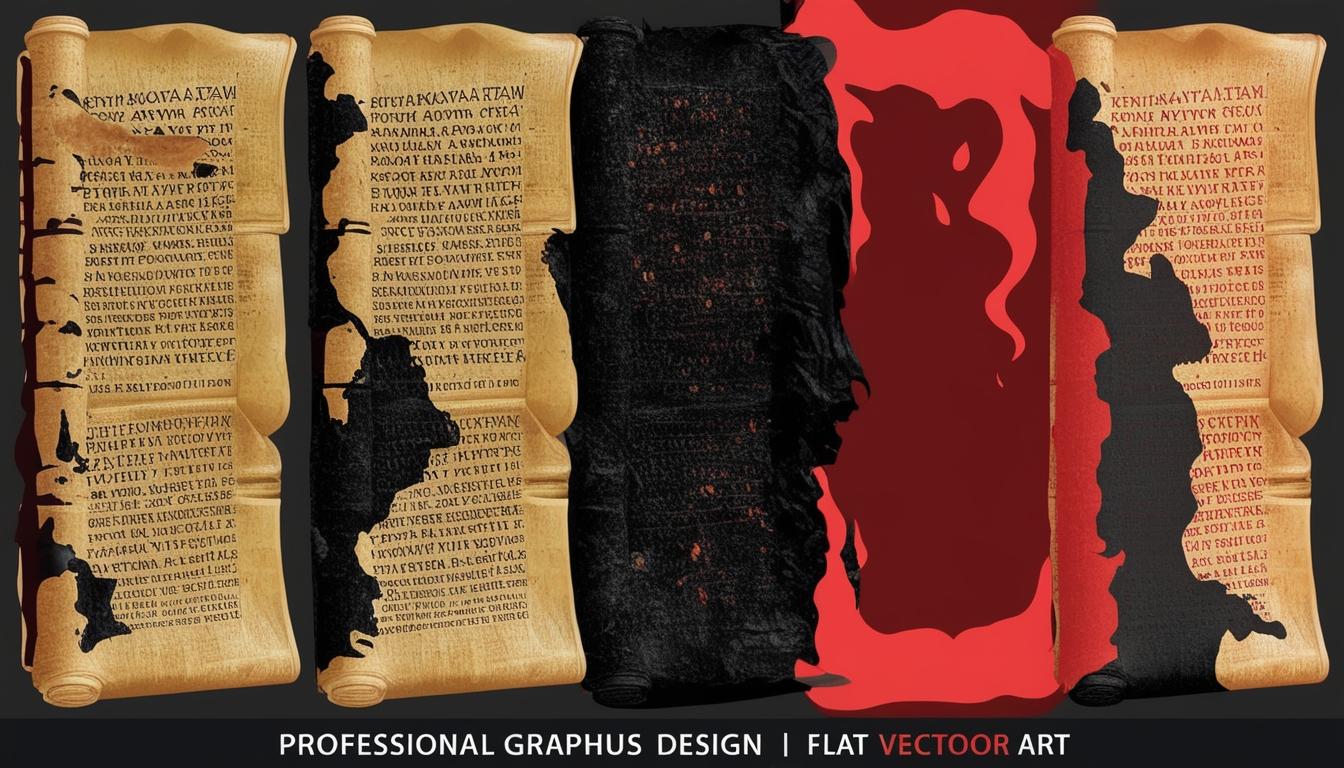
In a recent breakthrough that may alter the study of ancient texts, researchers have successfully employed artificial intelligence (AI) to read previously indecipherable fragments of papyrus scrolls charred during the eruption of Mount Vesuvius in AD 79. The exciting discovery came to light in October 2023 when an email containing an image of a papyrus fragment ignited a sense of possibility among scholars in the field. The Vesuvius Challenge, spearheaded by Federica Nicolardi, a papyrologist at the University of Naples, Italy, aims to develop AI methodologies that allow for the reading of these scrolls without physically unrolling them, as this would cause irrevocable damage.
Scholars have long faced insurmountable challenges in piecing together these remains, which were part of a luxury Roman villa in Herculaneum, located near Pompeii. Despite various efforts since their discovery in the eighteenth century, the fragile scrolls often remain unreadable. “It was incredible,” said Nicolardi, reflecting on the moment when lines of Greek text emerged from the deep shadows cast by the carbonised layers. “In that moment, you really think ‘now I’m living something that will be a historical moment for my field.’”
AI's application in the realm of classical studies, particularly in the area of papyrology, has broadened since the integration of sophisticated computational technologies. Researchers are employing models such as convolutional neural networks (CNNs) and recurrent neural networks (RNNs) to decode various lines of text, tackle vast archives, and even fill in missing characters from nearly forgotten languages. AI systems are not just analysing existing texts; they are also enhancing the capacity to hypothesise and confirm ideas about historical knowledge.
A collaborative project initiated at the University of Oxford in 2017 has birthed models like 'Pythia' and 'Ithaca,' designed to assist scholars in determining the origins, dating, and restoration of damaged texts. Such models have demonstrated impressive accuracy, yielding a 62% success rate in restoring missing ancient words compared with only 25% by human experts alone. Ithaca has since been made available online, drawing substantial interest from scholars seeking assistance with their own research.
In conjunction with Nicolardi's team is computer scientist Brent Seales from the University of Kentucky, working to develop ‘virtual unwrapping’ technologies, which employ high-resolution computed tomography scans to unveil the scrolls' internal structures without causing damage. Following several years of research, Seales, alongside team members and participants of the Vesuvius Challenge, has implemented a robust collaborative environment where over a thousand global teams competed to refine the ink-detection algorithms to reveal hidden texts.
This culminated in a significant success when the winning team presented 16 columns of readable text, which have been preliminarily identified as a previously unknown philosophical work by the Epicurean thinker Philodemus. “To work on it was ‘magical’,” Nicolardi shared, emphasising the implications of bringing to light ancient wisdom that had lain dormant for millennia.
The potential of AI extends beyond the Herculaneum scrolls. With ongoing efforts targeting historical archives from various cultures, researchers are strategically leveraging machine translation to decode extensive collections, ranging from Korean royal records to the Linear B script of Mycenaean Greece. The capacity of AI to streamline these translations and analyses is bringing forth layers of historical context that previously remained obscured.
Seales expressed optimism about the future of this research, saying that the unwrapping process could soon become automated, potentially facilitating access to hundreds more unexamined scrolls housed in various collections worldwide. Such a development could lead to the unveiling of considerable amounts of new text from the ancient world, thereby propelling classical studies into what could be considered a new era of enlightenment.
As AI technologies advance, the promise of uncovering hidden histories through data-driven methodologies offers an exciting pathway not just for scholars, but for anyone interested in the evolution of human thought and culture. The collaboration of human expertise with artificial intelligence could unlock insights from a vast array of ancient sources, illuminating the contours of our collective past that have remained tantalisingly beyond reach for generations.
Source: Noah Wire Services