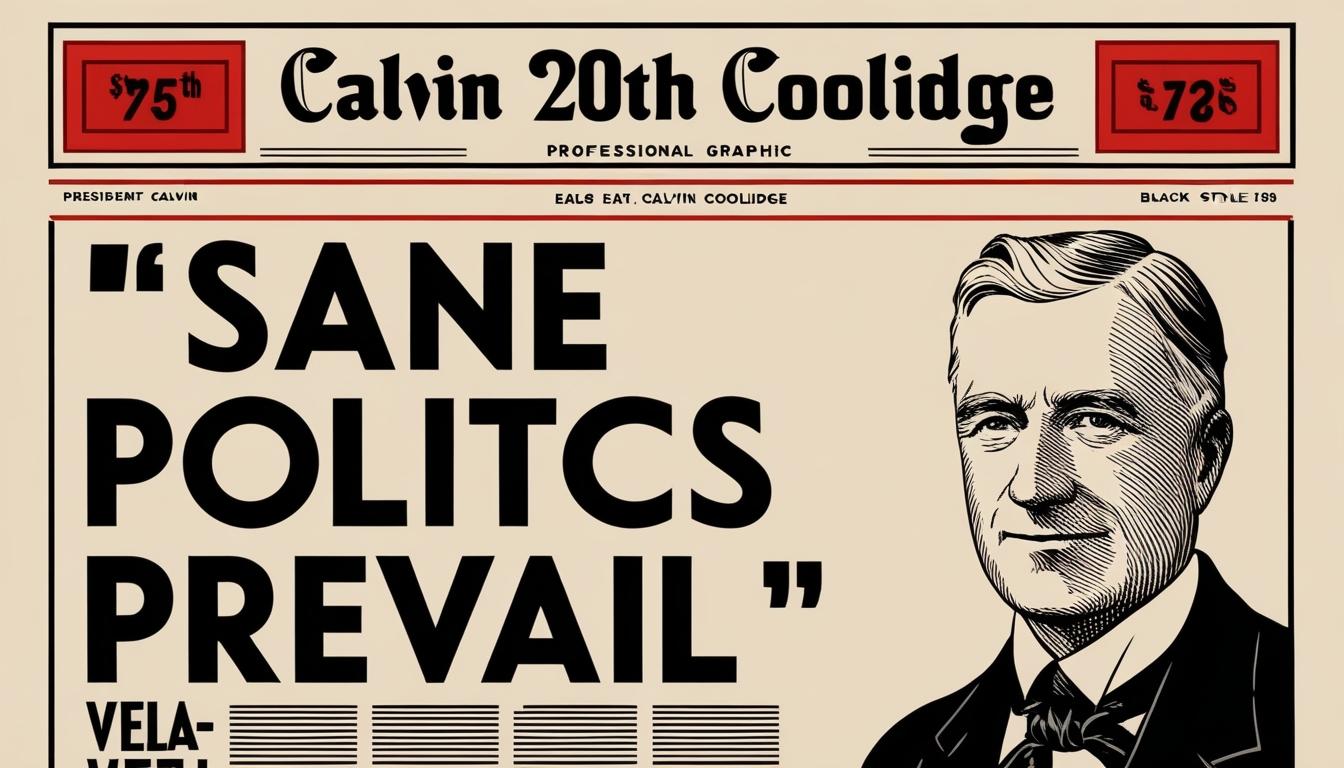
As 2024 came to an end, reflections on the past often emerge, prompting individuals and publications alike to explore historical precedents. A particularly engaging retrospective was published in The Fargo Daily Tribune on January 1, 1925, serving as a snapshot of life a century ago, complete with insight into the societal mood and predictions for the future.
The headline that greeted readers was "Sane Politics Prevail," a phrase that intriguingly contrasts with contemporary political discourse. By early 1925, the American electorate expressed confidence in President Calvin Coolidge, following his re-election, and considered the interplay between business and politics as a stabilising force. "Politics and business have rarely been so interwoven as in the year 1924," noted the publication, reflecting the sentiments of the time as they anticipated a stable political landscape.
Among the local news, readers learned of the passing of Sarah Russel, a pioneer who settled in Mapleton before North Dakota attained statehood. In another story, Sarah Rottenberg found herself arrested for selling candy cigarettes to minors, indicative of the more relaxed attitudes towards children's health and societal norms of the era. Commercially, Fargo's Herbst Department Store was engaging customers with half-price sales, with flapper-style dresses showcased at enticing prices, suggesting a vibrant consumer culture burgeoning in the post-World War I landscape.
A significant aspect of the 1925 edition was an editorial contemplating the future. This was titled "Hold Your Horses! The Elephants are Coming," and echoed the sentiments of columnist George Ade on the transformative events from 1900 to 1925. Ade noted that previous predictions about the advancements that took place were often dismissed as wild fantasies. He posited that living in the current era was radically different—describing it as a "more interesting, more sophisticated and more complicated three-ring circus."
The editorial boldly speculated on what the future—specifically the years leading to 2025—might hold. It contemplated topics ranging from the potential for "super-microbes" capable of obliterating bacteria, to the intriguing question of whether technological advancements could surpass the marvel of radio, which many considered the pinnacle of innovation at the time. The attempts to predetermine life expectancy through medical advancements and the speculations regarding habitats beyond Earth also generated keen interest among readers.
While the predictions made in 1925 about life a century later were not all accurate, they highlight the curiosity and ambition of that era. Some anticipations, such as the advent of antibiotics initiated by Alexander Fleming, came to fruition. Conversely, other forecasts, particularly regarding world peace and extraterrestrial life on Mars, were less optimistic or accurate.
Looking ahead, modern analysts speculate on the dawn of the next century, focusing on potential advancements in various domains including DNA technology, artificial intelligence (AI), and climate adaptation strategies. Experts suggest that enhanced medical technology may enable longer, healthier lives, while AI could assume a predominant role in society, affecting how humans engage with both work and leisure. Moreover, the ambition for humanity to extend its reach into space, which has gained renewed traction through ongoing missions to Mars, foreshadows the potential for multi-planetary settlements.
As discussions emerge regarding climate change and its implications for regional habitability, the necessity for ongoing adaptation becomes increasingly clear. These contemporary reflections illustrate a continuum of humanity’s quest for progression—a thread connecting the lives of individuals across generations as they navigate technology, governance, and the vastness of the cosmos.
Such evolving perspectives illuminate not only our past but also potential pathways forward as societal dynamics shift, influenced by innovations in technology and scientific discovery. The speculation on what awaits in 2125 remains a rich ground for both hope and inquiry, encapsulating the enduring human spirit to envision the future.
Source: Noah Wire Services