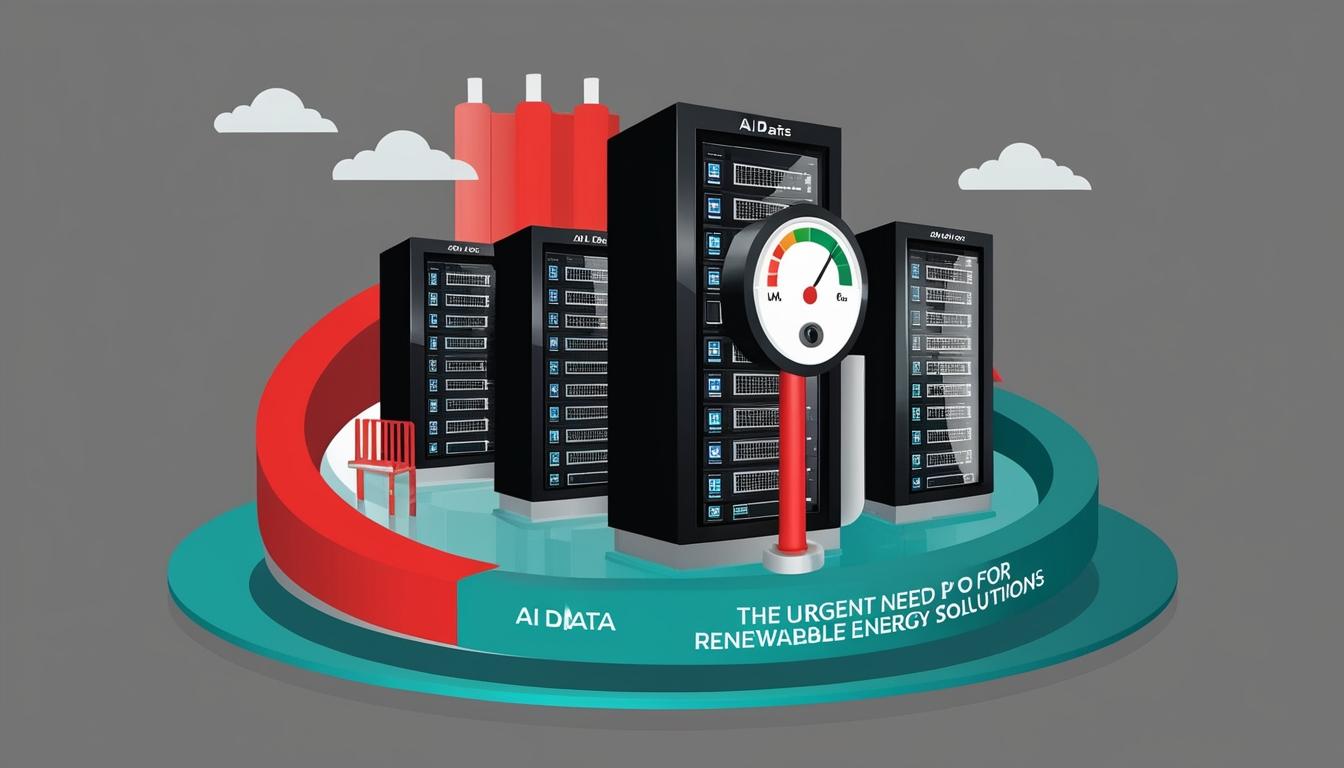
Artificial intelligence (AI) has increasingly become a dominant topic across various sectors, including finance and technology, in 2024. However, there remains a pressing concern over the significant rise in energy demand associated with AI technologies. According to the International Energy Agency, executing a single query with ChatGPT necessitates 2.9 watt-hours of electricity, starkly contrasting with just 0.3 watt-hours required for a standard Google search. This substantial energy footprint is indicative of the broader implications of AI usage, particularly for data centres that house extensive computing resources. A report from Goldman Sachs Research highlights a striking forecast: by 2030, power requirements for these data centres could surge by 160%, potentially consuming 8% of all electricity generated in the United States.
In response to this growing energy demand, both lawmakers and business leaders are exploring strategies to manage these needs while simultaneously fostering investment and pursuing climate objectives. The relationship between renewable energy expansion and the increasing energy consumption of data centres is especially pertinent, though legislative progress varies significantly by state.
In Virginia, which currently hosts the highest concentration of data centres in the U.S., several proposed regulations aimed at enhancing energy efficiency and promoting renewable energy standards have stagnated in committee. Among these were bills that sought to link tax exemptions for data centre operators to their energy performance, as well as bills mandating quarterly disclosures of energy usage. The fate of these proposals has been postponed until the 2025 legislative session.
In New York, legislators have raised alarms over the potential conflicts between data centre operations and the goals outlined in the Climate Leadership and Community Protection Act of 2019, which targets a 70% reliance on renewable energy by 2030. To address this, the New York State Sustainable Data Centers Act has been introduced, aiming to ensure that data centres work towards achieving compatibility with the state's renewable energy targets.
Michigan's legislative body has opted to advance S.B. 237, which revamps the state tax code to exempt equipment involved in data centre construction and operation from use tax. This legislation mandates that data centres source their power from renewable sources whenever feasible, and certain facilities are required to confirm they can procure clean energy equivalent to 90% of their expected annual electricity consumption. Critics of this legislation argue it may undermine Michigan’s comprehensive clean energy legislation enacted in 2023, which aims for 100% clean energy usage by the end of 2024.
In a contrasting move, Georgia's Governor Brian Kemp vetoed H.B. 1192 in May 2024, a measure intended to suspend tax exemptions for new data centres and establish a commission responsible for assessing the energy and water consumption of these facilities.
States such as South Carolina and Connecticut are also reconsidering their incentive schemes for data centre developments. These reconsiderations stem from concerns that while data centres may utilise renewable energy, they continue to diminish the availability of clean energy for other users.
Leading the charge for clean energy provisioning for data centres are prominent technology companies. On December 10, 2024, Google announced a pivotal collaboration with Intersect Power and TPG Rise Climate to create industrial parks in the U.S. that will integrate gigawatts of data centre capacity powered by newly established clean energy facilities. Supporting this approach, Microsoft entered into an agreement with Brookfield Asset Management in May 2024 to secure 10.5 gigawatts of renewable energy for its data centres between 2026 and 2030. The resurgence of nuclear energy projects has been another focus area, with technology firms, including Microsoft, committing to nuclear power as a vital energy source for the expansion of their data centre operations. The Three Mile Island nuclear plant is set to be revitalised to support Microsoft’s energy requirements, while both Amazon and Google are investing in small nuclear reactors to address the burgeoning energy demands associated with AI development.
As discussions on economic growth, climate objectives, and technological advancements unfold, the push for renewable energy solutions to meet the needs of AI-powered data centres remains a complex undertaking. The effectiveness of legal frameworks in fostering clean energy initiatives within the AI sphere is yet to be fully realised, although major tech giants appear committed to prioritising renewables in their strategies for future developments in AI technology.
Source: Noah Wire Services