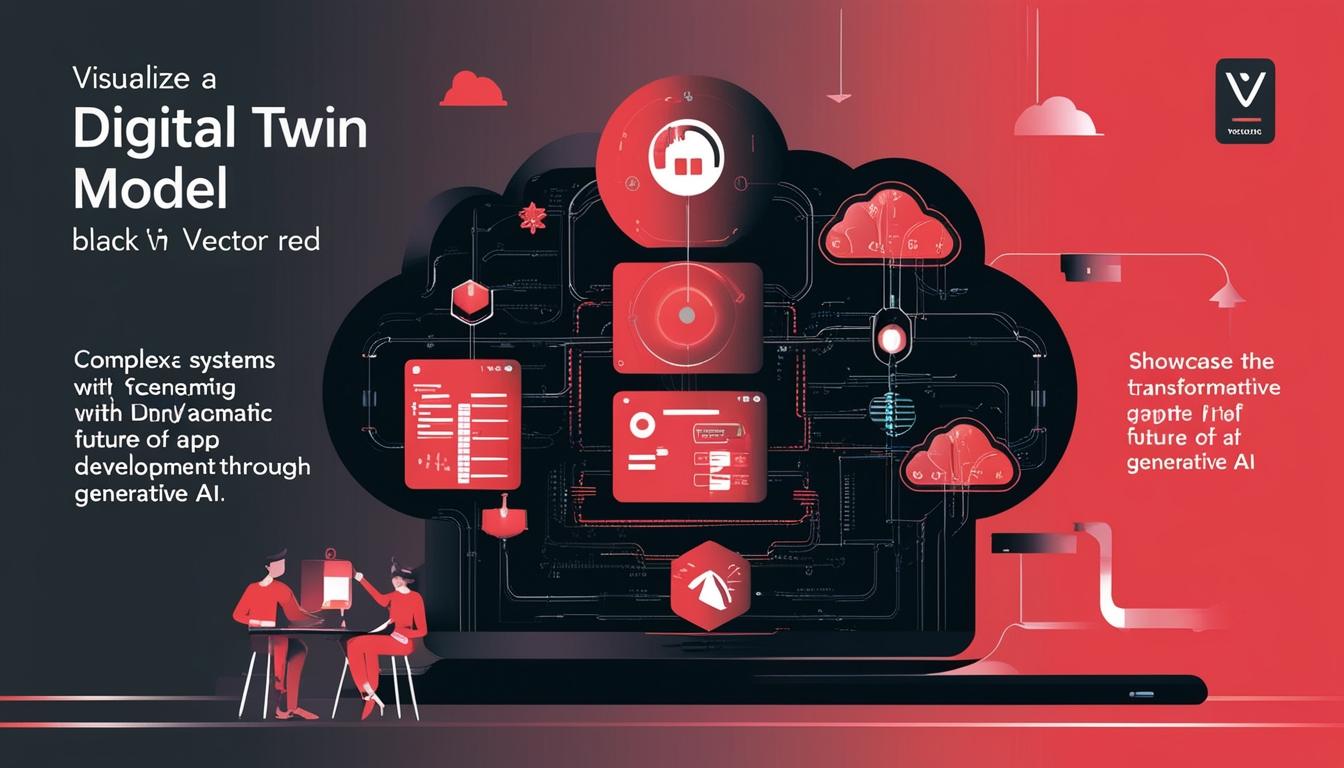
In a significant prediction for the future of app development, Dr. William Bain, the CEO and founder of ScaleOut Software, has articulated the transformative potential of digital twins and generative AI by the year 2025. With a career spanning over 40 years in parallel computing, Dr. Bain anticipates that these technologies will revolutionize the way applications are developed and managed, particularly in terms of delivering real-time insights and enhancing operational workflows.
Speaking to App Developer Magazine, Dr. Bain explained that digital twins are software models designed to represent and manage intricate live systems. These virtual counterparts will provide dynamic, data-rich analytics that allow developers to monitor and optimise operations in sectors such as aviation, cybersecurity, power distribution, and urban management. The convergence of digital twins with generative AI, he states, will enhance the capabilities of applications by enabling not only the handling of complex operations but also increasing situational awareness.
The integration of these technologies will bring forth substantial advancements in user interaction and decision-making processes. Digital twins will allow for continuous data processing from various sources within a complex system, facilitating the development of applications that provide actionable intelligence. For example, a digital twin app designed for retail management could consistently oversee inventory levels and supply chain dynamics. When paired with generative AI, the application could forecast stock shortages, suggest pre-emptive restocking actions, and effectively alert managers to emerging sales patterns.
Further emphasising the benefits of generative AI in app development, Dr. Bain discussed its potential to simplify the coding process. AI-driven tools are expected to automate routine tasks and optimise designs, thereby enabling developers to focus on higher-level strategic considerations rather than mundane technicalities. An illustrative example provided was an energy management application for urban power grids, which could utilise digital twins to monitor power consumption and automatically devise algorithms for energy distribution.
Another crucial aspect highlighted by Dr. Bain is the challenge of addressing generative AI errors, including issues of hallucination and data bias. These discrepancies can impair the reliability of AI-driven decision-making, especially in critical applications like flight scheduling. To counteract this, digital twins can offer real-time, accurate data to AI models. This method, known as Retrieval-Augmented Generation (RAG), allows AI systems to query live data, thereby reducing inaccuracies and increasing trust in AI outputs.
Looking ahead to 2025, it is anticipated that the application of digital twins alongside generative AI will set a new standard in app development. Developers utilising these innovations will not only improve immediate situational insights but also create adaptive systems capable of responsive operation within increasingly complex environments. From streamlining transportation logistics to managing smart city infrastructures, the pair's potential applications appear boundless.
Dr. Bain's predictions point to a significant evolution in business practices as organisations begin to embrace these technologies, which are set to become pivotal in the future landscape of app development. With advancements in operational intelligence and real-time analytics on the horizon, the industry stands poised for a transformative shift in how live systems are monitored and managed.
Source: Noah Wire Services