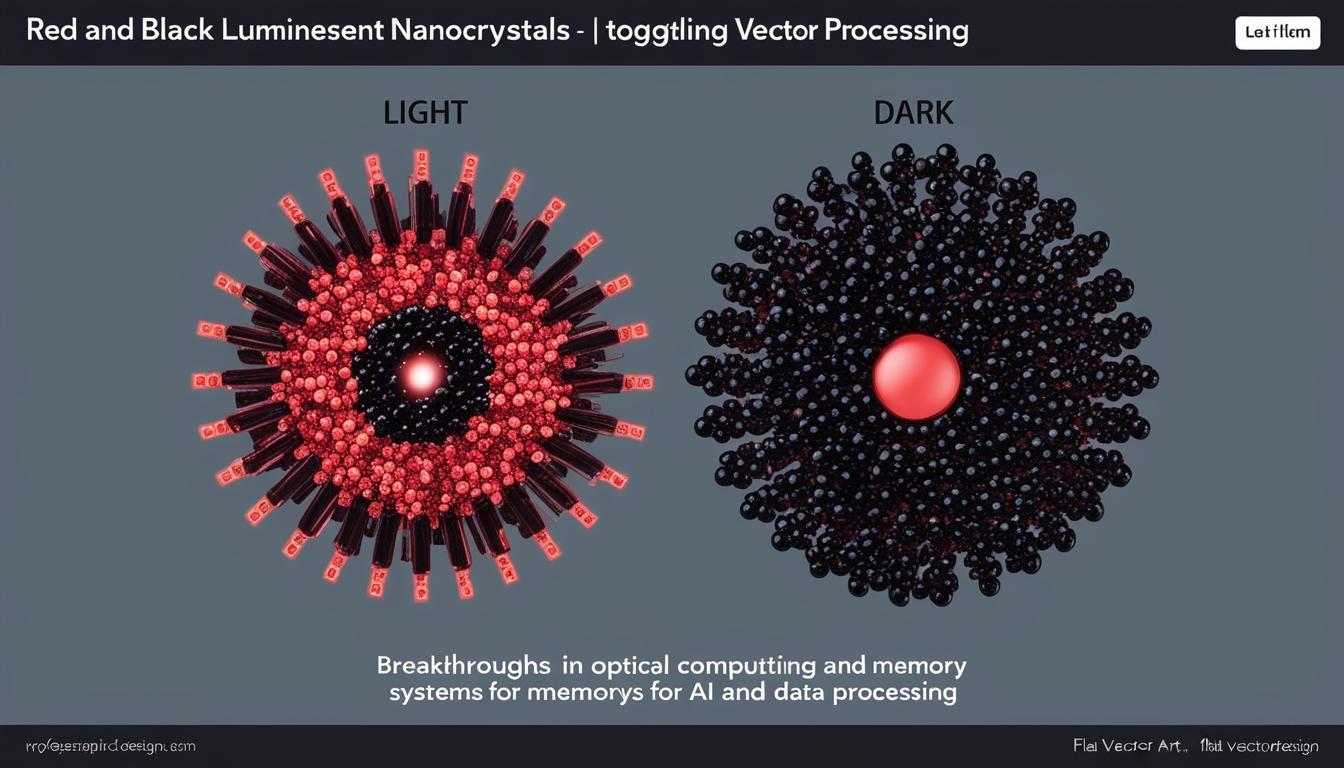
Researchers from various institutions, including those from Oregon State University (OSU) and Lawrence Berkeley National Laboratory, have made significant strides towards the development of next-generation optical computing and memory systems, as reported by ScienceDaily. Their breakthrough involves the discovery of luminescent nanocrystals that can be rapidly toggled between light and dark states, which could pave the way for faster information processing and storage using light.
Artiom Skripka, an assistant professor in the OSU College of Science and a key contributor to the study published in Nature Photonics, highlighted the potential implications of these findings for artificial intelligence and various information technologies. "The extraordinary switching and memory capabilities of these nanocrystals may one day become integral to optical computing," Skripka noted. Optical computing relies on the use of light particles, which are capable of travelling at speeds surpassing any known physical entities.
The study focused on a specific type of material known as avalanching nanoparticles, which showcases extreme non-linearity in their light-emission properties. These nanocrystals are composed of potassium, chlorine, and lead, along with neodymium, which is used to enhance their capacity to efficiently manage light signals. While potassium lead chloride typically does not interact with light, it acts as an effective host that enables neodymium ions to perform optimum functions for optoelectronic applications.
Skripka further elaborated on the unique capabilities of these nanocrystals, stating, "Under certain conditions, they show a peculiar behavior: They can be either bright or dark under exactly the same laser excitation wavelength and power," a phenomenon described as intrinsic optical bistability. Essentially, this means that after an initial surge of energy to start the emission process, the crystals can continue to emit light at much lower energy levels, akin to riding a bicycle where initial effort is needed to gain momentum, but less exertion is required thereafter.
The research aligns with global initiatives aimed at reducing energy consumption in the face of escalating demands from artificial intelligence, data centres, and electronic devices. AI systems typically necessitate immense computational power, which often encounters limitations imposed by current hardware capabilities. Skripka indicated that the integration of photonic materials, especially those exhibiting intrinsic optical bistability, could yield faster and more efficient data processors, thus enhancing machine learning algorithms and data analytics.
Potential application areas for this technology span telecommunications, medical imaging, environmental monitoring, and the development of optical and quantum computers. Nevertheless, Skripka cautioned that while these findings are promising, further research is essential to overcome challenges related to scalability and the integration of these nanocrystals with existing technologies before they can be deployed in practical applications.
This research initiative received support from notable organisations including the U.S. Department of Energy, the National Science Foundation, and the Defence Advanced Research Projects Agency (DARPA), with leadership provided by Bruce Cohen and Emory Chan of Lawrence Berkeley, alongside P. James Schuck from Columbia University, and Daniel Jaque from the Autonomous University of Madrid.
Source: Noah Wire Services