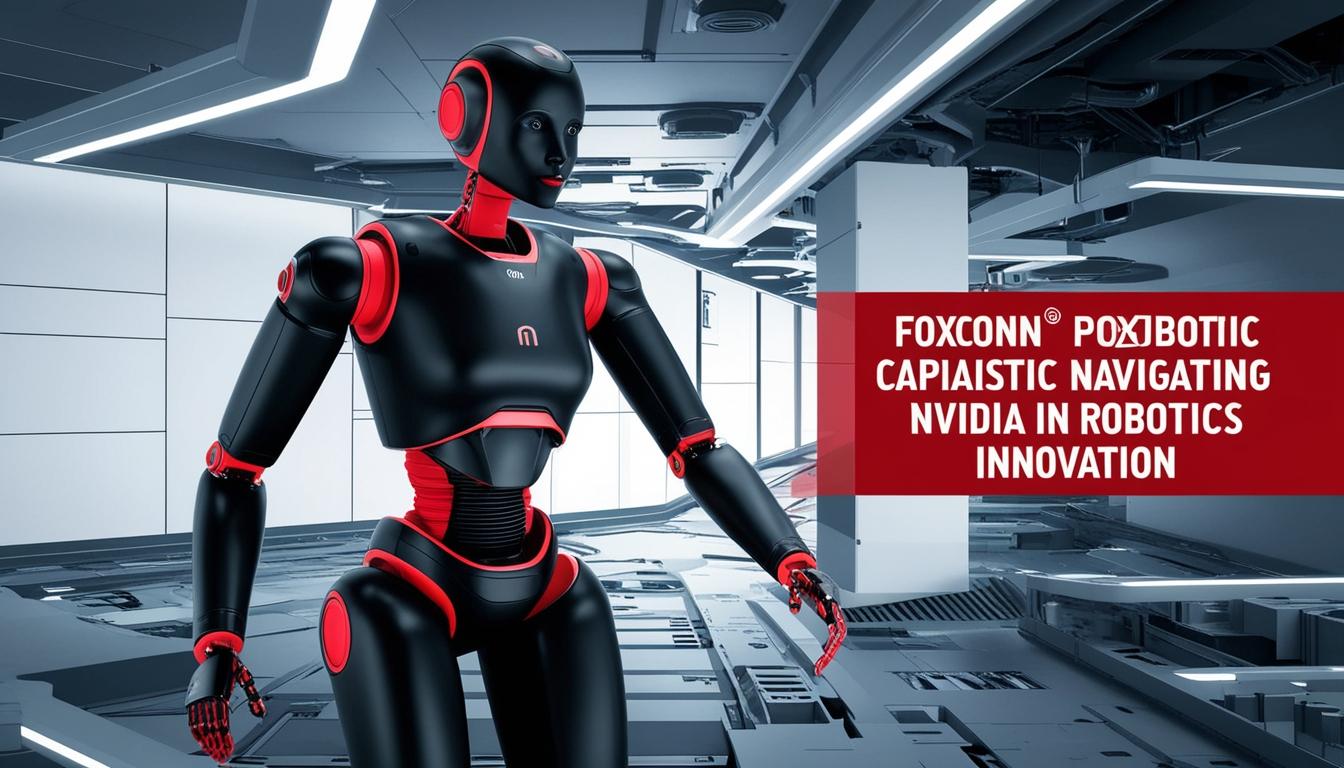
In a landmark collaboration expected to reshape the robotics industry, Hon Hai Precision Industry Co., Ltd., better known as Foxconn, has announced a strategic partnership with Nvidia, the world's leading computer chip manufacturer. The deal aims to develop advanced humanoid robots capable of executing complex tasks across various sectors. The news surfaced from a Taiwanese media outlet following remarks made by Foxconn’s chairman, Young Liu.
Headquartered in Taiwan, Foxconn is globally recognised as the largest contract electronics manufacturer, particularly for its role in assembling Apple’s iPhones. The company has pioneered the automation of its production lines, leveraging an extensive fleet of robots—referred to as “Foxbots”—to enhance operational efficiency and precision in manufacturing processes. This established expertise places Foxconn in a strong position to become a significant player in the burgeoning humanoid robotics market.
The partnership is primarily centred on Nvidia's upcoming Jetson Thor computing system, which is set to launch in the first half of 2025. Jetson Thor represents a next-generation compact computer specifically designed for humanoid applications, built upon Nvidia’s advanced Blackwell architecture. This architecture, boasting 208 billion transistors, includes an integrated functional safety processor, a high-performance CPU cluster, and 100Gb of Ethernet bandwidth, thereby facilitating the processing of complex AI models essential for advanced robotic operations.
The capabilities embedded in Jetson Thor are anticipated to allow humanoid robots to process data in real-time, empowering them to engage in sophisticated behaviours such as autonomous navigation, object manipulation, and human-robot interaction. Developers integrating this technology into their designs will potentially create robots adept at operating in dynamic environments, reflecting a significant evolution in robotics capabilities.
Additionally, the evolution of humanoid robots is being propelled by the emergence of large-scale datasets and advanced computing models. Robotics & Automation News recently reported the launch of notable systems contributing to this trend. For instance, AgiBot has introduced what it claims to be the world's largest humanoid manipulation dataset, encompassing over one million trajectories from across 100 robots in various real-world scenarios. Similarly, Robot Era unveiled ERA-42, a comprehensive computing model that, paired with its proprietary five-finger dexterous hand, allows robots to undertake over 100 intricate tasks.
Moreover, a collaboration between Apptronik and Google DeepMind aims to fuse advanced AI with state-of-the-art hardware to develop intelligent and versatile humanoid robots that can adapt to different environments with safety and efficiency.
The amalgamation of sophisticated hardware, extensive datasets, and advanced AI models is spearheading the field of humanoid robotics toward unprecedented capabilities. Humanoid robots outfitted with powerful computing platforms like Jetson Thor and trained on diverse datasets are poised to perform complex functions across numerous industries, including manufacturing, healthcare, and service sectors.
This development signifies a transition towards "embodied AI," where intelligence is seamlessly integrated within a physical form, enabling robots to interact with their surroundings in more human-like manners. The datasets and models curated for humanoid robots are vital for fostering such embodied intelligence, offering the framework necessary for robots to learn and exhibit behaviours akin to human actions.
The collaboration between Foxconn and Nvidia highlights the joint efforts that underpin this transformation in robotics, merging manufacturing dexterity with cutting-edge AI innovation to spearhead the future of humanoid robotics.
Source: Noah Wire Services