Mercedes-Benz has announced significant updates to its conditionally automated driving system, Drive Pilot, marking a notable development in the realm of automotive technology. As reported by Robotics & Automation News, the updated Drive Pilot has received official approval from the German Federal Motor Transport Authority (KBA). This certification positions Drive Pilot as the fastest certified system for conditionally automated driving (SAE Level 3) available in a standard production vehicle. The company plans to launch the updated system in early 2025 across Germany.
Drive Pilot will be available as an optional feature on two of Mercedes-Benz's luxury saloon ranges, the S-Class and EQS. The price for activating Drive Pilot remains consistent at 5,950 euros (approximately $5,135), and customers who have already purchased vehicles equipped with Drive Pilot will receive the update at no additional cost, either as an Over-the-Air update or through a workshop visit, without the need for any physical component changes.
Markus Schäfer, the chief technology officer for Mercedes-Benz, emphasised the value proposition for customers, stating, "With innovative technologies from Mercedes‑Benz, we always want to offer our customers added value... When Drive Pilot is activated, it is possible to concentrate on other things while the car takes over the driving task." He expressed pride in the achievement, noting the system’s capability to operate under certain conditions at speeds of up to 95 km/h on Germany’s extensive 13,191 km-long Autobahn network.
The advanced functionality of Drive Pilot allows drivers the opportunity to engage in activities such as watching TV, reading, or working while the vehicle navigates. However, Mercedes-Benz has prioritized safety in the development of Drive Pilot. The system's architecture includes redundancies for essential functions like steering and braking, ensuring the driver can regain control of the vehicle if required. In scenarios where the driver does not respond to prompts, the system is designed to bring the vehicle to a controlled stop while activating hazard warning lights.
Incorporating over 35 sensors including cameras, radars, ultrasonic sensors, and LiDAR technology, Drive Pilot is engineered for precise real-time environmental detection. Mercedes-Benz highlights the significance of LiDAR in achieving safe automated driving, which, alongside a detailed digital map and an advanced positioning system, ensures the vehicle accurately understands its lane placement with centimetre-level precision.
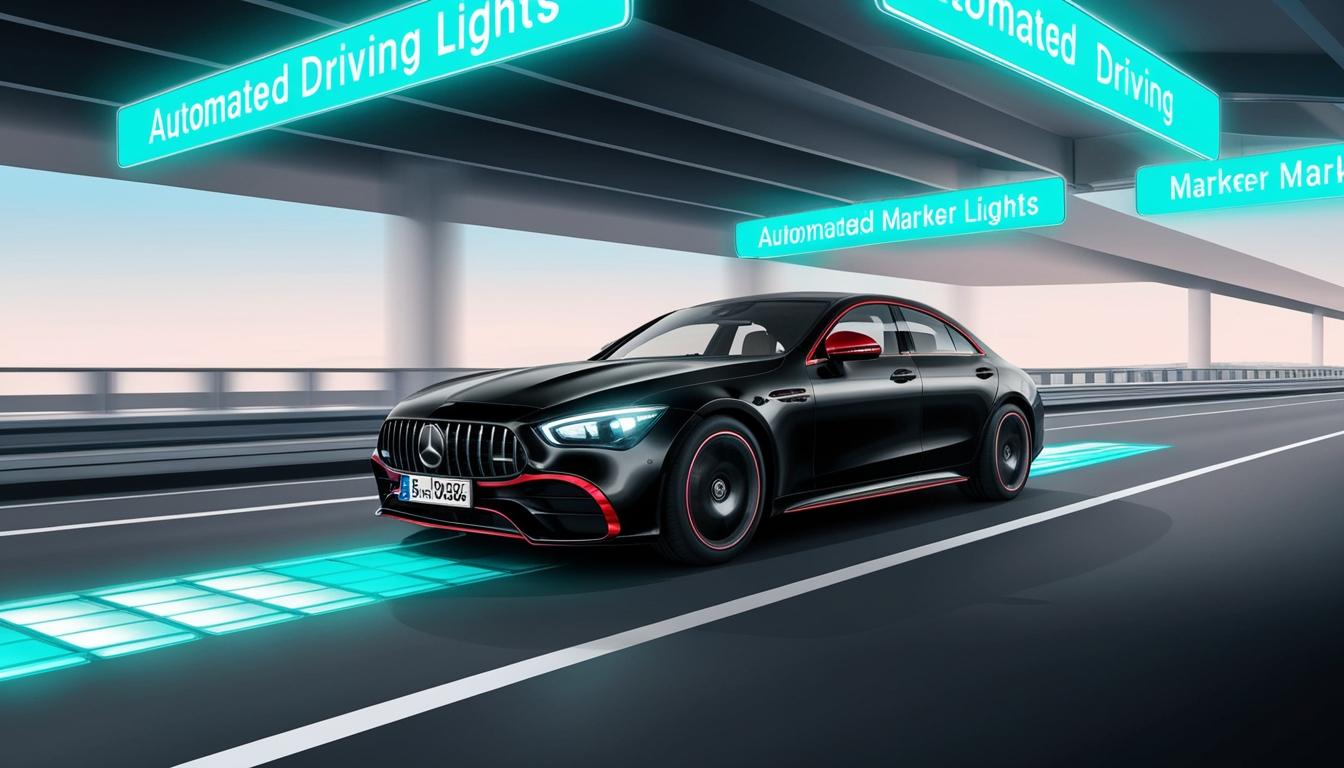
Looking to the future, Mercedes-Benz aims for higher speeds and longer periods of automated driving, aspiring to permit conditionally automated driving at the legal maximum speed of 130 km/h in Germany by the end of the decade. The company is also pioneering the introduction of distinctive turquoise lights that will signal the activation of Drive Pilot to other road users. Although these "Automated Driving Marker Lights" are not yet approved in Germany, initial testing in the US has shown positive feedback, with California and Nevada providing regulatory approval for trial use.
Mercedes-Benz's developments indicate a progressive movement towards widespread acceptance of automated driving technologies, with continued enhancements aimed at ensuring both comfort and safety for customers as well as other road users.
Source: Noah Wire Services