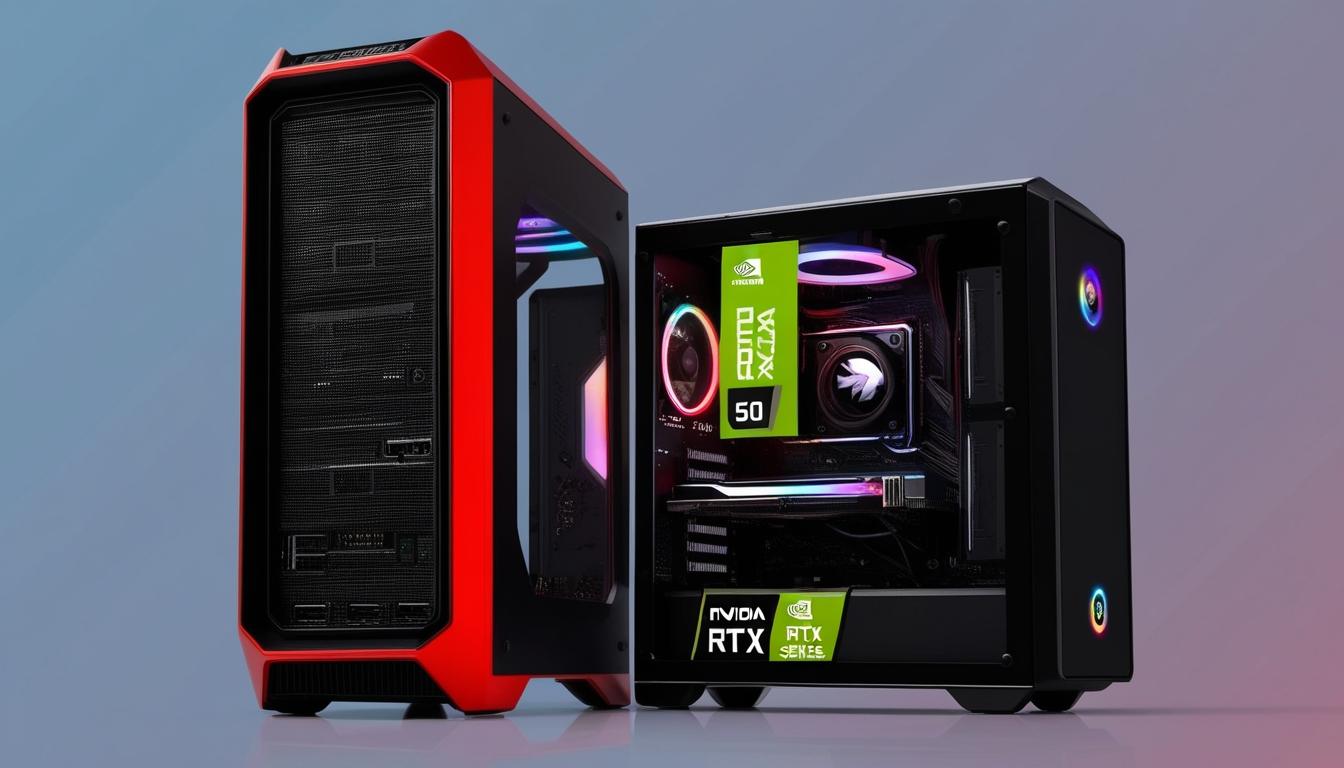
During the Consumer Electronics Show (CES) 2025, NVIDIA made significant announcements aimed at enhancing AI capabilities for businesses and developers. The company has introduced new foundation models running locally on NVIDIA RTX™ AI PCs, designed to improve productivity and foster creativity in digital content development. These foundation models, branded as NVIDIA NIM™ microservices, leverage the newly released GeForce RTX™ 50 Series GPUs, which boast impressive performance metrics, including the ability to execute up to 3,352 trillion operations per second and feature 32GB of VRAM.
The RTX 50 Series GPUs are foundational to a transformative AI experience, designed to run area-specific generative AI models locally on desktops, which previously were constrained to large data centres. Jensen Huang, founder and CEO of NVIDIA, highlighted the rapid advancement of AI, stating, “AI is advancing at light speed, from perception AI to generative AI and now agentic AI. NIM microservices and AI Blueprints give PC developers and enthusiasts the building blocks to explore the magic of AI.”
This introduction is complemented by the release of various low-code and no-code tools, such as AnythingLLM, ComfyUI, Langflow, and LM Studio, which enable non-experts to leverage AI models and construct complex workflows through user-friendly graphical interfaces. Furthermore, NVIDIA AI Blueprints provide predefined reference workflows for tasks that include content creation and developing digital human interfaces.
To support this surge in AI innovation, numerous leading PC manufacturers—including Acer, ASUS, Dell, and HP—are expected to roll out NIM-ready RTX AI PCs powered by the new GPUs. As various sectors seek to integrate AI into their operations, the NIM microservices are set to offer a diverse array of functionalities and use cases, from language processing to computer vision.
In a parallel announcement, NVIDIA also introduced Project Digits, characterised as a personal AI supercomputer. This system features the NVIDIA GB10 Grace Blackwell Superchip, which delivers a petaflop of AI computing performance. Project Digits aims to democratise access to powerful AI resources for researchers, data scientists, and students globally. Users will have the capability to develop and run large AI models as part of their desktop systems, allowing for a seamless deployment transition from local environments to cloud infrastructures.
Ahmad Al-Dahle, Head of GenAI at Meta, emphasised NVIDIA’s commitment by stating, “By making Llama models open source, we’re committed to democratising access to cutting-edge AI technology. With Project Digits, developers can harness the power of Llama locally." Meanwhile, Silvio Savarese, Chief Scientist at Salesforce, commented on the significance of the system, noting, "Advancing AI requires tools that empower researchers to experiment at scale, speed and precision.”
Project Digits will be available from May 2025 with a starting price of $3,000, aiming to provide researchers and developers with expansive capabilities to prototype and fine-tune AI models efficiently. This offering expands the potential for AI-driven applications, as users can run extensive large language models on a personal workstation, facilitating innovation in various applications across different sectors.
With the essential support of NIM microservices and the robust power of the Project Digits system, NVIDIA is poised to further drive AI advancements in individual and enterprise environments, clearly marking a significant trend in AI automation for businesses and technological development. As industries continue to evolve with advanced AI integration, both offerings from NVIDIA are expected to be pivotal in reshaping business practices and fostering creative solutions.
Source: Noah Wire Services