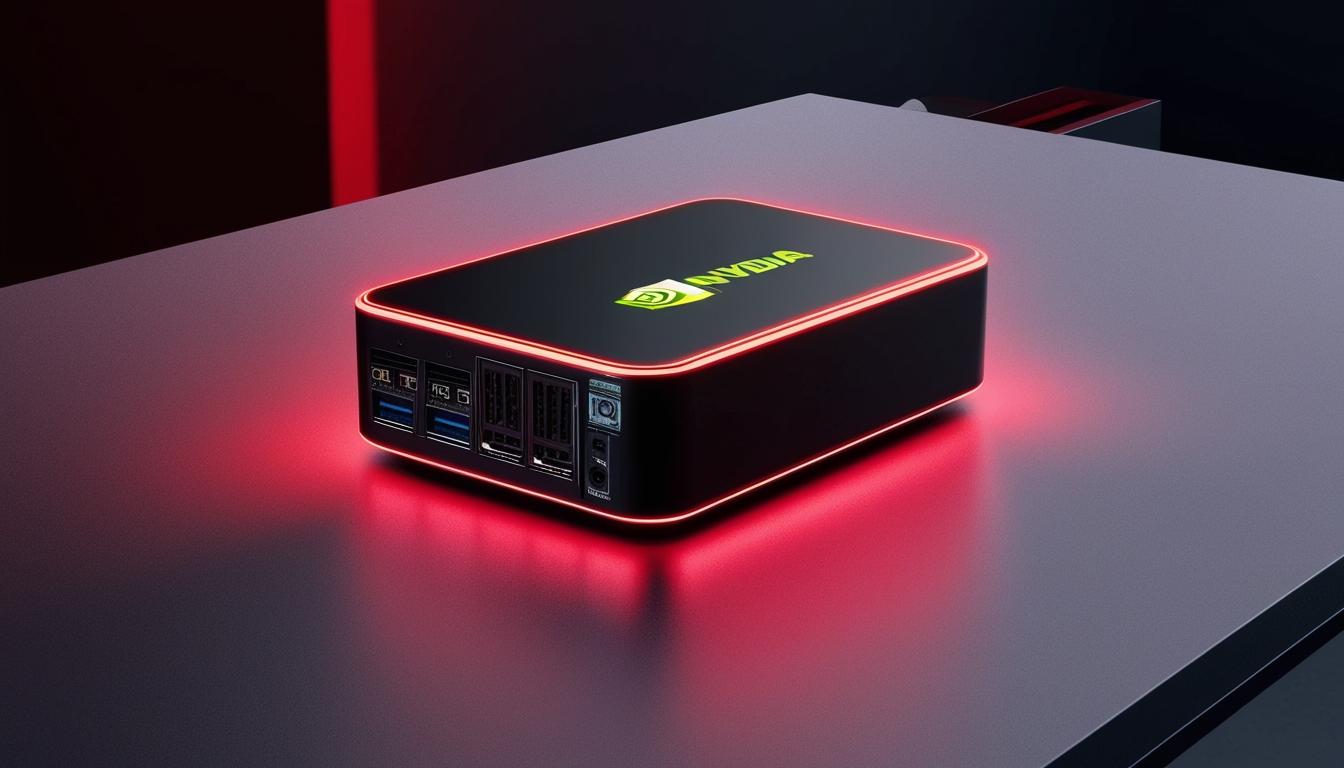
At the CES 2025 event held in Las Vegas, Nvidia's CEO Jensen Huang announced an innovative development in computing with the unveiling of "Project Digits," a compact mini PC designed to provide remarkable processing power that could reshape how researchers and developers approach artificial intelligence (AI) tasks. This device offers a petaFLOP of processing capability, a significant leap forward that is approximately 1,000 times more powerful than a conventional laptop, yet not quite on par with the most advanced supercomputers in operation.
Project Digits is poised to serve a variety of users, including developers, students, data scientists, and researchers, particularly in fields related to AI, such as robotics and computer vision. The design of the product is not finalised, but its compact size allows for easy portability, enabling it to fit comfortably on a desk or even inside a bag.
This groundbreaking mini PC is equipped with an Nvidia GB10 Grace Blackwell Superchip, which integrates a graphics card and processor into a single unit. The superchip includes an Nvidia Blackwell graphics card paired with an Nvidia Grace processor, complemented by 128 gigabytes of memory and 4 terabytes of SSD storage. This architecture not only enhances performance but also streamlines data transfer between components, making it significantly more efficient.
Raquel Urtasun, a professor of computer science at the University of Toronto and the founder of Waabi, a company specialising in self-driving trucks, shared her excitement regarding Project Digits. In a statement, she highlighted that "NVIDIA's Project DIGITS enables researchers in robotics, computer vision and autonomous systems to experiment, fine-tune and scale solutions faster than ever — all while fitting on your desk." Urtasun's sentiments underscore the potential impact of the device on the development of autonomous technologies and data-heavy projects.
Supercomputing capabilities are typically measured in floating point operations per second (FLOPS), with leading supercomputers delivering over 1,000 petaFLOPS, equating to a quintillion operations per second. In comparison, Project Digits delivers 1 petaFLOP, making it not as powerful as top-tier supercomputers, but significantly more capable than standard desktop PCs and laptops.
The device holds particular promise for AI applications. For instance, it is engineered to handle large language models, such as generative AI tools similar to ChatGPT. These models can operate with up to 200 billion parameters, with the possibility of connecting two Project Digits devices to scale up to 405 billion parameters. To put this in context, GPT-3.5, which powered the initial version of ChatGPT, managed approximately 175 billion parameters when it launched in November 2022.
The introduction of Project Digits signals a notable advancement in making powerful computing resources more accessible to a wider audience, and it is expected that its deployment will foster further innovation in both research and commercial applications of AI across various industries.
Source: Noah Wire Services