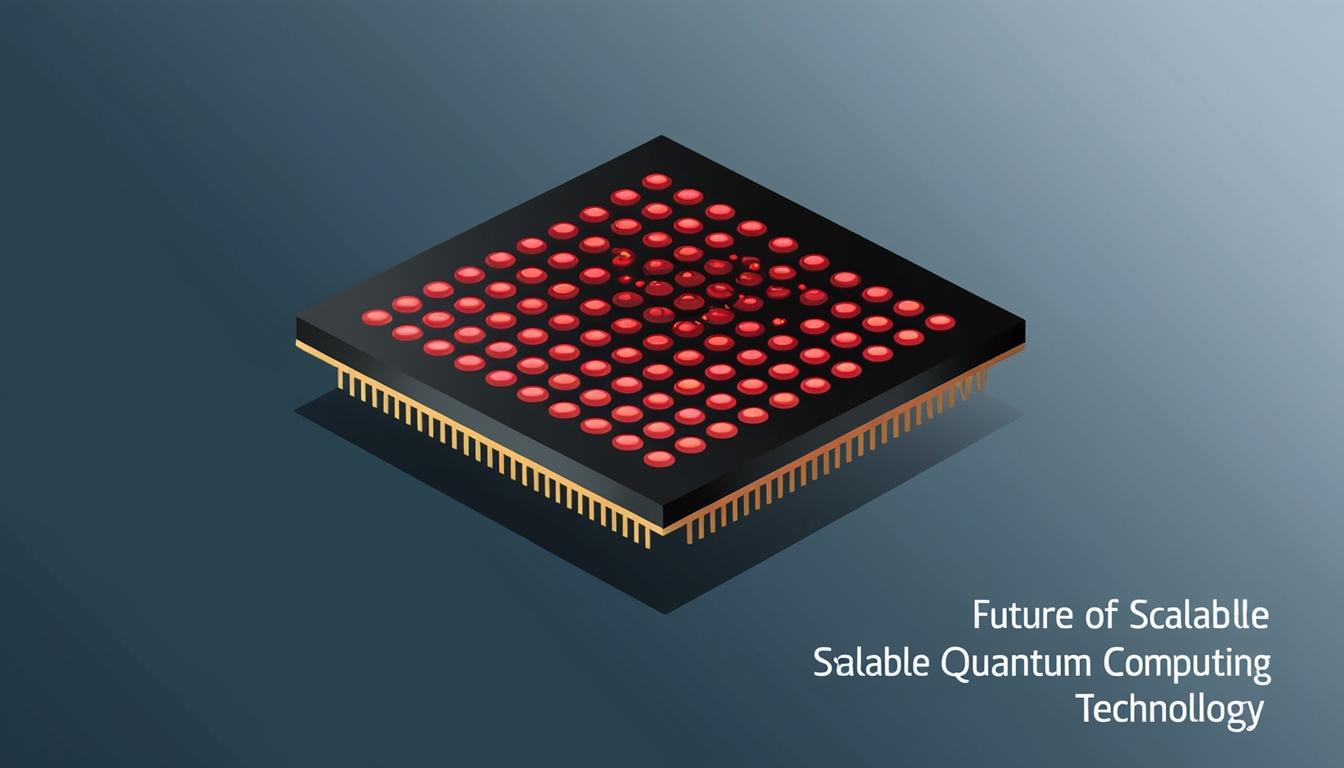
Quantum Motion (QM), a UK-based quantum computing scale-up formed by academics from University College London (UCL) and Oxford University, has recently achieved a significant milestone in the field of quantum device characterisation. The company has demonstrated the rapid and large-scale characterisation of quantum devices produced using commercial semiconductor processes. This breakthrough is particularly noteworthy given the increasing interest and investment in quantum computing technologies.
The innovative design by QM features an integrated circuit (IC) comprising an array of 1024 quantum dots, all functioning within an area smaller than 0.1mm². This characterisation process was completed in under five minutes, marking an impressive advancement as it is at least 100 times faster than current state-of-the-art methodologies. Such efficiency could greatly enhance the development of quantum processors and the scalability of quantum computing.
QM has collaborated with GlobalFoundries (GloFo), a leader in semiconductor manufacturing, to produce these chips. This partnership aims to develop quantum processors built on a scalable silicon platform, indicating a strategic move towards integrating quantum computing technologies with established manufacturing techniques. QM's chips were fabricated using GloFo's 300mm 22nm fully-depleted silicon-on-insulator (FD-SOI) process, which allows for edge processing and operates effectively at cryogenic temperatures of 1K and below.
CEO of Quantum Motion, James Palles-Dimmock, highlighted the significance of this partnership, stating, “Our work with GlobalFoundries has enabled us to demonstrate that scalable manufacturing techniques are compatible with the stringent demands of quantum computing. This achievement shows that silicon-based quantum chips can be fabricated using established semiconductor processes, bridging the gap between quantum research and industrial-scale production.”
Furthermore, the advantages of the back gate bias capability provided by GloFo’s FD-SOI technology facilitate cryogenic tuning and improved control. This feature positions QM’s silicon-based solutions as potentially superior to bulk silicon alternatives in terms of readout and control operations.
Ted Letavic, Senior Vice President of GlobalFoundries, expressed optimism regarding the partnership, stating, “We look forward to continuing our partnership with Quantum Motion to support their vision of a scalable monolithic quantum processor.”
As the field of quantum computing evolves, transitioning from small quantum processors to more extensive, practical quantum computers necessitates innovative approaches. One of these challenges is the capacity to measure each qubit in a large array without requiring an excessive number of input/output connections to the chip—much like conventional CPUs that manage billions of transistors with just a few hundred input/output interfaces.
The results achieved by Quantum Motion affirm that silicon-based quantum chips are not only compatible with commercial semiconductor manufacturing processes, but they also help address critical challenges involved in scaling quantum computing operations. By integrating qubits and control electronics on the same chip, QM continues to make significant strides towards the creation of viable, large-scale quantum processors, contributing to the wider advancements in the technology sector.
Source: Noah Wire Services