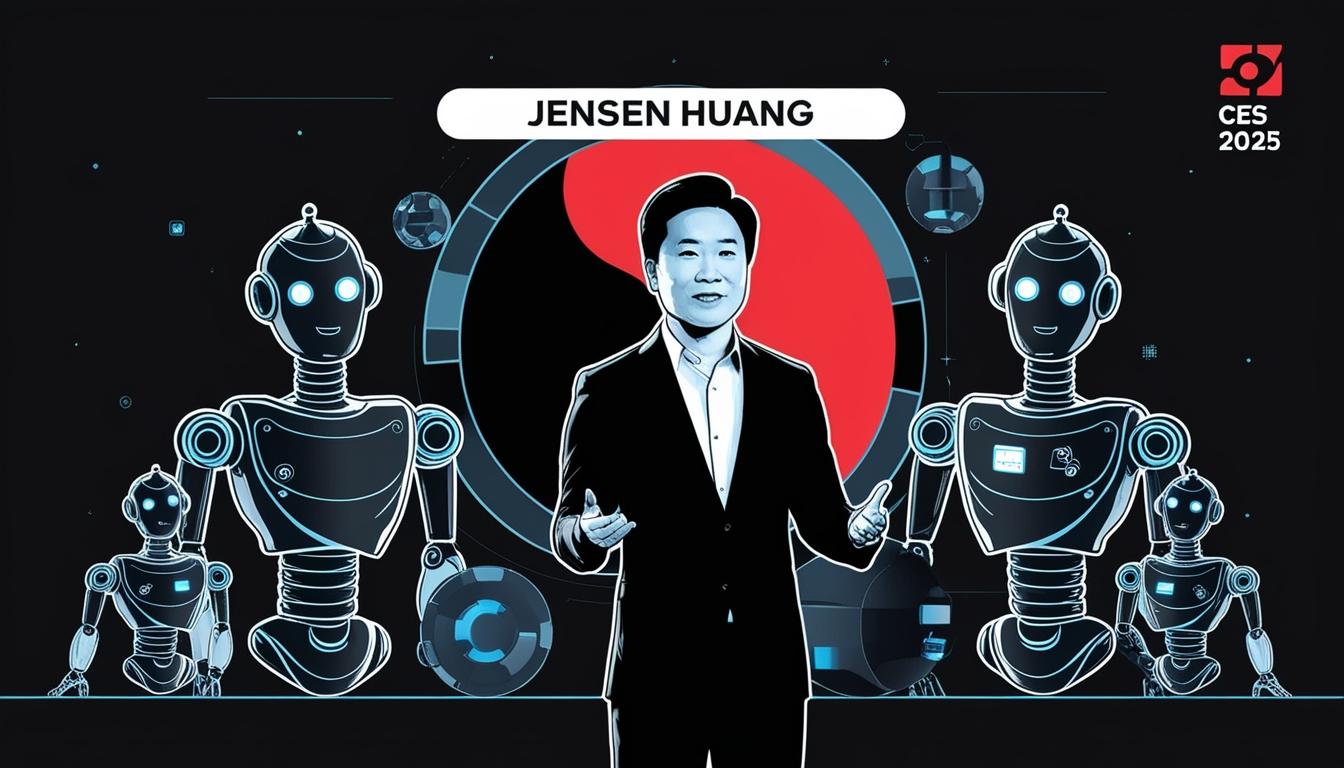
During an engaging keynote at CES 2025 on January 8, NVIDIA CEO Jensen Huang unveiled the company’s latest AI initiative, the "Cosmos" platform, signalling a significant advancement in robotics and autonomous systems. The announcement was made ahead of the main event opening, attracting considerable interest and resulting in thousands of attendees queuing for up to two hours to secure a seat, with the Mandalay Bay Convention Center reaching its full capacity of 12,000 attendees.
Addressing the crowd, Huang drew parallels between the rapid advancements in generative AI technologies, such as ChatGPT, and the expected convergence of AI with robotics. He stated that the developments anticipated from Cosmos could transform the landscape of robotics, enabling more efficient training processes driven by real-world data. “Our goal is to democratize robotics AI so that developers can engage with general robotics systems effortlessly,” Huang noted. The launch of Cosmos is aimed at significantly reducing the time and cost associated with training autonomous systems, making it accessible to a broader range of developers.
In a subsequent Q&A session, Huang elaborated on his optimistic outlook regarding superintelligent AI systems, asserting that these innovations will ultimately benefit humanity. He maintained that intelligent robots would be developed to work alongside humans, saying, “With the humans, because we're going to build them that way.” His confidence reflects NVIDIA's current position as one of the top contenders in the world’s AI semiconductor market, vying with industry giants like Apple and Microsoft.
Huang emphasized the practical implications of AI, stating, “That’s the future, you’re going to have superintelligent AI that will let you write, analyze problems, deal with supply chain planning, write software, design chips.” In his view, the machines themselves are neutral, with any potential harm deriving from human misuse rather than the technology itself.
Furthermore, Huang's vision includes the integration of NVIDIA's Omniverse technology, which allows for 3D visualisation, and the capabilities of Cosmos for producing photorealistic environments to enhance AI training. This approach could pave the way for advancements in the functionality of robots, potentially shifting the paradigm towards more capable autonomous systems.
As CES 2025 continues in Las Vegas, the technology community is keenly watching NVIDIA's developments in AI and robotics, which could signify the onset of a new era marked by enhanced collaboration between humans and intelligent machines.
Source: Noah Wire Services