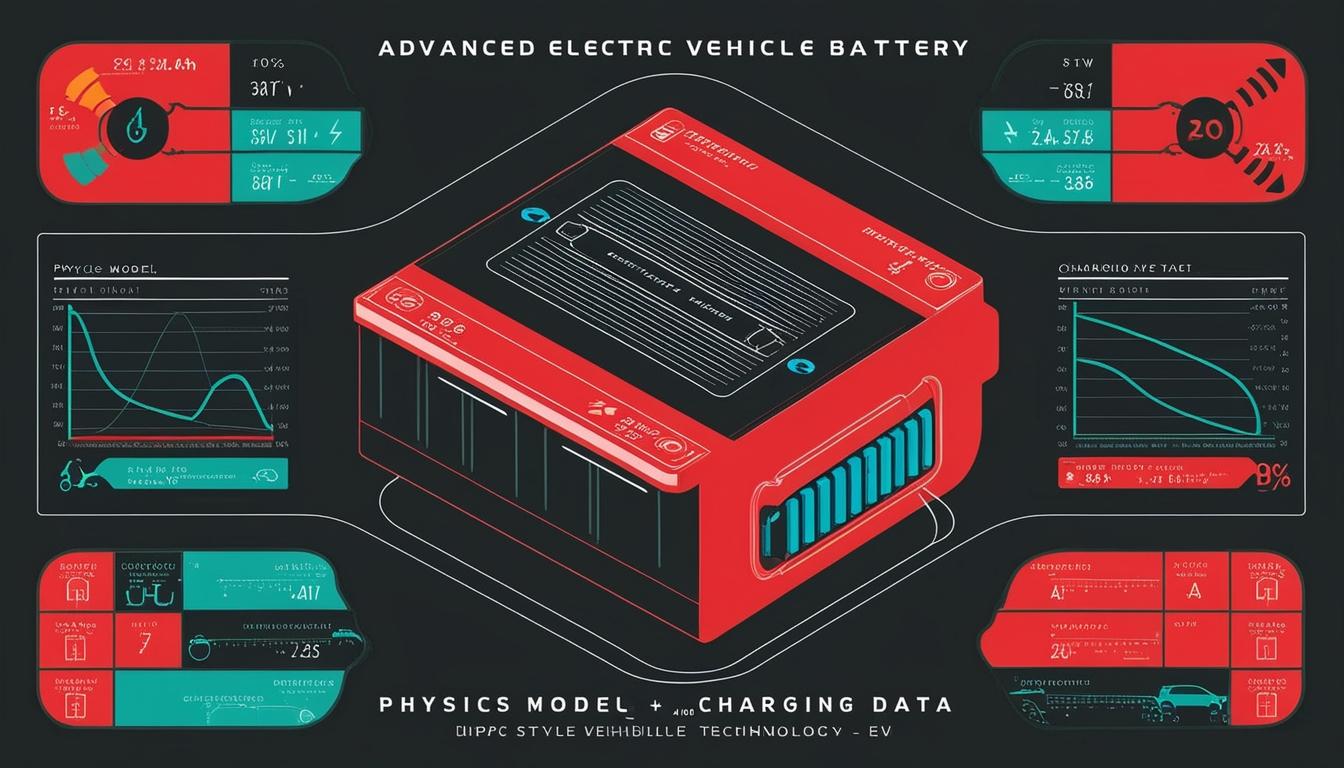
In the ever-evolving landscape of electric vehicles (EVs), advancements in battery technology continue to play a pivotal role in addressing consumer scepticism about battery life, range, and charging efficiency. Recent developments from Breathe Battery Technologies highlight the significance of physics-based models within the battery management systems, aimed at revolutionising the EV charging experience and boosting the sustainability of electromobility.
Dr Christian Korte, Head of Software and Engineering at Breathe Battery Technologies, underscored the contrast between the long-established internal combustion engine (ICE) and the relatively nascent development of lithium-ion batteries. While ICE technologies have benefitted from over a century of refinement, achieving levels of efficiency, performance, and durability, lithium-ion batteries still have a considerable way to go. Despite rapid advancements, Dr Korte pointed out that "the very best still have energy densities lower than that of gasoline or diesel fuels."
Central to improving battery performance is optimising the charging process, which is significantly more complex for EVs than for traditional combustion engine vehicles. Unlike petrol or diesel engines that remain unaffected by ambient temperatures during refuelling, battery performance can be heavily influenced by factors like temperature and state-of-charge levels. This introduces an additional layer of complexity for Original Equipment Manufacturers (OEMs) and battery suppliers, who are tasked with designing batteries and thermal management systems to ensure optimal performance across a range of conditions.
Currently, many EV battery management systems utilise a look-up table approach to control charging similar to legacy combustion engine control strategies. This method can lead to a disconnect between actual battery performance and its optimal potential. The limitations of look-up tables can lead to aggressive charging that accelerates battery degradation, reducing both performance and lifespan.
Breathe Battery Technologies, however, is pioneering an alternative method through the implementation of a patented physics-based model that informs their adaptive charging software. This innovative approach utilises data in real-time to better estimate the electrochemical states of the battery cells. Dr Korte emphasised that "this active, intelligent approach mitigates harmful processes such as lithium plating and brings battery degradation under control because the charging process is always adapting to state-of-health."
The benefits of this technology are twofold. For consumers, it promises a more consistent and reliable charging experience, leading to decreased loss of range as batteries age. This is particularly relevant as the automotive industry seeks to convert sceptical consumers who traditionally rely on combustion engine vehicles. For manufacturers, the longevity afforded by this technology can translate to reduced warranty costs while enhancing the residual values of EVs — an increasingly important consideration with upcoming regulations, particularly in the EU, mandating transparent reporting of battery state-of-health.
Collaborative efforts between Breathe Battery Technologies and Volvo Cars have yielded significant results, with charging times reduced by up to 30% when moving from a 10% to an 80% charge without compromising energy density or vehicle range. This innovation not only increases the efficiency of the charging experience but also maintains rapid charging speed throughout the battery's lifetime.
The introduction of physics-based models marks a significant shift in battery management strategies, particularly as competition heats up among OEMs looking to optimise their EV offerings. While many are focusing predominantly on state-of-charge and state-of-health estimations, Breathe's emphasis on active modelling and control stands out, promising immediate applicability within existing systems.
In light of the fact that batteries constitute the most significant cost component of any EV, extracting maximum value from them before they reach the end of their operational capacity is crucial. As the industry seeks sustainable practices in mineral use and resource conservation, Breathe Battery Technologies' advancements in battery management highlight a key pathway toward achieving greater viability, durability, and consumer acceptance in the electric vehicle market.
Source: Noah Wire Services