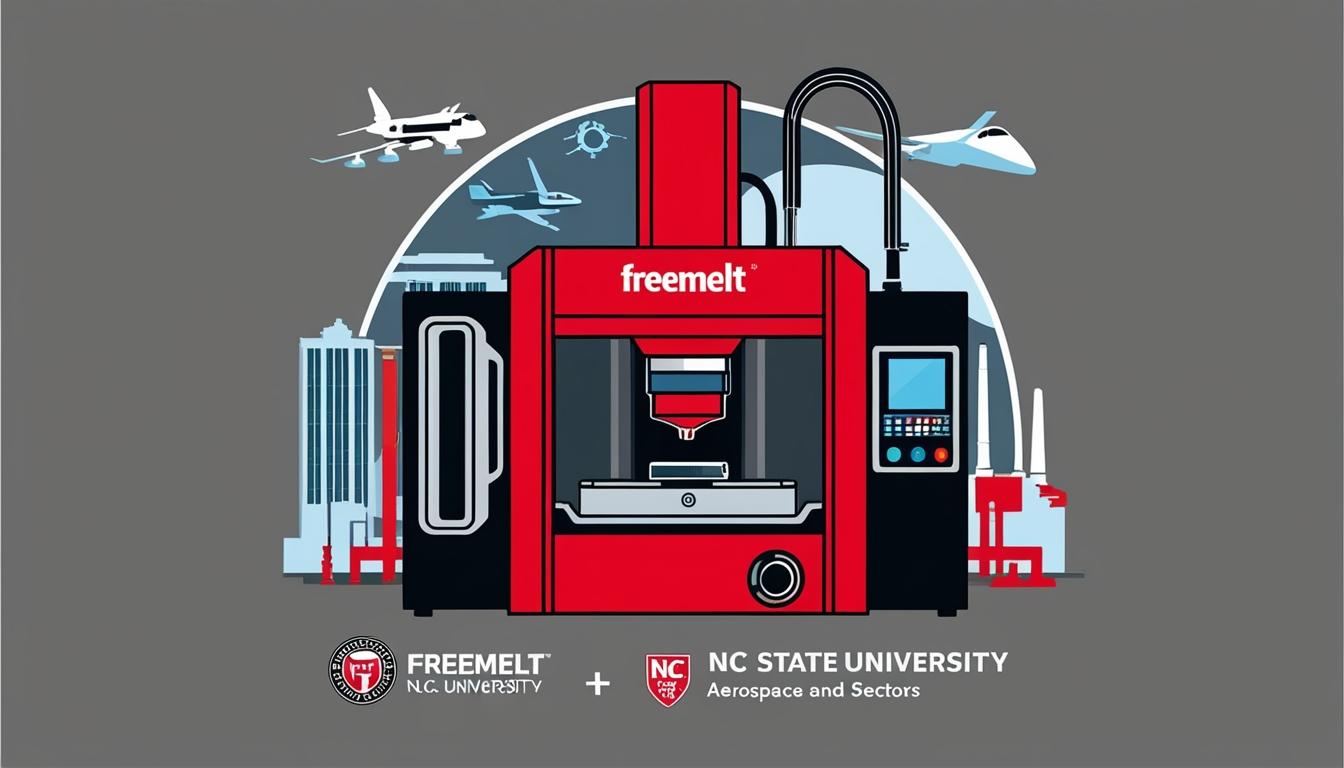
Freemelt, a Swedish original equipment manufacturer (OEM) specializing in electron beam powder bed fusion (E-PBF) additive manufacturing (AM) technology, has officially announced a collaboration with North Carolina State University (NCSU) to establish an Application Center. This initiative will be based at the university's Centre for Additive Manufacturing and Logistics (CAMAL), an entity designed to foster collaboration on advanced manufacturing between academia, government, and industry.
The impetus for this partnership was initiated due to a recent order for a feasibility study from an unnamed customer of Freemelt, which was first disclosed in October 2024. This customer is reportedly looking to advance the development of new metal alloys capable of withstanding high-temperature conditions, a need particularly pertinent to strategic sectors such as aerospace, defence, and energy.
The newly formed Application Center will provide future clients with access to CAMAL's Freemelt ONE machine dedicated to research and development. This strategic move aligns with Freemelt's ongoing efforts to broaden its footprint in the United States. The company, which was founded in 2017 and went public on Nasdaq First North in 2021, identified this venture as key to its growth strategy.
Daniel Gidlund, CEO of Freemelt, stated in a press release, “Partnering with NC State University, through its renowned CAMAL center, is a vital step in our US expansion. The Application Center will meet the growing demand for feasibility studies and proof-of-concept projects, helping companies transition to serial production and advancing our position in critical sectors such as defense, energy, and medical technology.” He further explained that “feasibility studies are the first critical step in realizing serial production through AM. They bridge the gap between concept and production, proving that AM is a viable, cost-effective, and scalable solution for serial production.”
Freemelt's emphasis on feasibility studies as essential for industrial application is particularly significant as they lay the groundwork for data-driven foundations necessary for mass production. These studies aim to mitigate risks associated with the transition to industrial production, thereby supporting Freemelt's move towards commercialisation in the competitive additive manufacturing landscape.
The collaboration between OEMs like Freemelt and academic institutions is emerging as an increasingly vital strategy to enable growth and scalability within the AM sector. This partnership model is not unique; for example, Australian cold spray OEM SPEE3D formed a similar alliance with the University of New Hampshire in June 2024, highlighting a trend among foreign companies seeking to penetrate the US market.
Looking ahead, European firms such as Freemelt are prioritising entry into the US manufacturing space, especially in light of ongoing international trade tensions. The intensification of trade conflicts, particularly under the previous US administration, has positioned collaborative industrial efforts as essential for leveraging mutual benefits between the regions.
In sectors such as energy, defence, and medical technology, where the US faces an imperative to enhance its manufacturing capabilities, companies like Freemelt may find a promising pathway for growth. The anticipated renaissance in nuclear energy is expected to create further demand, suggesting a potential upswing for Freemelt in appealing to US customers in the near future.
Source: Noah Wire Services