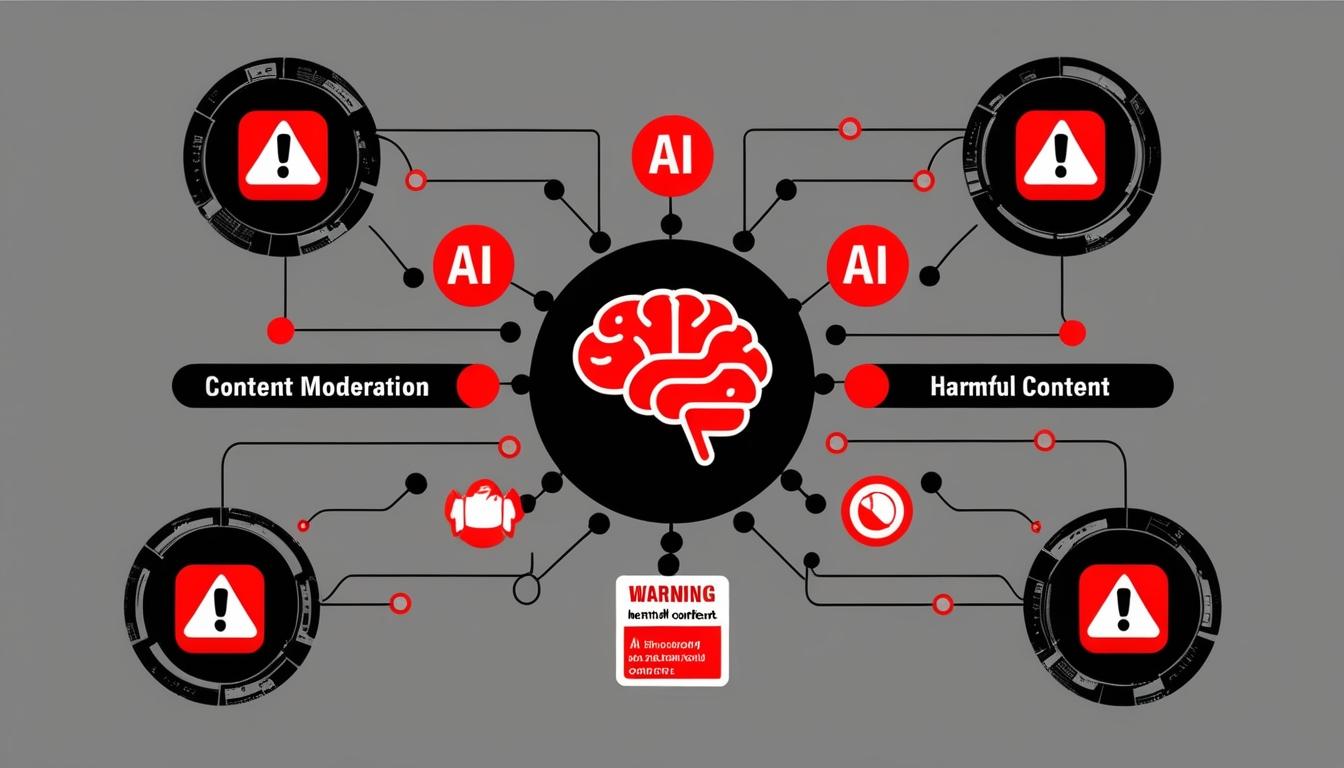
Facebook, now operating under its parent company Meta, is harnessing artificial intelligence (AI) extensively to enhance its content moderation capabilities in response to the escalating concerns over harmful content on its platform. Given the sheer volume of posts generated daily by its user base, the importance of a robust moderation system that preserves both user safety and freedom of expression has never been greater.
Meta's approach incorporates a combination of AI technologies and human oversight to efficiently identify and mitigate hate speech, violence, and misinformation. One of its most notable innovations is the Few-Shot Learner (FSL), introduced on December 8, 2021. This advanced AI tool requires significantly less training data while remaining effective across over 100 languages and versatile in processing both text and images. Early results indicate that FSL has led to a measurable reduction in hate speech on the platform.
Machine learning algorithms play a crucial role in this ecosystem by quickly analysing millions of posts to flag harmful content effectively. These algorithms continuously improve by learning from historical data and user interactions. Alongside this, natural language processing (NLP) enables Facebook to dissect the nuances of text posts and comments, thereby efficiently detecting violations of community standards.
Computer vision technology is also leveraged for scrutinising images and videos, allowing for the detection of harmful content even before a human moderator reviews it. This combination of AI-driven methods has increased the speed and efficiency of content moderation, while simultaneously alleviating some of the mental burden faced by human moderators who are often tasked with reviewing distressing or harmful material.
However, challenges persist in AI-based moderation. Issues such as algorithmic bias—where certain demographics may be unfairly flagged—highlight the need for ongoing refinement of data and methodologies. To address this, Facebook is actively working to improve the fairness of its AI frameworks, alongside balancing the dual necessity of speed and accuracy in content moderation.
Looking ahead, the evolution of AI in this field includes developing adaptable models capable of recognising new forms of content violations in real time, thereby enhancing the overall safety of social media interactions. User feedback mechanisms are poised to play a critical role in informing the AI's evolution, allowing it to better align with shifting social norms and linguistic trends.
In addition to social media platforms like Facebook, the use of AI is proving transformative across various sectors, particularly in project management and manufacturing. The rise of generative AI (GenAI) is enabling organisations to optimise workflows by automating the creation of reports and other outputs that would typically consume substantial amounts of time and resources. For example, a sprint report that previously took an hour to compile can now be generated in mere seconds using AI trained on the relevant data.
Generative AI functions as a copilot for teams, streamlining the onboarding process for new employees, providing contextual insights, and minimising inefficiencies in project and portfolio management. By enhancing resource allocation and tracking dependencies between tasks, AI can help predict risks such as budget overruns before they materialise. The cumulative effect of these efficiencies can lead to substantial time and cost savings, thus driving higher productivity levels across organisations.
However, the effectiveness of AI is contingent upon the quality of the data utilized for its training. Flawed or incomplete data can result in misguided insights and ineffective recommendations, underscoring the necessity for robust data management practices. Moreover, as organisations look to integrate AI cost-effectively, incremental implementation targeting specific challenges has been recommended to ensure successful adoption.
In the manufacturing sector, particularly within electronics quality control, AI applications are revolutionising traditional methods. Machine learning technologies are employed to enhance inspection processes, yielding greater precision and reducing the potential for human error. AI algorithms can identify defects with a high degree of accuracy, often outperforming manual inspections, which historically achieve around 80% accuracy.
For instance, a prominent communications manufacturer dealing with critical quality escapes in first-responder radios implemented AI inspection systems. A proof of concept with a limited run showcased the technology's potential to identify previously undetected defects. This demonstrated a clear return on investment by decreasing inspection times and improving product quality, a paramount necessity given the high stakes involved.
As AI technologies continue to advance, the relationship between machines and humans in quality control is set to evolve, offering unprecedented levels of efficiency and precision. The growing trend of adopting AI across industries highlights not just its potential, but the importance of effective change management strategies to facilitate integration and gain stakeholder support. The future landscape is likely to include a collaborative dynamic where AI and human expertise coalesce, unlocking new opportunities for innovation and operational excellence.
Source: Noah Wire Services