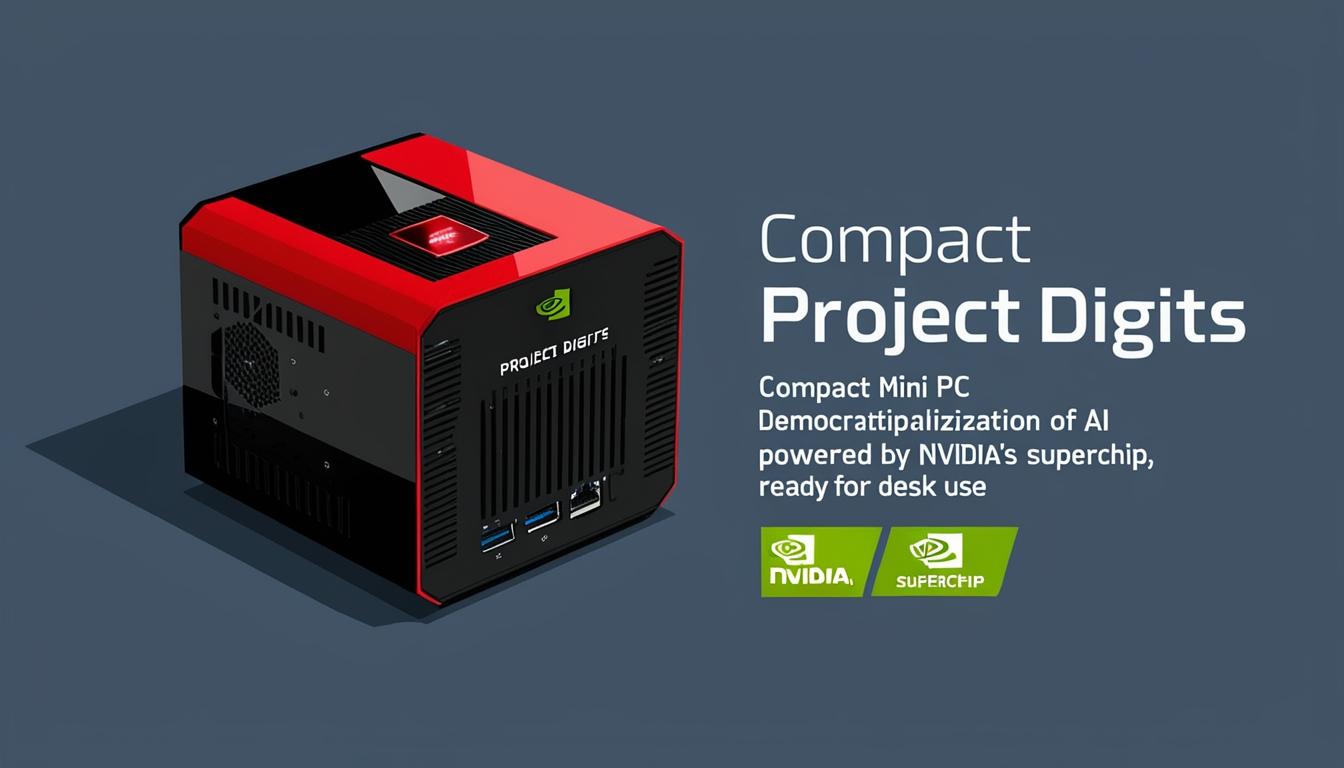
NVIDIA, a prominent chipmaker, unveiled its innovative mini PC, dubbed “Project Digits,” during the CES 2025 technology expo held in Las Vegas this week. The announcement was made by NVIDIA’s CEO, Jensen Huang, who emphasized the importance of making advanced AI capabilities accessible to more individuals. "Placing an AI supercomputer on the desks of every data scientist, AI researcher and student empowers them to engage and shape the age of AI," Huang stated, highlighting the device’s goal to democratize access to high-performance computing.
Project Digits is primarily designed for developers, researchers, students, and data scientists who require substantial computational power for running AI models. The final design specifications for the device are still in development, but its compact size is intended to enable easy placement on a desk and possibly within a backpack. This approach addresses the growing demand for portable and powerful computing solutions in the wake of an increasing reliance on AI technologies across various sectors.
Central to the capabilities of Project Digits is NVIDIA's GB10 Grace Blackwell Superchip. This innovative component incorporates a Blackwell graphics card alongside an NVIDIA Grace processor, allowing for enhanced data transfer efficiency between the two parts by integrating them onto a single chip. The mini PC is expected to offer impressive specifications, including 128 gigabytes of memory and four terabytes of solid-state drive storage. Notably, NVIDIA asserts that Project Digits will deliver performance more than 1,000 times greater than current mainstream PCs and laptops while functioning from a standard electrical outlet.
In terms of performance evaluation, supercomputers are typically measured by their floating-point operations per second (FLOPS). Project Digits will achieve a peak computing performance of one petaFLOP, which translates to the ability to perform a quadrillion calculations every second. Although this performance level is below that of the highest-tier supercomputers, it represents a dramatic leap from conventional personal computers, placing powerful AI tools into more users' hands. The device is capable of running large language models with up to 200 billion parameters; furthermore, linking two Project Digits units together via NVIDIA ConnectX Networking enhances their capabilities, allowing for the operation of models containing up to 405 billion parameters.
The commercial launch of Project Digits is scheduled for May 2025, with an estimated starting price of $3,000. Prospective buyers can register on the NVIDIA website to receive notifications and updates about the product’s availability. As businesses and educational institutions continue to explore and implement AI technologies, the introduction of hardware solutions like Project Digits could play a critical role in shaping future business practices and innovation within the AI landscape.
Source: Noah Wire Services