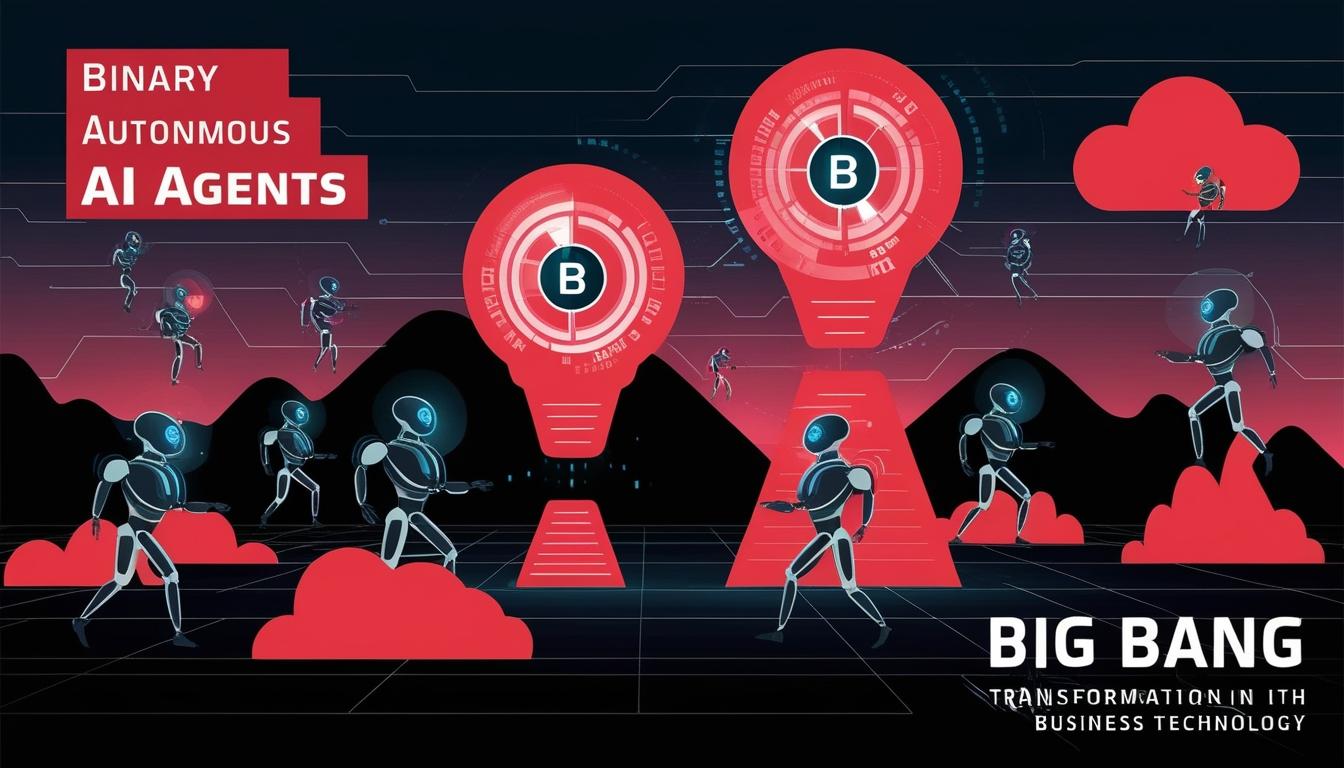
A recent report by Accenture predicts transformative changes in how businesses utilise technology, with a significant shift toward the integration of autonomous AI agents in operations. By 2030, the expectation is that these AI agents will outnumber human users in many internal digital systems, marking a notable transition from traditional user-based interactions.
Karthik Narain, Chief Technology Officer at Accenture and one of the report's primary authors, described this phenomenon as the "Binary Big Bang." He pointed out that advancements in foundation models have effectively broken down natural language barriers, initiating a fundamental shift in technology systems. He elaborated, "When foundation models cracked the natural language barrier, they kickstarted a shift in our technology systems: how we design them, use them, and how they operate." This evolution is expected to significantly enhance the capabilities of businesses, increasing their digital output and enabling a more profound integration of AI into the core of their operations.
According to Narain, the emerging landscape of technology development is set to revolve around three primary areas: agentic systems, digital core, and generative user interfaces. Each of these components is expected to be constructed on highly composable and modular frameworks, allowing for enhanced flexibility and speed in software engineering.
Agentic systems are emerging as powerful tools in coding and software development. These systems are characterised by their ability to call functions and APIs accurately, showcasing high performance with small pieces of code. A particularly noteworthy example highlighted in the report is Anthropic's Claude 3.5 Sonnet. It achieved a 49% resolution rate on the SWE-Bench Verified software engineering benchmark, a dramatic increase from the sub-5% success rate observed in 2023.
The foundational architecture of the AI-powered enterprise is termed the digital core. This environment will support the agents, enabling them to connect diverse data sources with analytical platforms necessary for informed decision-making. While today’s agents may not fully build and maintain the entire digital infrastructure, Narain noted that significant capabilities are being integrated. According to executives surveyed by Accenture, 48% anticipate that agents will soon modernise functions and integrations. However, the survey also revealed more cautious optimism concerning agents interacting with third-party systems, with only 29% of executives predicting this capability would be realised shortly.
Another noteworthy development is that of generative user interfaces, which aim to create custom experiences for users through AI-driven design. Narain remarked that conventional software development has been limited by high costs and the need for a one-size-fits-all user interface. The advent of agentic systems is expected to change this paradigm, enabling more affordable and bespoke UI components.
While the potentials of autonomous agents are vast, the report does underscore the need for careful monitoring. With an increasing reliance on AI, transparency will be essential for fostering trust within organisations. The report advocates for businesses to establish governance frameworks that guide the oversight of these technologies, detailing what data the systems access and the quality of their outputs.
Despite the innovations that AI agents represent, Narain cautioned that they are not without flaws. He noted their computational demands, non-deterministic behaviour, and occasional lack of explainability. However, he also suggested that techniques such as retrieval augmented generation (RAG) could enhance the performance of AI agents by grounding them in code and functions, thus increasing their reliability.
As businesses begin to explore these technologies further, the report encourages organisations to start small. Developing task-specific internal agents can lay the groundwork for more expansive applications in the future, enabling companies to better prepare for the inevitable rise of AI agents as central figures in digital interactions.
Source: Noah Wire Services