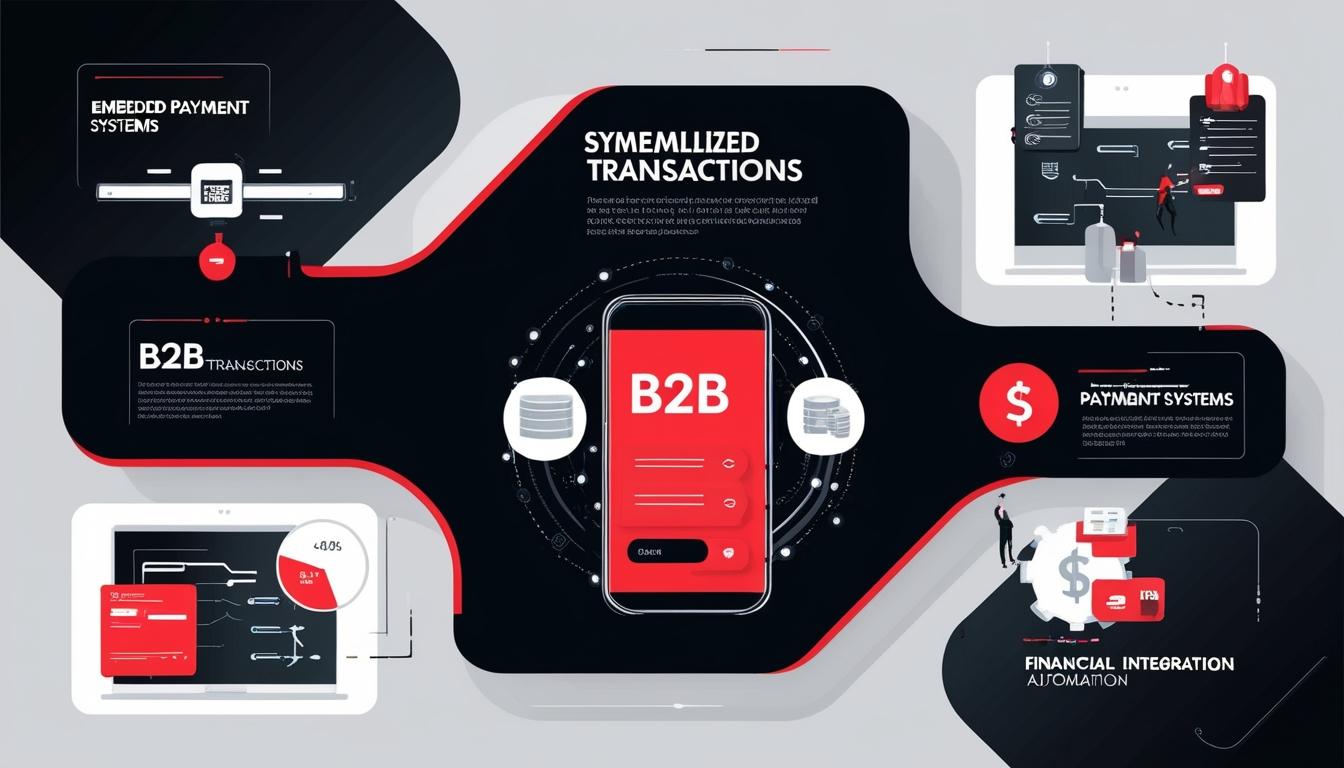
Embedded payments are increasingly becoming integral to business-to-consumer (B2C) services, and now businesses are beginning to adopt these practices in the business-to-business (B2B) sector. This transition aims to streamline processes ranging from payroll and invoicing to procurement, relying heavily on automation technologies. However, the complexity of B2B transactions poses significant challenges to the seamless integration of embedded payment systems.
Daniel Artin, Head of Fintech Partnerships at Boost Payment Solutions, highlighted these complexities in an interview with PYMNTS, stating, “B2B is anything but seamless,” and emphasized the necessity of managing client expectations throughout the digitization of larger transactions. The integration of embedded payment systems in B2B transactions presents a unique set of challenges, prompting an examination of the potential impacts on traditional banks and financial intermediaries by the year 2025.
As global marketplace and platform business models continue to grow, B2B embedded payments are attracting significant interest. Scott Southall, Head of Banking as a Service at Citi Services, noted that sectors such as e-commerce, marketplaces, and the gig economy are demonstrating impressive double-digit growth. For example, Walmart reported over 40% growth in marketplace sales for five consecutive quarters, and Microsoft announced a 100% revenue growth in its Commercial Marketplace as of October 2024.
“Embedding payments and financial services into how these companies operate provides a significant opportunity to monetize the flow further and increase the value-added,” Southall remarked. These integrated systems allow businesses to offer wallet services and foreign exchange services at the settlement stage, thereby creating enhanced commercial opportunities.
Conversely, the road to widespread adoption of B2B embedded payments is not without its hurdles. Todd Manning, Vice President of Global Commercial Services at American Express, identified awareness as the primary barrier to adoption. According to recent research from American Express, 79% of business decision-makers expressed a desire for greater knowledge surrounding embedded finance solutions, with 84% actively seeking information.
Manning suggested that once businesses explore and begin utilising these solutions—such as virtual cards—they realise the benefits often outweigh the initial challenges. To facilitate awareness and adoption, American Express introduced the Sync Commercial Partner program in 2023, aiming to streamline how payment solutions are integrated into business software platforms.
Concerns about investments for 2025 were echoed by Ron Karpovich, Managing Director at J.P. Morgan Payments. He noted significant deliberation amongst enterprises regarding their role in the flow of funds associated with embedded payments. Companies need to ascertain their willingness and capability to engage in these transactions, as well as strategies for maintaining distance if preferred.
Additionally, the imperative for B2B payment solutions to align with the traditional reliance on bank transfers—as opposed to credit and debit card transactions—presents complications. Southall revealed that corporate entities are often content with accepting some friction in payment processes due to their stringent risk assessments and controls.
New developments, such as faster payment networks like FedNow and the increasing popularity of virtual International Bank Account Numbers (IBANs), present potential solutions to some of these challenges, offering near real-time, efficient payment experiences.
As the January 2025 horizon approaches, the impact on traditional banks and financial intermediaries remains uncertain. However, Manning asserted that these institutions are well-poised to leverage emerging trends in embedded payments. He suggested that partnerships between technology companies and banks could create mutual benefits, allowing financial institutions to utilise their regulatory expertise and payment capabilities while technology firms focus on software development.
“Partnerships make us more helpful to businesses than we can be on our own,” Manning added, highlighting the collaborative nature of the evolving financial landscape.
Citi's Southall further emphasized that institutions failing to invest in application programming interfaces (APIs) and scalable infrastructure may struggle to meet the expectations of businesses, particularly those increasingly gravitating towards online commerce solutions. As such, the successful integration of embedded financial services becomes imperative to remain competitive in the marketplace.
Looking ahead, the future of B2B embedded payments appears promising, with ongoing advancements in technology and collaborative efforts among banks, fintechs, and businesses facilitating a smoother transition towards automated solutions. The strategies businesses adopt in response to these changing dynamics will shape the landscape of B2B transactions in the years to come.
Source: Noah Wire Services