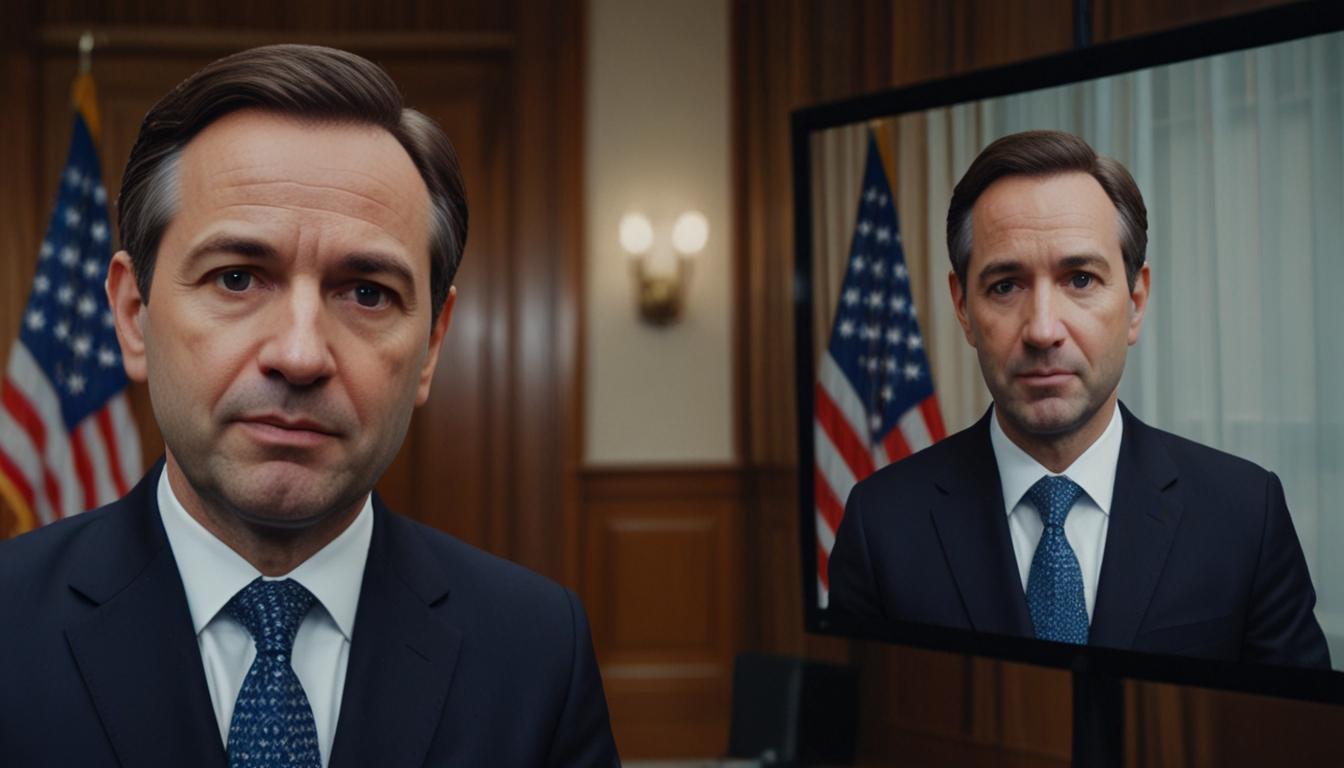
Deepfake Impersonation Targets U.S. Senator in Sophisticated AI Fraud
Washington, D.C. — In a recent incident highlighting the growing threat of advanced digital deception, Senator Ben Cardin, Chairman of the Senate Foreign Relations Committee, found himself the target of a deepfake operation. The attempt involved a fraudulent impersonation of Dmytro Kuleba, Ukraine's former Minister of Foreign Affairs, via a video call that utilised sophisticated artificial intelligence (AI) technology.
The incident came to light after the Office of Senate Security issued a notice on Monday, describing the operation as one that "stands out due to its technical sophistication and believability." According to the notice, Cardin's office had received an email from an individual purporting to be Kuleba, with whom Cardin had established a professional relationship during a previous meeting.
The video call seemed authentic at first, replicating Kuleba's appearance and voice convincingly. However, suspicions were raised when the impersonator began posing politically charged questions such as, "Do you support long range missiles into Russian territory? I need to know your answer." At this juncture, Cardin and his staff recognised that "something was off," eventually terminating the call and contacting the Department of State, which confirmed the impersonation.
Senator Cardin commented on the incident in a statement on Wednesday, referring to it as "a malign actor engaged in a deceptive attempt to have a conversation with me by posing as a known individual." He confirmed that the call was ended immediately upon realising the deception, and the matter has since been handed over to law enforcement for a comprehensive investigation.
This event underscores the increasing accessibility and integration of generative AI technology, which has significantly lowered the barriers to producing believable deepfakes. Rachel Tobac, a cybersecurity expert and CEO of SocialProof Security, noted that advancements in the past months have simplified the process of creating live video and audio deepfakes. Earlier versions of this technology were often detectable due to issues like unnatural lip movements or reverse blinking. However, these irregularities have been largely mitigated in recent iterations.
This incident is not an isolated one. Similar schemes have been seen globally, targeting high-profile individuals using AI for impersonation. A finance professional in Hong Kong lost $25 million to a scammer posing as their CFO through an AI-generated deepfake. Additionally, political consultant in the U.S. utilised AI to mimic President Joe Biden's voice in a fraudulent effort to influence voters, resulting in significant legal repercussions.
Security officials in the Senate, as well as AI experts, anticipate a rise in such schemes. Siwei Lyu, an AI expert at the University at Buffalo, predicted an increase in these incidents, noting that "Anyone with some kind of malicious intent now has the ability to conduct this kind of attack."
Furthermore, R. David Edelman, a former cybersecurity policy leader at the White House, described the incident as a "sophisticated intelligence operation," pointing out that it combined AI technology with traditional intelligence strategies that exploited the relationship between Cardin and Kuleba.
The Senate’s security office has issued warnings to staff to ensure the authenticity of meeting requests and to exercise caution with external communications, anticipating further attempts in the coming weeks. They highlighted the potential for similar attacks aiming to discredit individuals or extract sensitive information, advising vigilance against threats that leverage existing relationships to appear more credible.
In a statement, Kuleba expressed caution, suggesting that "99 percent" of such deepfake operations likely originate from entities with ulterior motives, and urged individuals to verify sources and remain guarded in their communications.
As the boundaries of impersonation continue to be pushed by advances in AI, the incident has served to illuminate the contemporary challenges faced by public figures and lawmakers in safeguarding against technologically sophisticated deception tactics. The FBI is currently investigating the incident, although no comments have been made by the bureau at this time.
Source: Noah Wire Services