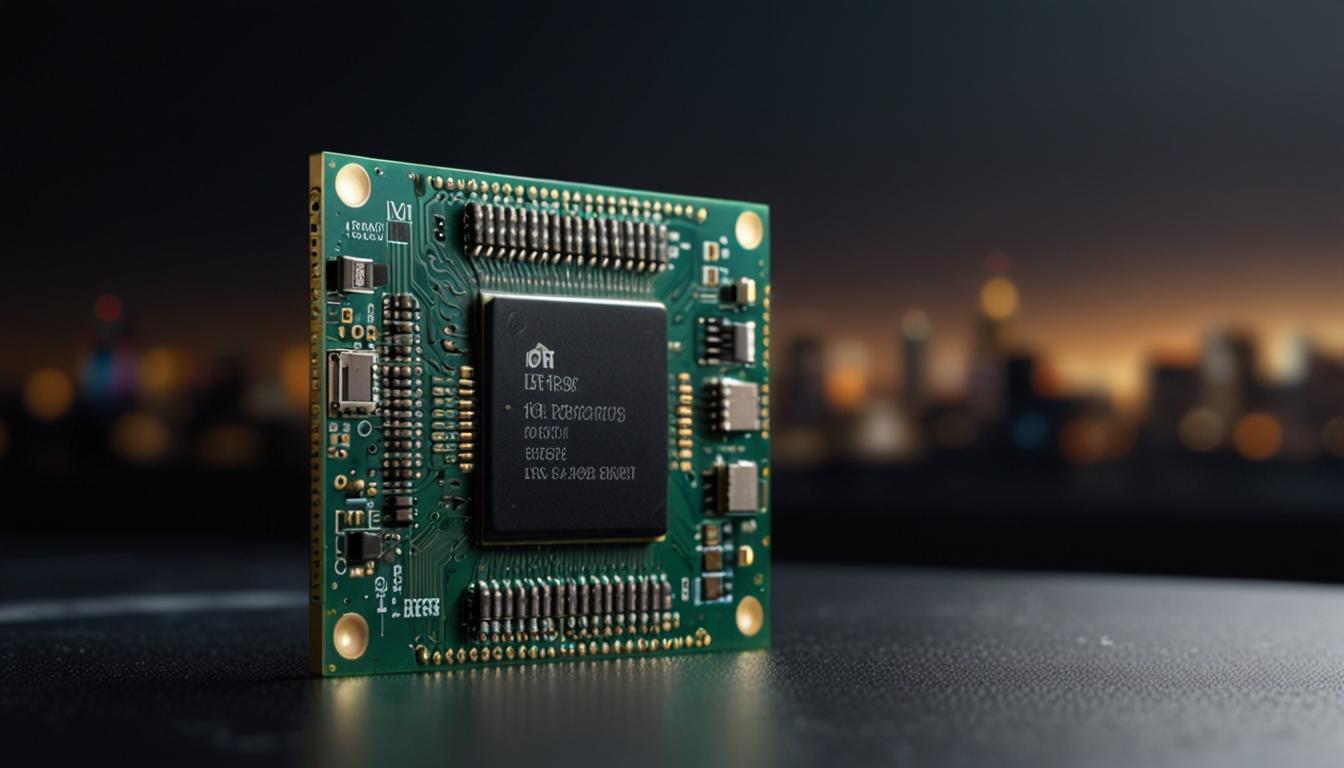
NXP Semiconductors Unveils i.MX RT700 MCU Family, Propelling AI at the Edge
In an era where Artificial Intelligence (AI) and edge computing are rapidly transforming consumer and industrial markets, NXP Semiconductors has announced a significant development aimed at enhancing the performance and efficiency of these technologies. The company introduced its i.MX RT700 crossover microcontroller (MCU) family, designed to cater to the growing demand for smarter, low-power edge devices, including wearables, consumer medical gadgets, smart home devices, and Human-Machine Interface (HMI) platforms.
Technological Breakthroughs for Edge Devices
Launched recently, the i.MX RT700 isn't just another advancement in MCU technology; it represents a redefinition of capabilities at the edge. Charles Dachs, Senior Vice President and General Manager of Industrial and IoT at NXP, highlighted the significance of this new product line, stating, "The i.MX RT700 provides significant enhancements in power consumption and efficiency, enabling breakthroughs that extend battery life and ensure reliability in resource-constrained applications." Dachs also emphasised the integration of NXP's eIQ Neutron Neural Processing Unit (NPU), which bolsters the machine learning and multitasking abilities of low-power edge devices.
Key Features and Specifications
The i.MX RT700 MCU family stands out with its combination of up to five powerful cores in a single device. It marks the first implementation of the eIQ Neutron NPU in a crossover MCU, accelerating AI workloads by up to 172 times and reducing energy per inference by up to 119 times. The design features up to 7.5MB of ultra-low power SRAM, promising a substantial 30-70 percent reduction in power consumption compared to its predecessors.
The MCUs are built on a multi-core, low-power platform that boasts impressive graphics capabilities, AI hardware acceleration, advanced security features, and a sense-compute subsystem. This ensemble facilitates the development of solutions with versatile capabilities such as presence sensing, gesture recognition, and voice control within a unified platform.
Among the five cores, the primary one is an Arm Cortex-M33 running at 325 MHz, complemented by an integrated Cadence Tensilica HiFi 4 Digital Signal Processor (DSP) for demanding audio and DSP tasks. A secondary Cortex-M33 and integrated Cadence Tensilica HiFi 1 DSP are also included in the ultra-low power sense compute subsystem.
Power Optimisation Strategies
In terms of power efficiency, the i.MX RT700 MCU family employs various strategies. These include advanced adaptive deep sleep techniques, optimised clock architectures with low-power cache schemes, and sophisticated wake/sleep cycles. These measures collectively contribute to the family's significant improvement in power consumption, making it suitable for battery-operated devices requiring extended battery life and operational reliability.
Availability
Currently, the i.MX RT700 crossover MCUs are being sampled to qualified early-access customers, with wider availability expected to follow. Interested parties can find more information on NXP's website.
The introduction of the i.MX RT700 MCU family underscores NXP's commitment to pushing the boundaries of what is possible in edge computing and AI, offering robust solutions tailored to the evolving needs of various applications in both consumer and industrial domains.
Source: Noah Wire Services