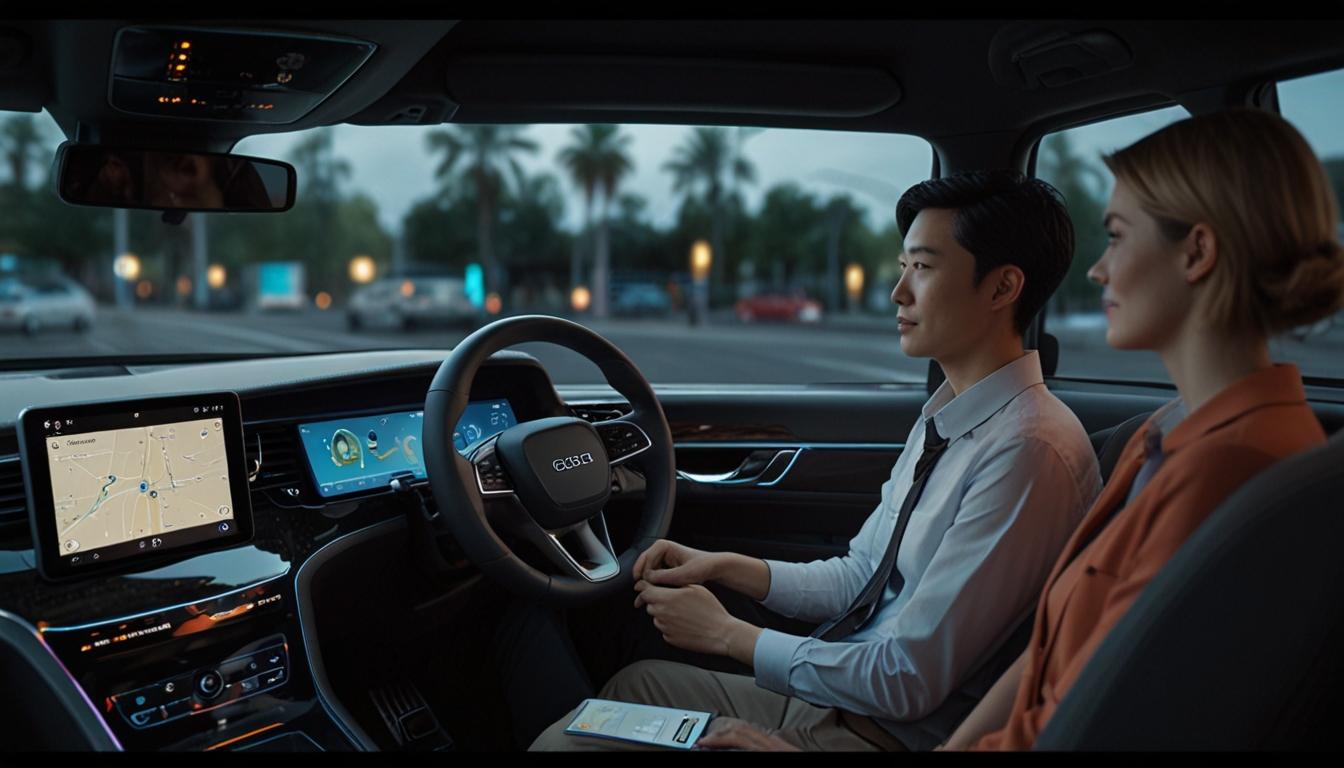
Purdue University Engineers Explore AI Chatbots to Enhance Autonomous Vehicle Communication
Researchers from Purdue University have unveiled a promising new role for AI-powered chatbots, like ChatGPT, in improving communication between autonomous vehicles (AVs) and their passengers. The study, led by Dr. Ziran Wang, an assistant professor at Purdue's Lyles School of Civil and Construction Engineering, demonstrates the significant potential of large language models (LLMs) to facilitate more natural and fluid interactions within AVs.
The research highlights the shortcomings of current systems which often rely heavily on explicit voice commands or manual inputs to operate an AV’s features. In contrast, LLMs offer an advanced, nuanced understanding of a variety of passenger commands. According to Dr. Wang, "The power of large language models is that they can more naturally understand all kinds of things you say. I don’t think any other existing system can do that."
In this pioneering study, LLMs were not employed to directly control the vehicle; rather, they served to assist the AV's existing systems. Researchers trained ChatGPT to interpret both direct commands like "Please drive faster" and more subtle cues such as "I feel a bit motion sick now." These inputs were processed in conjunction with road rules, traffic conditions, weather data, and the vehicle’s sensor information. The resulting instructions were then relayed to the AV’s drive-by-wire system responsible for controlling throttle, brakes, and steering.
Participants involved in the study expressed a higher degree of comfort when riding in AVs integrated with LLMs compared to those driving standard Level 4 autonomous vehicles. Despite these promising results, several challenges need to be addressed. Notably, while LLMs responded to commands in an average of 1.6 seconds, researchers aim to reduce this response time for practical applications. Dr. Wang also pointed out that extensive testing and obtaining regulatory approval are critical steps before LLMs can be fully integrated into AV control systems.
The findings from this research will be presented on September 25 at the IEEE International Conference on Intelligent Transportation Systems in Edmonton, Canada. The presentation is titled “Personalized Autonomous Driving with Large Language Models: Field Experiments,” and is expected to offer further insights into the viability and future applications of LLMs in autonomous driving technology.
Source: Noah Wire Services