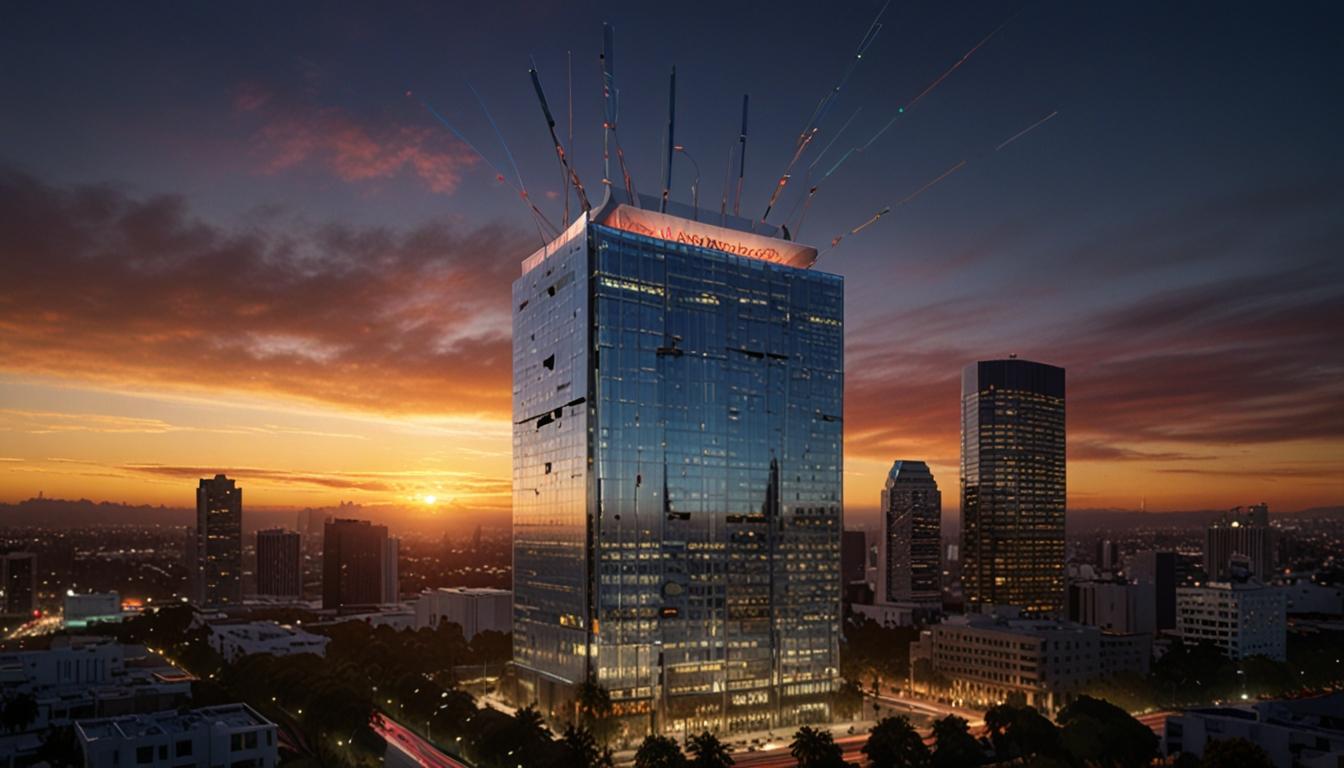
Where Data Meets the Sky: One Wilshire’s Transformation into a Digital Powerhouse
Los Angeles, CA — At the nexus of Wilshire Boulevard in downtown Los Angeles, an unassuming office tower hides a technological powerhouse that underpins much of our daily digital lives. One Wilshire, once home to a bustling network of white-collar professionals, now stands as a central hub in the global data network, acting as a vital link between Asia and North America for fibre-optic data transmission.
Once a typical workplace for lawyers and office workers, this mid-century building's 30 floors are now almost entirely dedicated to supporting the complex infrastructure required for data storage and computation. The high-rise hosts a labyrinth of cables, climate control systems, pipes, and backup power generators that maintain its essential 24/7 operations.
Maile Kaiser, Chief Revenue Officer of the building's largest tenant, CoreSite, succinctly captured the evolving utility of data centres. “We’re all consumers of data centres,” Kaiser explained, drawing a direct line between the building’s capacity and everyday digital activities such as streaming Netflix or placing online orders.
The metamorphosis of One Wilshire aligns with a broader real estate trend sweeping through Los Angeles County, where burgeoning demand for data hosting capacity is converting traditional office buildings into specialised data centres. This transformation comes in response to the exponentially growing needs driven by artificial intelligence (AI) and cloud storage. The COVID-19 pandemic's impact on conventional office space utilisation has further catalysed this shift, as real estate developers seize the opportunity to repurpose underused office buildings.
In a recent industry report by real estate brokerage JLL, the construction of data centres was described as occurring at “extraordinary levels.” The vast demand, fuelled primarily by AI and cloud service giants like Amazon, Microsoft, Google, and Oracle, has triggered a market scarcity for secure server locations. Consequently, developers find themselves in a race, pressing on even as backup generators and essential equipment grow hard to come by.
“Never in my career of 25 years in real estate have I seen demand like this on a global scale,” remarked Darren Eades, a JLL real estate broker with a focus on data centres. This insatiable need has spurred a rapid build-up of new facilities and adaptive re-use of older buildings, even leading to significant rises in rent. For instance, rents at One Wilshire are now double those for newer downtown office high-rises, as per data from real estate provider CoStar.
With this high demand comes workforce challenges. The industry struggles to keep its facilities staffed around the clock, given the high stress and isolation involved in the job. According to the JLL report, 30% of data centre workers left their roles in the past year, largely due to dissatisfaction with work-life balance. Filling second- and third-shift roles has proven particularly difficult, extending hiring timelines by months.
As Southern California deals with a deficit of data centre capacity, developers are driven to seek cheaper and abundant power sources both within and outside Los Angeles County. Areas like Vernon, with its own power plant, and Monterey Park, served by Southern California Edison, have become hotspots for new developments.
The power-intensive nature of data centres, especially with the rise of generative AI, exacerbates pressure on the national power grid. This immense energy requirement is pushing developers to construct facilities in regions known for cheaper power access, like Alabama, the Dakotas, and Indiana. A notable project by CalEthos near California’s Salton Sea exemplifies this trend. Their proposed data centre, to be powered by nearby geothermal and solar plants, spans land equivalent to 15 football fields and demands energy enough to power 425,000 homes.
Such advancements in data centre infrastructure also signal high stakes for the national power supply. Projections from Goldman Sachs suggest data centre power consumption might escalate from 3% to up to 11% of the U.S. demand by 2030. Highlighting this trend, a recent deal proposes the reopening of Pennsylvania's Three Mile Island nuclear power plant to supply Microsoft’s data centres, contingent on regulatory approval.
For the digital era’s architectural marvels like One Wilshire, the narrative of transformation from prestigious office address to a critical data nexus underscores an inevitable evolution. Maile Kaiser noted, “Everybody loves to create their content now... Now we’ll see what we do with AI.”
As these developments progress, the story of One Wilshire reflects a broader shift in the landscape of modern infrastructure, underpinning the digital economies of today and tomorrow.
Source: Noah Wire Services