AI Memes Dominate 2024 Presidential Campaign: Absurdity and Propaganda
WASHINGTON — As the U.S. hurtles towards the 2024 presidential election, the landscape of political campaigning has drastically shifted with the advent of generative artificial intelligence, sparking fears of deepfakes and rampant misinformation. Contrary to worst-case scenarios envisioned by experts, what has emerged is a plethora of AI-generated memes, many of which border on the ridiculous rather than the insidious.
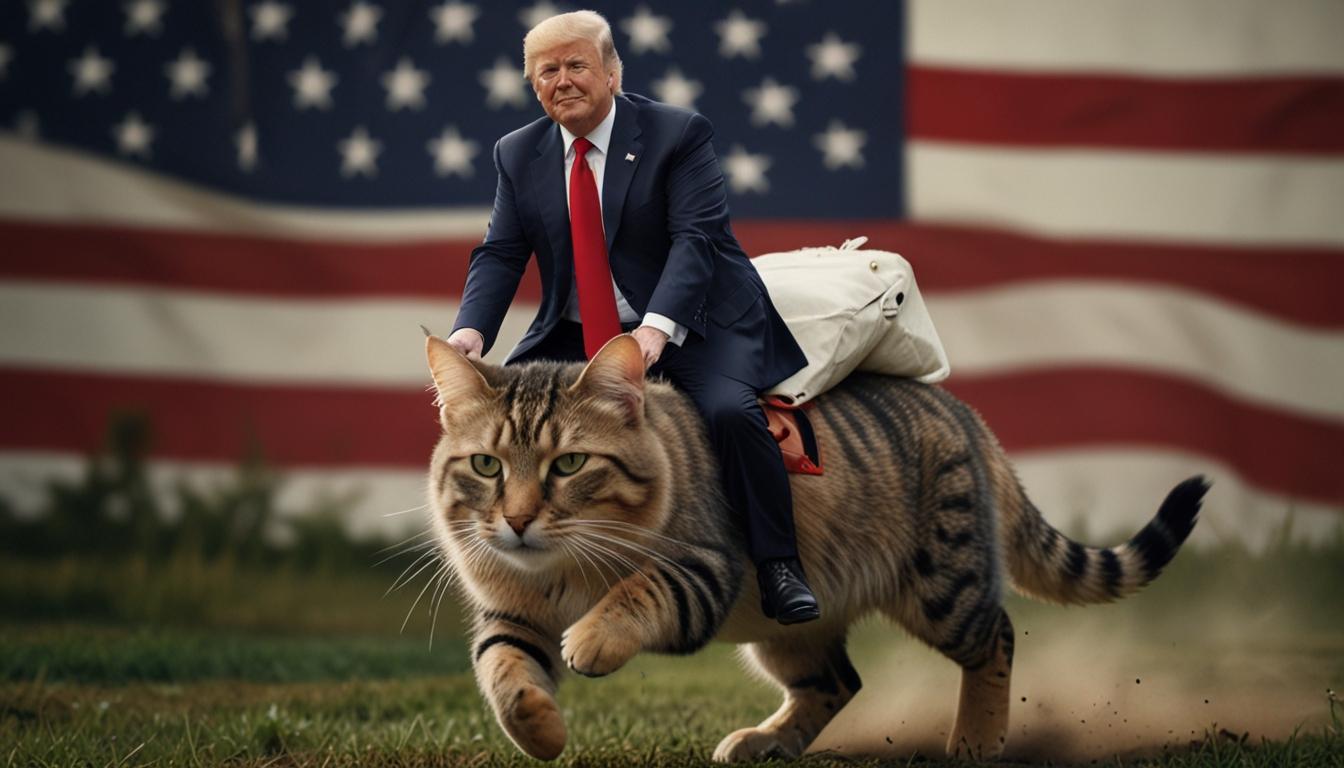
The political theatre is buzzing with all manner of AI-fabricated imagery. From a video of former President Donald Trump riding a cat while wielding an assault rifle to a mustachioed Vice President Kamala Harris attired in communist garb, these images are circulating widely on social media platforms. One prominent example includes a hilariously unlikely image featuring Trump and Harris in a passionate embrace.
Such whimsical content, while seemingly harmless, has become a tool to spread politically charged and sometimes racist messages. These AI-generated memes, often shared under the guise of humour, serve to propagate false narratives with a clear political agenda. Among the key players is Donald Trump and his allies, who have notably utilised such imagery to bolster unfounded conspiracy theories, particularly targeting Haitian migrants in Springfield, Ohio.
An infamous instance involved Trump's Truth Social account posting an AI-generated image depicting Trump on a luxury jet surrounded by cats and ducks, alongside memes denigrating migrants with messages such as, "DON'T LET THEM EAT US, Vote for Trump!" Francesca Tripodi, a sociologist specialising in online propaganda at the University of North Carolina at Chapel Hill, remarked on the pernicious nature of these memes. "The memes that are amplifying this claim are anything but humorous. When you have elected officials who are utilising this imagery as a way of perpetuating racism and xenophobia, that's a huge problem," she said.
Defending these creations, Republican strategist Caleb Smith characterised them as light-hearted jokes reflective of Trump's distinctive communication style. "The intent is to entertain, not to deceive," Smith stated. He framed this meme culture as symptomatic of Trump's persona rather than a means of political manipulation.
Although AI-generated content is not exclusive to the Trump campaign, it appears Republicans have a comparative edge in its usage. Democrats have also delved into the AI meme territory, with images mocking prominent figures such as Elon Musk and depicting Trump in unflattering situations. However, Vice President Harris' campaign has notably refrained from amplifying AI content, primarily focusing on TikTok trends and traditional memes.
Harris campaign spokesperson Mia Ehrenberg emphasised that their use of generative AI is limited to productivity tools, excluding the creation of memes. Conversely, Trump campaign spokesman Steven Cheung claimed their strategy had not evolved since May and denied engagement with AI companies' tools.
Generative AI's capacity to produce hyperrealistic images has elevated these memes beyond the realms of traditional political cartoons and photoshopped images, drawing increased scrutiny and political impact. Critics argue the hyperrealism of AI-generated images exacerbates the risks associated with misleading political messages.
Recently, Springfield faced bomb threats and school evacuations, highlighting the real-world ramifications of AI-induced misinformation. "Memes that are obviously parody are one thing. It's another where it's obviously intended to deceive," commented Rep. Adam Schiff, a Californian Democrat.
The widespread accessibility of AI image generators further magnifies these concerns. The speed at which such content can be produced and disseminated helps campaigns rapidly respond to online trends, but it also intensifies the spread of misinformation. Teddy Goff, digital director of Barack Obama’s 2012 reelection campaign, highlighted the evolving challenge. "Campaigns have had to deal with disinformation and misinformation for a very long time…But obviously what AI allows is for this stuff to do done more rapidly, perhaps more convincingly, and in a more targeted environment."
Paul Ingrassia, a New York-based political commentator, recounted creating a viral image of Trump emerging from a lion's den using Grok, an AI tool, within seconds. Shared by Trump’s Truth Social account, the image garnered immediate attention. "The president loved the image," Ingrassia noted. This anecdote underscores the swift integration of AI in political narrative crafting, illustrating its potent appeal and effectiveness.
As the presidential campaign gears up, the role of AI in shaping public perception is undeniable, adding a novel yet contentious dimension to modern political discourse.
Source: Noah Wire Services