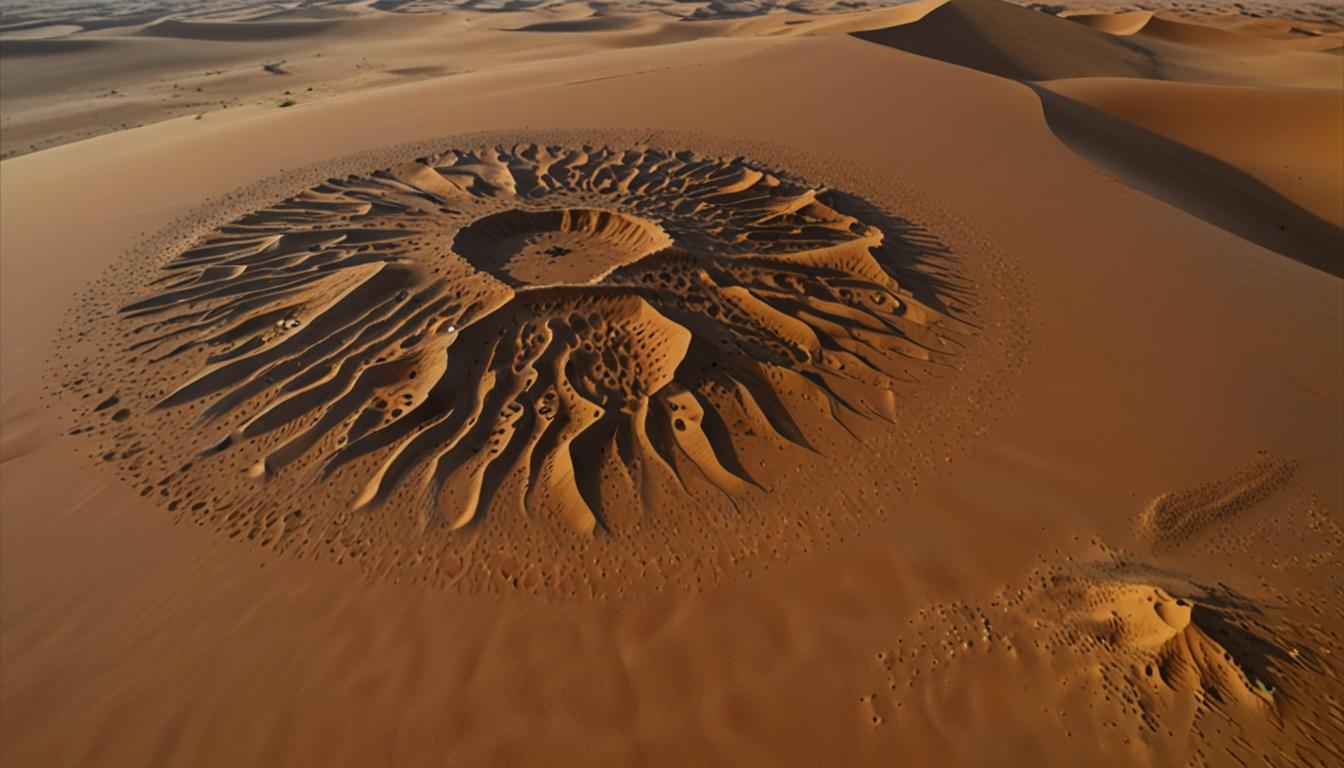
AI Set to Uncover Hidden Secrets in the Rub' al-Khali Desert
ABU DHABI – A new dawn in the world of archaeology is being heralded by the integration of artificial intelligence (AI) technology in the search for historical sites buried beneath the endless sand dunes of one of the world's most formidable deserts, the Rub' al-Khali.
Known as "The Empty Quarter," the Rub' al-Khali desert spans approximately 250,000 square miles, making it the world's largest continuous sand desert. Its ochre-coloured dunes and challenging environment have rendered it virtually unexplored and uninhabited. However, scientists from Khalifa University in Abu Dhabi believe that advanced technology can alter this situation.
A team at Khalifa University has developed a machine learning algorithm designed to aid in the detection of potential archaeological sites within this expansive desert. They harnessed synthetic aperture radar (SAR), a satellite imagery method that employs radio waves to penetrate surfaces such as sand, soil, vegetation, and ice. This technique enables the machine learning model to analyse imagery data and identify hidden structures.
Diana Francis, an atmospheric scientist and one of the project's lead researchers, explained, "We needed something to guide us and focus our research." By training the machine learning algorithm with data from Saruq Al-Hadid in Dubai - an already-known archaeological site - the team was able to refine the technology's capabilities in identifying other potential excavation sites.
Francis elaborated on the project's precision, noting that the technology could pinpoint potential buried structures within an accuracy of 19 inches. It can also generate 3D models of these structures, providing archaeologists with a comprehensive understanding of what lies beneath the desert sands.
Traditionally, archaeological site detection has relied on ground surveys and optical satellite images, the latter enabling large-scale searches for anomalies in the terrain. The introduction of AI, however, marks a significant improvement by streamlining and enhancing the search process.
Khalifa University's initiative is part of a broader trend where AI is being adopted across various archaeological projects worldwide. For example, Amina Jambajantsan, a PhD student at the Max Planck Institute, uses machine learning to expedite the labour-intensive task of sifting through high-resolution drone and satellite imagery to locate potential sites of interest.
In another notable instance, researchers from Yamagata University have employed AI to decode Nazca civilisation geoglyphs in Peru. Utilizing this technology, the researchers discovered 303 geoglyphs, which they subsequently confirmed through on-site examinations of the photographed locations.
Masato Sakai, an archaeologist from Yamagata University, remarked on the efficiency brought by AI, "The use of AI in research has allowed us to map the distribution of geoglyphs in a faster and more precise way." The conventional method of manually identifying geoglyphs from high-resolution images was time-consuming and risked missing some of these intricate designs.
The findings and methodologies were detailed in a publication in the Proceedings of the National Academy of Sciences (PNAS), highlighting the effectiveness of AI in recognising smaller, relief-type geoglyphs that are usually difficult to discern with the naked eye. Of the 303 geoglyphs newly discovered in Nazca, 178 were identified by the AI model.
As the Rub' al-Khali desert awaits its secrets to be unveiled, the fusion of AI with traditional archaeological methods promises to revolutionise the field, unlocking the long-hidden histories buried beneath the sands of time.
Source: Noah Wire Services