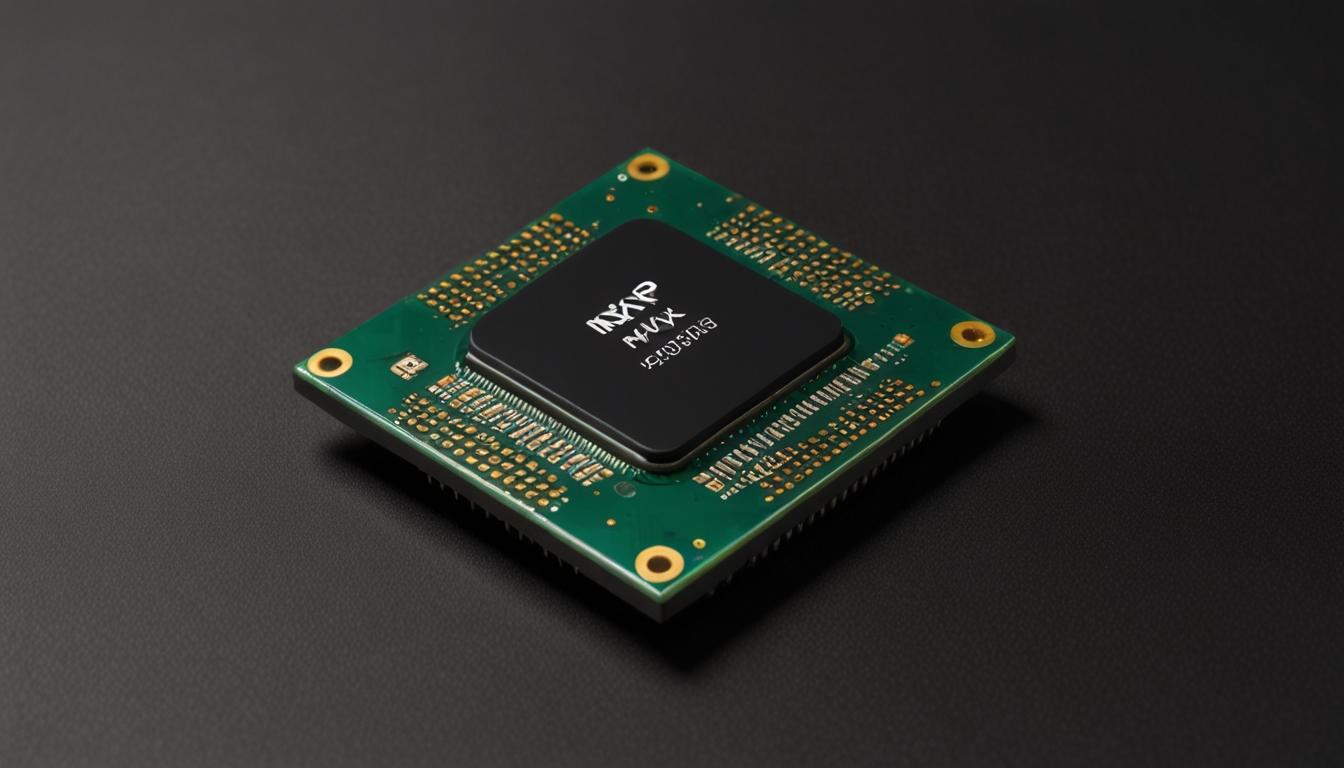
NXP Unveils Advanced i.MX RT700 AI Crossover MCU
NXP Semiconductors has released the i.MX RT700 AI crossover microcontroller unit (MCU), the latest addition to its well-regarded MCUs portfolio. This new product builds on the foundations set by the NXP i.MX RT600 series launched in 2018 and the i.MX RT500 series introduced in 2021.
The i.MX RT700 brings notable advancements in computing power and efficiency tailored for modern, high-demand applications. Featuring dual Cortex-M33 cores, the primary core operates at 325 MHz and includes a Tensilica HiFi 4 digital signal processor (DSP). The secondary core, clocked at 250 MHz, features a lower-power Tensilica HiFi 1 DSP designed for always-on tasks. Enhanced with the eIQ Neutron neural processing unit (NPU) and a substantial 7.5 MB of SRAM, the device also integrates a 2D graphics processing unit (GPU) with a JPEG/PNG decoder, making it suitable for a variety of applications, including augmented reality (AR) glasses, hearables, smartwatches, and fitness wristbands.
Key Specifications:
Compute Subsystems:
- Main Compute Subsystem: Cortex-M33 up to 325 MHz with Arm TrustZone, MPU, FPU, Tensilica HiFi 4 DSP, interrupt handling via NVIC, and SWD for debugging.
- AI Accelerator: NXP eIQ Neutron NPU.
- Sense Compute Subsystem: Cortex-M33 up to 250 MHz and Tensilica HiFi 1 DSP up to 250 MHz.
Memory:
- On-chip SRAM: Up to 7.5 MB.
External Storage Interfaces:
- Three Quad SPI interfaces supporting up to 16-bit wide external memories.
- Two SD/eMMC memory card interfaces, including one supporting eMMC 5.0 with HS400/DDR operation.
Graphics:
- 2.5D GPU with vector graphics acceleration and frame buffer compression.
- Full openVG 1.1 support.
- Integrated JPEG/PNG decoder support.
- LCD Interface: MIPI DSI up to 720p60 from on-chip SRAM.
Camera Interface:
- CSI 8/10/16-bit parallel (FlexIO).
Peripherals:
- 8-channel digital microphone interface.
- One USB high-speed host/device controller with integrated PHY and eUSB support.
- Multiple serial peripherals (UART, I²C, I3C, SPI, HSPI, SAI).
- 16-bit SAR ADC, 24-bit SD ADC with analog microphone support.
- Timers, PWM, MRT, RTC, PLL, DMA, and CRC.
Security:
- EdgeLock Secure Enclave (Core Profile), Secure Boot, Secure Debug.
- Secure Storage using Physically Unclonable Function (PUF) and One-Time Programmable (OTP) memory.
- Cryptographic services including TRNG, DICE, and UID.
- Crypto accelerators (PKC, AES, SHA).
- Security monitoring with tamper and intrusion detection.
- Device attestation with support for Device Identifier Composition Engine (DICE).
- Life cycle management.
Package:
- FOWLP249, WLCSP141.
The MCU is supported by NXP's eIQ machine learning software development environment, which offers tools like the eIQ Toolkit, inference engines such as TensorFlow Lite Micro and DeepViewRT, and neural network compilers like Glow. These are all integrated into the MCUXpresso SDK and Yocto development environments, enhancing efficiency for on-device machine learning. Additionally, the i.MX RT700 is compatible with popular real-time operating systems (RTOS) like FreeRTOS and Zephyr, enabling versatile real-time application development.
While the new i.MX RT700 is currently in the preproduction stage, detailed specifications and other resources are accessible through NXP's product page, press releases, and related blogs. Information on pricing and a complete datasheet remain unavailable at this early stage, pending the move to full production.
This development continues to showcase NXP's commitment to pushing the boundaries of embedded technology, offering powerful, flexible solutions that cater to a rapidly evolving market.
Source: Noah Wire Services